
电网级储能电池

Search documents
欧洲储能十年六倍增量空间:R.Power抢滩波兰,欲五年内跻身欧盟前十
智通财经网· 2026-02-26 08:20
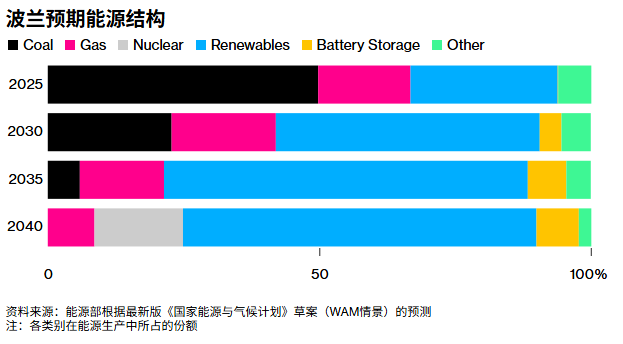
Core Viewpoint - Poland is actively seeking to reduce high energy costs and gradually move away from coal dependency, presenting significant opportunities for companies in the energy sector, particularly in battery storage solutions [1][2]. Group 1: Market Dynamics - Poland is the EU member state with the highest reliance on coal, with coal-fired power plants currently accounting for over half of the country's total electricity generation [2]. - The European battery storage market is expected to grow sixfold by the end of this decade, reaching approximately 400 GWh, which is crucial for the EU's energy security and international competitiveness [1]. - The Polish government has initiated a capacity auction mechanism to stimulate investment in the storage sector, providing economic compensation to participants who ensure the availability of storage facilities and maintain grid stability [5]. Group 2: Company Strategy and Positioning - R. Power SA aims to become one of the top ten battery storage operators in the EU, having identified a critical opportunity window for market entry [1]. - The company has secured government support for over 1.7 GW of battery storage projects and has locked in approximately 650 MWh of battery orders, bolstering its competitive position against state-owned giants like PGE [4]. - R. Power's CEO emphasizes that the next five years will be pivotal for establishing competitive advantages through scalable operations, with participation in capacity auctions providing stable revenue streams [4][5]. Group 3: Competitive Landscape - R. Power faces intense competition from both domestic state-owned companies and international players, such as Spain's Grenergy and Germany's RWE, which have also won significant contracts in Poland [5]. - The market is characterized by a growing number of households installing photovoltaic systems, creating a favorable environment for battery storage investments and arbitrage opportunities [6]. - The company has successfully reduced long-term power purchase agreement prices for corporate clients, indicating a shift in focus from the 'green' attributes of renewable energy to price competitiveness [6].

美媒刊文:美国若想保持竞争力,就必须与中国合作
Huan Qiu Wang· 2026-02-08 22:58
Group 1 - The article emphasizes that the U.S. must consider collaboration with China to maintain its competitive edge, as evidenced by recent agreements between Canada and the EU that indicate a shift in the West's hardline stance on Chinese technology [1][3] - Canada has agreed to import a limited number of Chinese electric vehicles at low tariffs, while the EU has allowed Chinese automakers to set minimum prices for their electric vehicles to avoid tariffs [1][3] - The U.S. manufacturing sector has seen a decline in employment for eight consecutive months, largely due to an unfavorable policy environment for clean energy, which has led to the cancellation of $8 billion in clean energy investment plans [1] Group 2 - Despite challenges, U.S. companies are actively seeking Chinese technology, with Ford planning to produce grid-scale energy storage batteries in Kentucky using technology from CATL and considering a partnership with BYD [2] - Tesla is also utilizing Chinese technology by using battery cells from CATL and building a battery cell factory in Nevada with equipment sourced from the Chinese company [2] - A poll by the Royal Institute of International Affairs indicates that over half of Americans support government procurement of Chinese clean energy technology, reflecting a growing recognition of the advanced technology offered by Chinese products [2] Group 3 - Other Western countries are recognizing the need for a more nuanced approach to trade and investment with China, with the EU and Canada focusing on how to collaborate rather than whether to collaborate [3] - Successful cooperation could enable U.S. companies to access and learn from Chinese technology, train local workers, and create high-paying jobs, while implementing targeted safeguards for sensitive areas instead of blanket bans [3] - The current issue is not whether Chinese technology can enter the U.S., as American companies are already seeking it, but rather how the U.S. can leverage this technology for its own prosperity in the global market [3]