
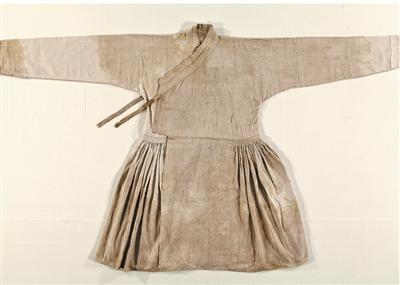
白棉布束腰窄袖褶袍

Search documents
洞藏锦绣六百年(传承之光)
Ren Min Ri Bao· 2026-01-24 09:15
Core Viewpoint - The discovery of a collection of valuable textiles from the Yuan Dynasty, buried for over 600 years in the "Pigeon Cave" of Hebei, highlights the rich cultural and historical significance of these artifacts, showcasing the craftsmanship and aesthetic values of the era [4][5][6]. Group 1: Discovery and Significance - A total of 67 artifacts, including textiles and documents, were unearthed from the Pigeon Cave, dating back to the late Yuan Dynasty (1341-1368) [4]. - The artifacts are believed to have been hidden by their owner to escape war, providing a unique glimpse into the daily life and culture of the time [4][5]. - The exhibition "Weaving Mountains and Rivers" at the Beijing Grand Canal Museum showcases these restored textiles, emphasizing their historical and artistic value [4]. Group 2: Textile Characteristics - The "white cotton waist-narrow sleeve pleated robe" is a rare cotton garment from ancient times, measuring 121 cm in length, designed for practicality in horseback riding [4][5]. - The robe features a refined design with a "tight upper and loose lower" structure, reflecting the practical needs of nomadic lifestyles [4][5]. - Other notable artifacts include embroidered knee pads, which combine natural imagery with daily life aesthetics, showcasing the artistic expression of the Yuan Dynasty [5][6]. Group 3: Cultural Exchange and Craftsmanship - The textiles reflect a blend of Mongolian and Han Chinese influences, illustrating the multicultural fabric of Yuan Dynasty society [6][7]. - The use of gold thread in textiles and the introduction of foreign weaving techniques signify the era's material culture exchange [7]. - The intricate designs, such as the "brown ground phoenix and peony pattern," highlight the artistic sophistication and craftsmanship of the period [7]. Group 4: Restoration Efforts - The restoration of these fragile textiles began in 2006, involving meticulous scientific methods to address issues like decay and discoloration [8][9]. - The restoration team employed advanced techniques, including microscopic sewing methods, to ensure the integrity of the original artifacts [9]. - This effort not only preserves the artifacts but also honors the craftsmanship and cultural heritage of the Yuan Dynasty [9].

洞藏锦绣六百年
Ren Min Ri Bao· 2026-01-24 06:16
Core Viewpoint - The discovery of 67 pieces of valuable artifacts from the Yuan Dynasty in the "Pigeon Cave" of Hebei's Longhua County has garnered significant attention, showcasing the rich textile culture and craftsmanship of the era [1][3]. Group 1: Artifacts and Their Significance - The artifacts include rare cotton garments, such as a "white cotton waist-narrow sleeve pleated robe," which reflects the practical design suited for horseback riding, indicating the lifestyle of nomadic cultures [1][2]. - The collection features exquisite embroidery items, including "green dark flower brocade knee pads" and "white dark flower brocade knee pads," which are among the few surviving examples from the Yuan Dynasty, highlighting the blend of natural imagery and daily life aesthetics [2][3]. - The textiles also include various "bannai" half-finished products and remnants, providing a unique historical perspective that contrasts with the ceremonial completeness of burial artifacts, thus revealing a more authentic glimpse into everyday life during that period [2][3]. Group 2: Cultural Exchange and Craftsmanship - The artifacts reflect the cultural exchange during the Yuan Dynasty, showcasing both Mongolian and Han Chinese clothing styles, which illustrates the era's multi-ethnic integration [3][4]. - The use of gold thread in textiles, a trend during the Yuan Dynasty, signifies the influence of foreign craftsmanship, with materials like "green cloud pattern gold brocade" representing the sophisticated weaving techniques of the time [3][4]. - The intricate patterns on the textiles, primarily based on Han Chinese themes, demonstrate a transition in weaving techniques from the Song Dynasty to the Ming and Qing Dynasties, marking an important evolution in textile craftsmanship [4]. Group 3: Restoration Efforts - The restoration of these artifacts, initiated by the National Cultural Heritage Administration in 2006, involves meticulous scientific methods to address issues like decay, pollution, and severe damage [4][5]. - The restoration process employs advanced techniques, combining traditional sewing methods with modern technology, ensuring that the repairs maintain the original characteristics of the artifacts [5]. - The successful restoration of these textiles not only preserves their historical value but also celebrates the craftsmanship of the Yuan Dynasty, providing a vivid representation of the era's social landscape [5].