
石马桃花

Search documents
今年白云年花销售额有望突破7000万元
Guang Zhou Ri Bao· 2026-01-30 02:19
Core Viewpoint - The flower industry in Baiyun District of Guangzhou is a significant contributor to the city's annual flower market, with a projected production of 20 million pots for the 2026 Spring Festival, of which 6 million pots will come from Baiyun, accounting for 30% of the total [2]. Group 1: Industry Overview - Baiyun District is a traditional flower production area in Guangzhou, with a flower industry output value of approximately 470 million yuan in 2025, covering an area of about 12,000 acres [5]. - The district produced around 6.13 million stems of cut flowers and 30.1 million pots of potted plants in 2025, establishing itself as a core region for flower production and distribution in Guangzhou [5]. - Baiyun's flower sales reached a record high of 66 million yuan last year, with expectations to exceed 70 million yuan this year [5]. Group 2: Product Highlights - The main flower varieties in Baiyun include Phalaenopsis orchids, Shima peach blossoms, kumquats, and rose begonia, with over 100 cultivated varieties of Phalaenopsis orchids [5]. - The Shima peach blossom is known for its high yield and long flowering period, with a stable planting area of around 1,000 acres and an annual output exceeding 200,000 trees [5]. - Baiyun's kumquats include varieties like golden kumquat and four-season kumquat, which have high market recognition [5]. Group 3: Market Expansion - Baiyun's flower sales extend beyond the district to cover the entire Guangzhou area and cities in the Guangdong-Hong Kong-Macao Greater Bay Area, with exports to major cities like Shanghai and Beijing [6]. - The flower products, particularly Phalaenopsis orchids, are gaining popularity in overseas markets, especially in Southeast Asia, with kumquats receiving orders from Singapore for the first time this year [6]. Group 4: Industry Innovation - The Baiyun District has established a modern agricultural demonstration park for Phalaenopsis orchids, attracting over 30 enterprises and forming a complete industrial chain from research to sales [7]. - New sales models such as live streaming and new retail collaborations are becoming prevalent, with live streaming accounting for about 90% of sales for some companies [7]. - The "Guangzhou Flower Industry High-Quality Development Three-Year Action Plan (2024-2026)" aims to position Baiyun as a base for high-end ornamental plants and export bonsai, emphasizing the district's role in leading the flower industry towards high-quality development [7][8].

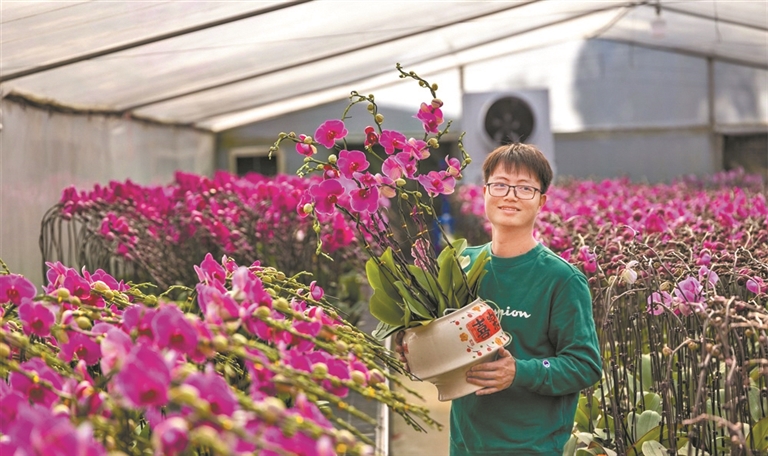
解码广州新春“花样”经济
Zhong Guo Xin Wen Wang· 2026-01-29 07:55
Core Insights - The flower industry in Baiyun District, Guangzhou, is a significant contributor to the city's annual flower market, with approximately 30% of the annual flowers sold in Guangzhou originating from this area [1][2] - The total production of annual flowers in Guangzhou is expected to reach 20 million pots by the 2026 Spring Festival, with Baiyun District contributing around 6 million pots [1] - Baiyun District's flower industry is projected to generate a value of approximately 470 million yuan in 2025, with a planting area of 12,000 acres [1] Industry Overview - Baiyun District is a traditional flower production area in Guangzhou, maintaining a robust flower industry that has thrived for over a century [1] - The sales revenue of annual flowers from Baiyun District reached a record high of 66 million yuan last year, with expectations to exceed 70 million yuan this year [1] - The district's flower varieties include distinctive species such as Phalaenopsis orchids, Shima peach blossoms, and annual kumquats, which are well-received in both domestic and international markets [2] Market Expansion - Baiyun's flower products are not only popular within Guangzhou but also extend to the Greater Bay Area and major cities like Shanghai and Beijing [2] - The district has seen increasing demand in overseas markets, particularly in Southeast Asia, with new orders from Singapore for annual kumquats this year [2] - Future plans for the flower industry in Baiyun District include enhancing genetic resource cultivation, upgrading technology, and expanding distribution channels to shift towards high-quality development [2]