科创创新药ETF汇添富(589120)

Search documents
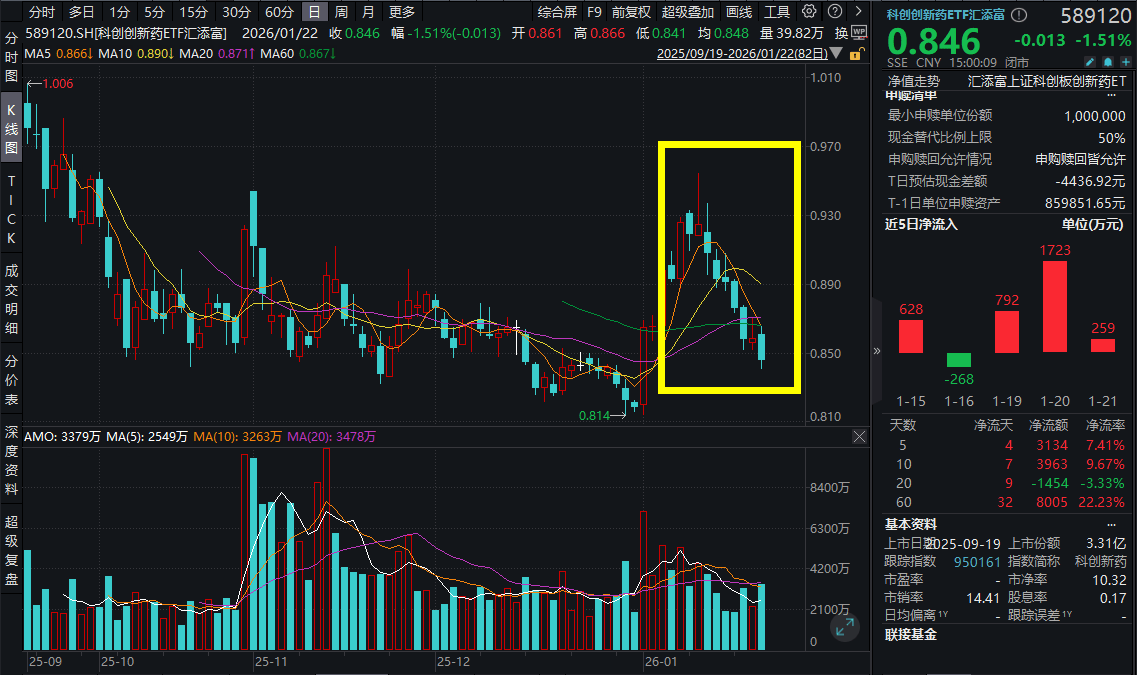
科创创新药反弹,三生国健涨超10%,25年净利或高增超310%!科创创新药ETF汇添富(589120)近5日吸金超4000万元!全球创新药新一轮周期开始?
Sou Hu Cai Jing· 2026-01-27 10:01
Core Viewpoint - The A-share market is experiencing a rebound, particularly in the innovative pharmaceutical sector, with significant capital inflow into the ETF focused on innovative drugs, indicating strong investor confidence in this segment [1][5]. Group 1: Market Performance - The A-share market showed a positive trend on January 27, with the Shanghai Composite Index fluctuating upwards, closing with a gain [1]. - The ETF for innovative drugs, Huatai-PineBridge (589120), saw a 0.71% increase in the afternoon session, attracting over 40 million yuan in capital over the past five days [1]. Group 2: Stock Performance - The majority of the index component stocks for the innovative drug ETF experienced gains, with notable performances from companies such as Sanofi (10.93% increase) and Junshi Biosciences (nearly 8% increase) [2][3]. - The top ten component stocks of the ETF include companies like BeiGene and I-Mab, with varying weightings and performance metrics [4]. Group 3: Industry Outlook - The innovative pharmaceutical sector is witnessing a recovery in performance, with over 50 companies expected to report profits for 2025, driven by improved industry conditions and favorable policies [5]. - As of January 26, more than 90 A-share innovative and biopharmaceutical companies have disclosed their 2025 earnings forecasts, with 53 companies expected to be profitable [5]. Group 4: Strategic Developments - Significant collaborations, such as the partnership between Sanofi and Pfizer, are contributing to substantial revenue growth, with Sanofi projecting a net profit of 2.9 billion yuan for 2025, marking a 311.35% increase year-on-year [5]. - The innovative drug sector is entering a phase of capital influx, research iteration, and value realization, indicating a positive cycle for the industry [8]. Group 5: Global Competitiveness - The Chinese innovative drug sector is becoming increasingly competitive on a global scale, with a record-breaking outbound transaction volume exceeding 135 billion USD in 2025 [7]. - China is expected to play a leading role in the next cycle of global innovation in pharmaceuticals, with a focus on areas such as PD-1 dual antibodies and antibody-drug conjugates [8].


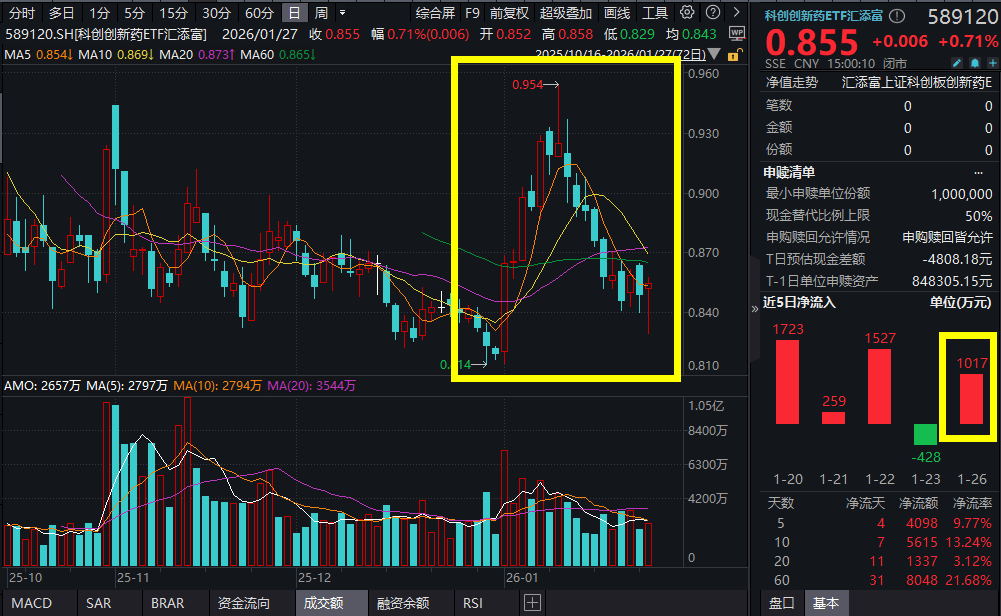
创新药继续承压,益方生物跌超6%,科创创新药ETF汇添富(589120)跌1.5%,连续3日吸金近2800万元,资金逢跌坚定增仓!什么信号?
Sou Hu Cai Jing· 2026-01-22 08:38
Core Viewpoint - The A-share market experienced fluctuations on January 22, with the Shanghai Composite Index rising by 0.14%. The innovative drug sector faced pressure, as evidenced by the decline of the Science and Technology Innovation Drug ETF Huatai (589120) by 1.51% by 15:00. However, the ETF saw a net inflow of funds totaling 27.7361 million yuan over the past three days, indicating a trend of buying on dips [1]. Group 1: Market Performance - The Science and Technology Innovation Drug ETF Huatai (589120) recorded a net inflow of 27.7361 million yuan over three days, showing a clear trend of increased buying despite market declines [1]. - By 15:00, the ETF's component stocks exhibited mixed performance, with notable gains from Kangxinuo at 1.81%, Baiaotai at 0.49%, and Haoyuan Pharmaceutical at 0.48%. Conversely, Yifang Bio fell over 6%, Rongchang Bio dropped over 4%, and Baili Tianheng decreased by over 3% [6]. Group 2: Industry Insights - According to the National Medical Insurance Administration, 76 innovative drugs are expected to be approved for market entry by the National Medical Products Administration by 2025, marking a record high and indicating a trend towards diversified innovative therapies in China [4]. - Donghai Securities predicts that the innovative drug sector is entering a new era, transitioning from a generics-dominated market (pre-2018) to a period of transformation (2018-2025) characterized by price reductions and increased R&D investments in innovative drugs. By 2026, innovative drugs are expected to dominate the pharmaceutical industry in China, supported by complementary insurance policies and a focus on the pace of new drug launches and competitive dynamics [5].