
创新药出海

Search documents
低处藏珠,蓄势待发:创新链价值迎修复拐点,创新药板块底部夯实
Changjiang Securities· 2026-04-01 08:46
Investment Rating - The report maintains a "Positive" investment rating for the healthcare sector [11] Core Insights - The innovative chain sector is entering a new growth cycle driven by both domestic and international demand, with significant improvements expected in China's innovative drug R&D investment starting in 2025 [2][6] - Chinese innovative drug companies are expected to see a substantial increase in available funds, with a projected total of 201.5 billion yuan in IPO fundraising and financing activities in 2025, marking a 145% year-on-year increase [6] - The report highlights the strong performance of CDMO companies, with significant order improvements anticipated by mid-2024, and a positive trend in their financial performance [7] - The innovative drug sector is entering a realization phase with low valuation levels, and numerous catalysts expected in Q2 2026, suggesting a favorable outlook for investments in this area [8] Summary by Sections Domestic Demand - By 2025, the investment climate for innovative drug R&D in China is expected to improve, leading to a new cycle of prosperity in the innovative drug industry [6] - The funding available to Chinese pharmaceutical companies is increasing, with a projected 880.5 billion yuan in potential milestone payments from external business development (BD) activities, a 185.9% year-on-year increase [6] International Demand - CDMO companies focused on overseas revenue are expected to see significant improvements in new orders starting from Q2 2024, with year-on-year growth rates recovering to over 15% [7] - WuXi AppTec's backlog is projected to reach 58 billion yuan by the end of 2025, reflecting a 28.8% year-on-year increase, with expected revenue growth of 18-22% in 2026 [7] Innovative Drug Sector - The innovative drug sector is entering a realization phase with low valuations, supported by a series of policy measures that have been implemented since 2024 [8] - The number of Chinese companies participating in international academic conferences is increasing, with over 100 expected to present nearly 400 research outcomes in 2026 [8] Technological Advancements - Chinese pharmaceutical companies are rapidly enhancing their global competitiveness, with innovative technologies such as second-generation ADCs and molecular therapies being developed at a leading global level [9] - The report suggests that the outbound business development strategies are diversifying, including mergers and collaborations, which could enhance the global presence of Chinese pharmaceutical companies [9]

凯莱英两连板,三生制药涨11%,AH生物医药爆发!恒生生物科技ETF汇添富(513280)涨近6%,生物医药ETF汇添富涨近4%!CXO创新药拐点已来?
Sou Hu Cai Jing· 2026-04-01 06:35
Group 1 - The article highlights a rebound in the Asia-Pacific stock market, particularly in the biopharmaceutical sector, driven by easing tensions in the US-Iran conflict [1] - The Hang Seng Biotech ETF (513280) surged nearly 6%, with significant trading volume exceeding 220 million yuan, and many constituent stocks, such as Sangfor Biopharma and Innovent Biologics, showing strong gains [1] - The A-share market also saw the Huatai Biopharmaceutical ETF (159839) rise nearly 4%, marking a strong performance with a net inflow of over 180 million yuan in the past 60 days [1] Group 2 - According to Founder Securities, the innovative drug sector is entering a profitability cycle, with leading companies like BeiGene and Innovent Biologics achieving profitability [2] - The total value of innovative drug licensing transactions from China exceeded 60 billion USD in the first three months of this year, indicating accelerated international expansion [2] - A series of international academic conferences are set to take place, providing opportunities for Chinese pharmaceutical companies to present promising data and enhance pipeline value [2] Group 3 - China’s CXO sector is benefiting from improved financing conditions, with a notable reversal in investment trends since early 2025, which is expected to stimulate new rounds of innovative drug research and development [3] - The impact of AI on the pharmaceutical industry is deepening, transitioning from concept to practical application, enhancing efficiency across various segments [3] - The CXO sector is expected to see a recovery in demand driven by improved investment sentiment and increased orders, with a focus on the structural upgrades and integration within the industry [4] Group 4 - The CXO sector's fundamentals are improving, with new orders and demand expected to drive future market performance, supported by favorable conditions in the innovative drug investment landscape [4] - The sector is anticipated to expand due to increasing outsourcing needs in research and production, alongside the emergence of new therapies [5] - AI in drug discovery is projected to reach a critical development point by 2026, further validating its value in early-stage research decisions [5] Group 5 - The Hang Seng Biotech ETF (513280) is noted for its low management fee of 0.15% per year, making it an attractive option for investors looking to capitalize on the biopharmaceutical sector [6] - The ETF tracks 30 leading Hong Kong pharmaceutical stocks, with a balanced focus on innovative drugs and CXO growth opportunities [6] - The ETF has seen a significant increase in net inflows, with a growth rate exceeding 34% for the year [6] Group 6 - The Huatai Biopharmaceutical ETF (159839) focuses on the A-share market, balancing contributions from CXO and innovative drugs, and includes leading companies in the sector [10] - The top ten holdings in the ETF account for over 55% of its total weight, indicating a concentrated investment strategy [10] - The ETF aims to capture opportunities in various sub-sectors, including vaccines and blood products, enhancing its overall market responsiveness [10]


凯莱英(002821) - 2026年3月31日凯莱英特定对象调研记录表
2026-03-31 09:56
Group 1: Company Overview and Growth Prospects - Kailaiying Pharmaceutical Group is focusing on expanding its peptide business, which is currently the fastest-growing segment, with 19 clinical projects in the GLP-1, Amylin, and cyclic peptide areas, 8 of which are in late-stage clinical trials [2][3] - The company has seen significant growth and structural changes in its service pipeline over the past two years, with over 50 peptide projects extending beyond weight loss to autoimmune and other fields [3] Group 2: Production Capacity and Capital Expenditure - The small molecule business is operating at high capacity, with the TJ3 plant expected to alleviate API capacity constraints by Q2 2026 [4] - The total capital expenditure plan for 2026 is approximately RMB 2.1 billion, with 70%-80% allocated to emerging business segments, particularly in chemical and biological macromolecules [4] Group 3: Revenue and Profitability Outlook - The company anticipates a revenue growth of 19%-22% for 2026, with a potential 2-3 percentage point increase under constant exchange rates [5] - Emerging business segments are expected to see continuous improvement in gross margins due to factors such as increased overseas revenue share and enhanced capacity utilization [5] Group 4: Order Growth and Market Demand - As of the end of Q1 2026, the total order backlog is USD 1.385 billion, reflecting a 31.65% year-over-year increase, driven by sustained growth in small molecule commercialization projects [6][8] - The demand for new molecular types, such as conjugated drugs and peptides, is robust, with a notable scarcity in production capacity [7] Group 5: Strategic Initiatives and Challenges - The company is actively managing cost impacts from rising chemical prices due to geopolitical tensions, with proactive procurement strategies in place [5] - There is ongoing exploration of overseas capacity expansion, aligned with business development efforts, although the pace remains cautious [6]
中银晨会聚焦-20260331-20260331
Bank of China Securities· 2026-03-31 00:33
Core Insights - The report highlights a focus on the transportation sector, particularly oil shipping, which is expected to maintain high prices due to ongoing geopolitical tensions in the Middle East [3][14] - The innovative pharmaceutical sector is identified as having dual support from declining US Treasury yields and strong outbound business development, making it a key area for investment [11] - The report suggests that the A-share market may see a breakthrough opportunity in April, supported by domestic fundamentals and long-term capital [12] Transportation Sector - Oil shipping is currently experiencing low vessel traffic through the Strait of Hormuz, with only about 10 vessels passing daily since the onset of conflict, indicating a rebalancing in the global oil shipping market [14] - China National Airlines is projected to see stable revenue growth in 2025, although it remains unprofitable, indicating a transitional phase in its financial recovery [14] - The new regulations for unmanned aerial vehicles in Beijing, effective May 1, 2026, will enforce stricter management of airspace and outdoor flights [14] Industry Performance - The report notes that the social services sector has seen a decline of 5.46% in the past two weeks, ranking 17th among 31 sectors, with travel and retail sectors particularly affected [19] - The upcoming Qingming Festival and spring break are expected to boost travel demand significantly, with a notable increase in search and booking activity for flights and accommodations [20] Investment Recommendations - The report recommends focusing on opportunities in the oil shipping, dry bulk, and container shipping sectors due to the evolving geopolitical landscape [16] - Specific stocks such as China Merchants Energy and China National Offshore Oil are highlighted for potential investment [16] - The report also suggests monitoring the recovery of the cross-border e-commerce logistics and engineering logistics sectors, with specific companies recommended for investment [17]
国际油价涨3%,美油升破100美元,美股期指全线下跌
21世纪经济报道· 2026-03-29 23:06
Group 1 - International crude oil prices surged, with New York crude rising over 3% to $102.66 per barrel and Brent crude increasing by 2.72% to $108.17 per barrel [1][2] - Spot gold increased by 0.29% to $4508 per ounce, while spot silver fell approximately 1% to $68.95 per ounce [2] - Domestic gold jewelry prices continued to decline, with many brands dropping below 1400 yuan per gram [2] Group 2 - U.S. stock index futures fell by about 0.5%, with the Dow Jones futures down 0.53%, Nasdaq futures down approximately 0.47%, and S&P 500 futures down about 0.47% [3] - Reports indicated that Iran's foreign ministry criticized U.S. proposals as extreme and unreasonable, asserting that Iran must rely on its own strength for national security [3] - Iranian military officials stated that U.S. and Israeli military and political leaders' residences would become legitimate targets for Iran [3] Group 3 - The largest aluminum company in the Middle East faced an attack, which may impact related A-share companies with production capacity [4] - In the first quarter, Chinese innovative pharmaceuticals experienced significant growth, with a revenue of 410 billion yuan, potentially benefiting certain A-share companies [4] - Stocks that have been delisted from the third board saw a dramatic increase, with a rise of over 1000% in just 59 days [4]

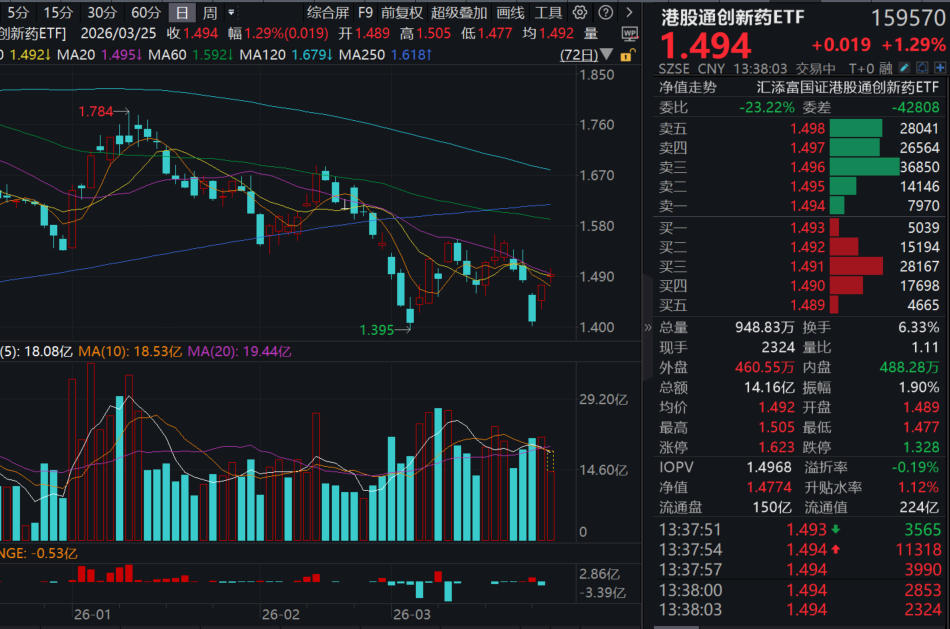
石药集团绩后涨近4%!信达生物与礼来制药的战略合作已生效,澄清非收购交易!港股通创新药ETF(159570)涨超1%连续反攻!
Xin Lang Cai Jing· 2026-03-25 06:07
Group 1 - The core viewpoint of the news highlights the positive performance of the Hong Kong pharmaceutical sector, particularly the Hong Kong Stock Connect Innovation Drug ETF (159570), which has seen significant inflows and a rise in trading volume [1][4] - The strategic partnership between Innovent Biologics and Eli Lilly has officially commenced, aimed at advancing new drug development in oncology and immunology, clarifying that it is not an acquisition [3] - The annual performance report from CSPC Pharmaceutical Group indicates a profit attributable to shareholders of RMB 3.882 billion for the year ending December 31, 2025, with a projected increase to RMB 4.328 billion for 2024 [3] Group 2 - The Hong Kong Stock Connect Innovation Drug ETF (159570) has a leading scale of over RMB 22.1 billion, with a net inflow of RMB 22 million over the past three days [1] - The majority of stocks in the ETF's underlying index have shown positive performance, with CSPC Pharmaceutical rising nearly 4% and other companies like Innovent Biologics and Kintor Pharmaceutical also experiencing gains [4] - The biopharmaceutical sector in Hong Kong and A-shares has raised approximately RMB 70 billion from 2024 to March 21, 2026, supporting innovation drug pipeline investments [6] Group 3 - The business development (BD) income has become a significant source of funding for innovative drug research and development, with a total of USD 57.1 billion in BD contracts signed by 2026, representing 41% of the total for the year [8] - The financial health of the pharmaceutical sector is robust, with most companies maintaining over a year of funding coverage for R&D expenses, ensuring sustainability for clinical trials and pipeline expansion [11] - The upcoming AACR conference in April 2026 will feature over 250 innovative drugs from 104 Chinese pharmaceutical companies, showcasing advancements in various therapeutic areas [13]
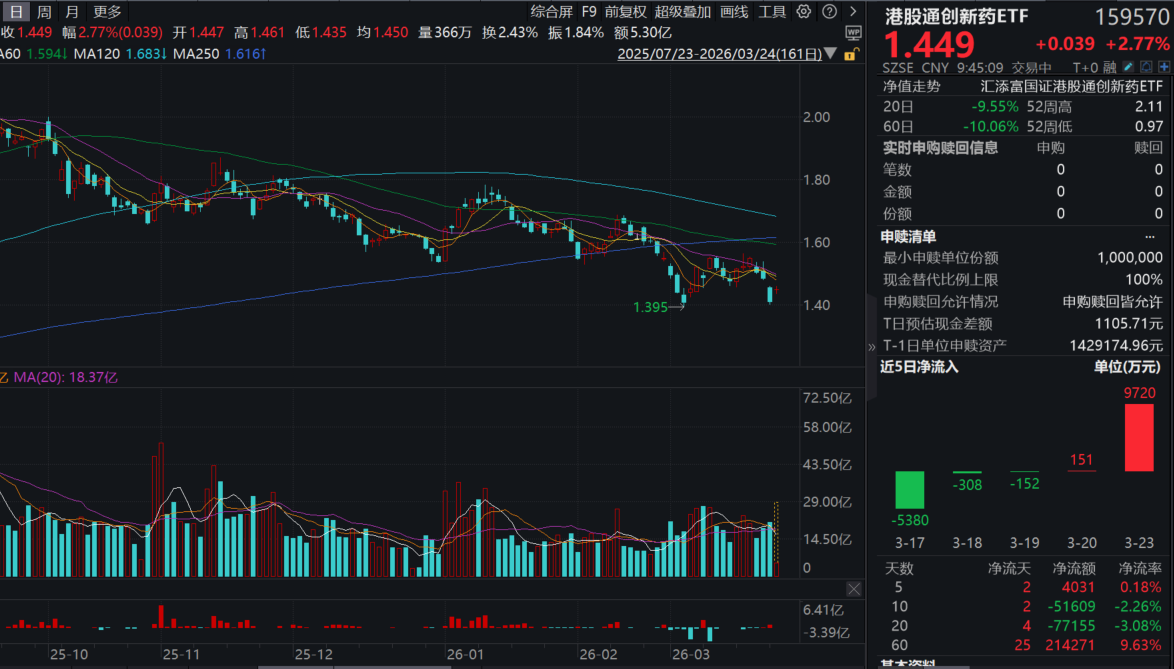
荣昌生物维迪西妥单抗获批第四项适应症,药明康德业绩再创历史新高!港股通创新药ETF(159570)放量大涨近3%!AACR 2026开幕在即
Xin Lang Cai Jing· 2026-03-24 02:31
Group 1 - The Hong Kong pharmaceutical market saw a significant rebound, with the Hong Kong Stock Connect Innovation Drug ETF (159570) rising nearly 3% and achieving a trading volume exceeding 900 million yuan, reflecting strong capital inflow [1] - The ETF's latest scale has surpassed 21.4 billion yuan, leading its peers in the same category [1] - The "20CM Innovation Drug New Species" ETF from Huatai-PineBridge (589120) surged by 4%, with strong capital inflow for two consecutive days [1] Group 2 - Rongchang Biopharmaceutical announced the approval of its antibody-drug conjugate (ADC) Vidi Xituzumab (brand name: Aidiqi®) for a new indication, making it the first domestic ADC therapy approved for treating adult breast cancer patients with low HER2 expression and liver metastasis [3] - Gilead Sciences agreed to acquire Ouro Medicines, which holds approximately 15% equity in Ouro, marking a strategic move in the biopharmaceutical sector [3] Group 3 - WuXi AppTec reported a record high in 2025, achieving revenue of 45.456 billion yuan, a year-on-year increase of 15.8%, and a net profit of 19.195 billion yuan, up 105.2% year-on-year [4] Group 4 - The Hong Kong Stock Connect Innovation Drug ETF (159570) saw most of its underlying index stocks perform positively, with notable gains from companies like Connaissance-B, which rose over 4%, and others like Innovent Biologics and Rongchang Biopharmaceutical, which increased by over 2% [5] Group 5 - The AACR 2026 conference will take place in San Diego, featuring numerous innovative pharmaceutical companies discussing breakthroughs from basic research to clinical translation [6] - Key presentations will include Merck's disclosure of clinical data for MK-2010 and updates from various companies on their clinical trials and research advancements [6][7][8][9] Group 6 - The innovation drug sector is experiencing a surge in funding, with approximately 700 billion yuan raised for research and development from January 1, 2024, to March 21, 2026, across Hong Kong and A-share markets [10] - The BD income and post-listing fundraising are providing substantial financial support for innovative drug companies [10][15] Group 7 - Despite short-term volatility in the innovation drug sector, the long-term growth potential remains intact, with a focus on overseas clinical deployment and product progress becoming critical for future success [16][17] - Leading innovative drug companies are entering a positive cycle of product commercialization, which is expected to exceed market expectations [18]
医药行业跟踪报告:GSK首创小核酸新药拟纳入优先审评,有望实现乙肝功能性治愈
Shanghai Aijian Securities· 2026-03-23 09:42
Investment Rating - The report assigns an investment rating of "Outperform the Market" for the pharmaceutical sector, indicating a relative performance better than the benchmark index [2][4]. Core Insights - The pharmaceutical sector has shown resilience despite market pressures, with the SW Pharmaceutical Index declining by 2.77%, underperforming the CSI 300 Index, which fell by 2.19% during the week of March 16 to March 22 [2]. - GSK's new small nucleic acid drug, Bepirovirsen, is set for priority review in China, potentially offering a functional cure for chronic hepatitis B, marking a significant advancement in the field [2]. - KX-826, developed by Akeso, has successfully met primary endpoints in its Phase III clinical trial for androgenetic alopecia, indicating a breakthrough in treatment options for hair loss [2]. - The report emphasizes the ongoing trend of innovation in China's pharmaceutical industry, with a focus on ADCs, bispecific antibodies, small nucleic acids, and weight-loss drugs as key investment opportunities [2]. Summary by Sections Industry Performance - The pharmaceutical sector's performance is under scrutiny, with all sub-sectors experiencing a pullback, although some innovative drug stocks showed signs of rebound [2]. - The report highlights the performance of the Hong Kong pharmaceutical indices, with the Hang Seng Biotechnology Index gaining 0.48% [2]. Key Developments - GSK's Bepirovirsen is the first small nucleic acid drug to complete Phase III trials in the chronic hepatitis B space, with significant implications for treatment [2]. - Akeso's KX-826 has demonstrated statistical significance in its clinical trials, positioning it as a first-in-class treatment for androgenetic alopecia [2]. Investment Recommendations - The report suggests focusing on investment opportunities in glove and vitamin sectors due to price increases driven by global energy supply constraints [2]. - Long-term trends in China's pharmaceutical innovation are expected to create substantial investment opportunities post-market correction, particularly in the areas of drug exports and advanced therapeutic modalities [2].
中泰国际:生物医药将成为新兴支柱产业 重点推荐中国生物制药(01177)等
智通财经网· 2026-03-20 06:41
Group 1 - The Hong Kong pharmaceutical industry outperformed the Hang Seng Index in February, with the Hang Seng Healthcare Index declining by 2.2%, which is less than the overall Hang Seng Index decline [1] - The central government has officially classified biomedicine as an emerging pillar industry, indicating strong future support for the biopharmaceutical sector [2] - The total amount of innovative drugs exported in January exceeded 33.2 billion RMB, approaching a quarter of the total for the entire year of 2025, reflecting increasing recognition of Chinese innovative drugs by overseas pharmaceutical companies [1] Group 2 - China National Pharmaceutical Group announced the acquisition of Haogiya Biotech, a pioneer in small nucleic acid fields, and granted Sanofi exclusive rights for the global development and commercialization of Rovafatinib, with potential payments up to 1.53 billion USD [3] - The company is expected to achieve double-digit growth in product sales revenue by 2025, bolstered by the acquisition and the successful licensing of Rovafatinib, which indicates strong recognition of its R&D capabilities by global industry leaders [3] - The CXO sector leaders, WuXi Biologics and WuXi AppTec, are also recommended due to their positive earnings forecasts for 2025 and strong demand for new projects, supported by the government's increasing backing for innovative drugs [3]


医药行业跟踪报告:全球首款侵入式脑机接口医疗器械在中国获批上市
Shanghai Aijian Securities· 2026-03-16 10:46
Investment Rating - The report assigns an investment rating of "Outperform the Market" for the pharmaceutical sector, indicating a relative performance better than the benchmark index [2][4]. Core Insights - The pharmaceutical sector is experiencing a mixed performance, with the SW Pharmaceutical Biotechnology Index declining by 0.22%, ranking 13th out of 31 sectors, underperforming the CSI 300 Index which increased by 0.19% [2]. - The approval of the world's first invasive brain-computer interface medical device in China marks a significant milestone, indicating the commercialization of brain-computer interface technology and addressing a substantial medical need for spinal cord injury patients [2]. - Eli Lilly plans to invest $3 billion over the next decade to expand its supply chain in China, focusing on local production capabilities for oral solid formulations, which reflects the growing importance of Chinese pharmaceutical companies in global innovation [2]. Summary by Sections Industry Performance - The pharmaceutical sector's performance is influenced by geopolitical events, with energy sectors leading the market while medical devices and CXO sectors lagged [2]. - Notable segments such as medical consumables and raw materials showed positive growth, while medical devices and CXO faced declines [2]. Key Developments - The brain-computer interface device approved for clinical use is designed for patients with specific spinal cord injuries, showcasing significant improvements in hand function and quality of life [2]. - The National Healthcare Security Administration has established pricing projects for brain-computer interface technology, facilitating its clinical application [2]. Investment Opportunities - The report highlights investment opportunities in areas such as ADC, dual antibodies, small nucleic acids, and weight-loss drugs, with a focus on companies like Innovent Biologics, 3SBio, and others [2]. - The report emphasizes the potential for long-term investment in China's pharmaceutical innovation, particularly in the context of increasing international collaboration and investment from multinational corporations [2].