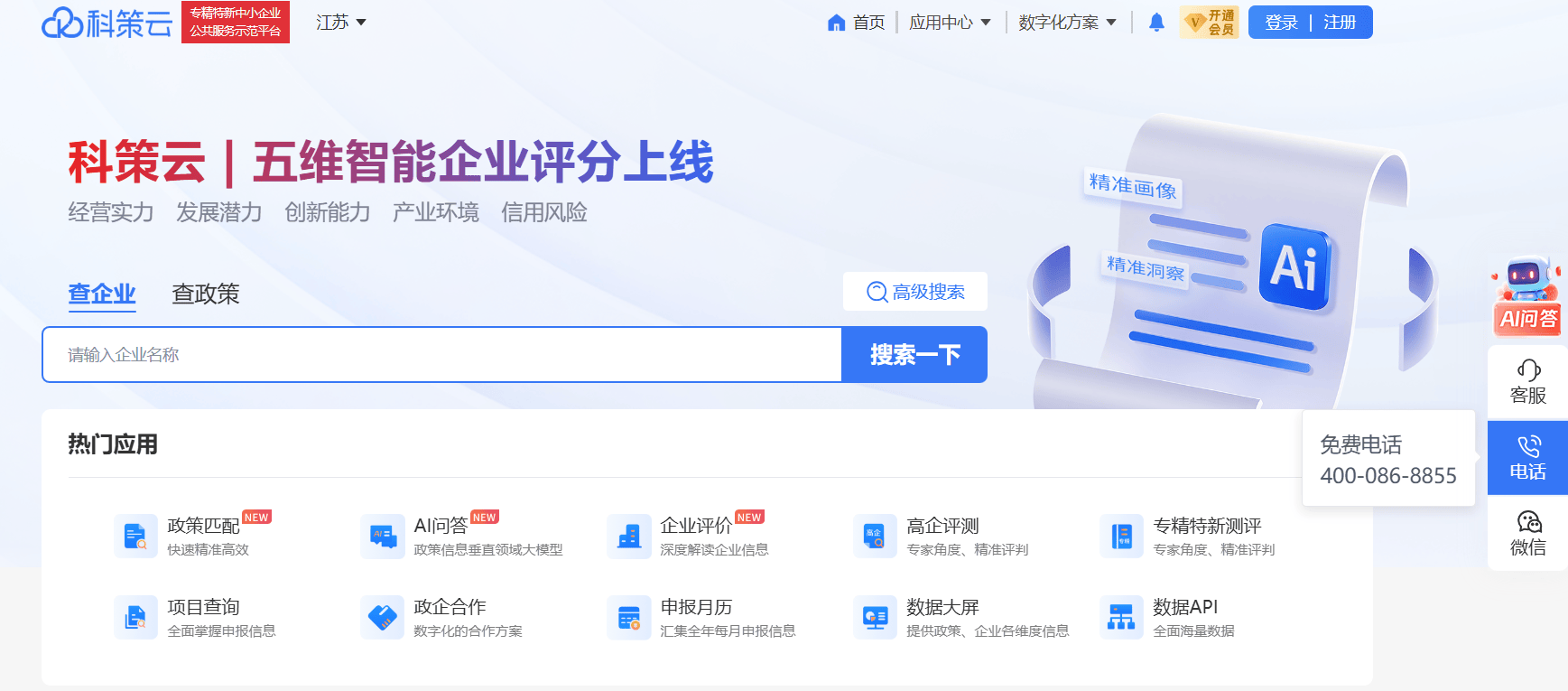
科策云平台

Search documents
科策云企业信息查询范式
Sou Hu Cai Jing· 2025-12-18 03:14
Core Insights - The enterprise information query industry has formed two main camps: official platforms and third-party tools, both of which have significant shortcomings [1][5] - Traditional platforms suffer from data fragmentation and delayed updates, leading to increased commercial decision-making costs [1][5] - The introduction of the Kecy Cloud platform, leveraging big data and AI, offers a new solution by integrating and updating enterprise data in real-time [2][5] Group 1: Industry Challenges - Official platforms like the National Enterprise Credit Information Publicity System have authoritative data but are limited by their update mechanisms, requiring annual corrections by June 30 [1] - Users must navigate over 10 channels for comprehensive due diligence, taking 3-5 working days, with potential data omissions [1] - Traditional query tools fail to provide specialized support for technology companies needing precise evaluations and qualifications [1] Group 2: Kecy Cloud Platform Advantages - Kecy Cloud integrates over 180 million enterprise registration data and over 100 million patent data, covering more than 80 million technology enterprises across 500 dimensions [2] - The platform employs a T+0 real-time update mechanism, ensuring timely access to critical information such as business changes and policy adjustments [2] - Its "Enterprise Evaluation" feature uses over 10 core tags and multidimensional data modeling to objectively present credit status, industry competitiveness, and growth potential [3] Group 3: Technical Innovations - Kecy Cloud's proprietary Tech model significantly improves data processing accuracy and recall efficiency compared to traditional AI algorithms [3] - The platform integrates over 5 million industry policy data across more than 470 cities, allowing precise filtering based on enterprise type and industry [3] - Compared to traditional manual methods, Kecy Cloud reduces information processing costs by 60%, enhancing problem-solving capabilities in complex scenarios [4] Group 4: User Benefits - The platform offers a "one-stop" query experience, allowing users to access comprehensive data without switching between multiple sites [4] - Specialized services cater to various users, including industry investment departments, research institutions, and small businesses, optimizing their development paths [4] - Kecy Cloud's approach aligns with the industry's shift from "tool value" to "service value," enhancing the overall user experience [4][5]


政策查询要点汇总
Sou Hu Cai Jing· 2025-12-02 03:46
Core Insights - The article focuses on five key national industrial policies that are currently effective, aimed at helping companies quickly grasp policy benefits and align with development needs [1] Group 1: 5G and Industrial Internet - The Ministry of Industry and Information Technology (MIIT) aims to build 10,000 5G factories and create at least 20 integrated application pilot cities by 2027 [2] - Key opportunities for companies include subsidies for high-energy-consuming industries to build independent 5G networks and collaboration with leading enterprises for small and medium-sized enterprises (SMEs) [2] - The policy emphasizes the need for planning technology solutions and application timelines by the end of 2025 for the first batch of independent network pilot assessments [2] Group 2: SME Challenge Mechanism - The policy encourages SMEs to lead or participate in major national and provincial technology projects, offering up to 5 million yuan in financial support for successful projects [3] - Companies should focus on "breakthrough" and "results transformation" projects, highlighting collaboration with universities and clear timelines for results [3] - Financial support is disbursed in stages, with 40% at project initiation, 30% after mid-term evaluation, and the remaining 30% upon project completion [3] Group 3: Battery Recycling - The interim measures for the recycling of new energy vehicle batteries require manufacturers to establish recycling networks with a minimum recovery rate of 90% [4] - Companies can apply for "white list" qualifications to enjoy tax reductions and priority subsidies, and collaborate with battery manufacturers for additional funding [4] - The policy mandates full coverage of recycling points by 2025, with penalties for non-compliance [4] Group 4: Smart Photovoltaics - The action plan for smart photovoltaic industry aims for over 80% smart upgrade rate of photovoltaic components by 2025, supporting integration with 5G and AI [5] - Companies can apply for up to 1 million yuan in rewards for smart photovoltaic pilot projects and should focus on smart upgrades and scenario integration [5] - Requirements for pilot projects include meeting six indicators related to smart levels and energy efficiency, necessitating third-party evaluations [5] Group 5: Innovation Support for SMEs - The policy increases the tax deduction rate for R&D expenses to 175% and establishes a 20 billion yuan innovation fund for SMEs [6] - Companies should maintain documentation for R&D projects and focus on applying for the innovation fund through local technology departments [6] - SMEs participating in national standard formulation can apply for special subsidies linked to the standard's level [6] Additional Insights - The article highlights that there are more detailed policies at national and local levels for companies to explore [7] - Companies can utilize the platform for in-depth policy queries and application tracking to better seize policy opportunities [10]