纤维素材料

Search documents
研判2025!中国秸秆行业市场政策、产业链图谱、综合利用量、利用率、市场规模、竞争格局及发展趋势分析:市场格局较为分散[图]
Chan Ye Xin Xi Wang· 2025-12-23 01:36
Core Viewpoint - The straw industry in China is deeply integrated with agriculture, energy, chemicals, and building materials, forming various industrial chains that enhance rural employment and farmers' income while creating indirect economic value through the substitution of petrochemical and wood resources [1][12]. Market Policies - A series of national policies have been implemented to promote comprehensive utilization of straw, with local governments providing subsidies, market construction, and incentive measures to support the development of the entire straw recycling, processing, and utilization industry chain [8][9]. Industry Chain - The straw industry chain consists of upstream resource supply and equipment manufacturing, midstream processing, and downstream diversified applications, evolving towards scale, high value, and intelligence [9][10]. Development Status - The comprehensive utilization of straw in China is projected to increase from 555 million tons in 2024 to 647 million tons, with a utilization rate rising from 77.7% to 88.3% and market size expanding from 147.63 billion yuan to 205.10 billion yuan [1][13]. Competitive Landscape - The straw comprehensive utilization market is characterized by a fragmented structure with many small-scale enterprises, including those focused on fertilizer, feed, and energy applications [13][14]. Development Trends - The future of straw utilization will shift towards high-value applications, including biodegradable tableware and bio-based composite materials, while also enhancing collaboration across the industry chain [16][17]. - Technological innovations will focus on key processes such as straw pretreatment and conversion, improving efficiency and reducing costs [19][20].


2025年中国秸秆垃圾处理行业发展背景、产业链、发展现状、竞争格局及发展趋势研判:市场格局较为分散[图]
Chan Ye Xin Xi Wang· 2025-06-06 01:40
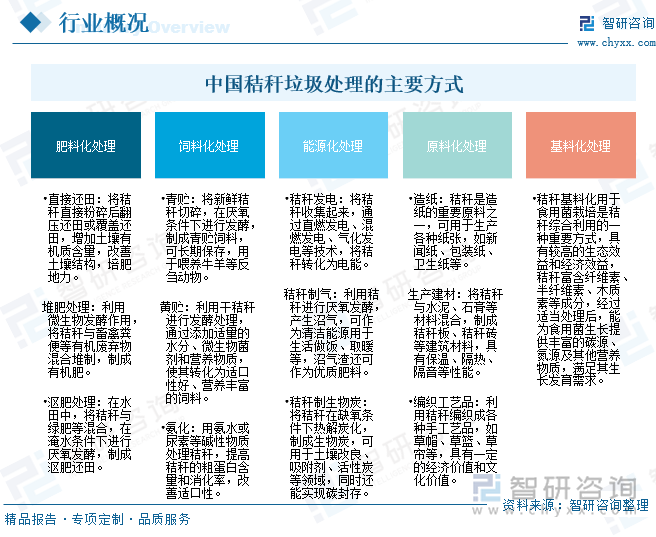
Overview - The increasing scale of agricultural production in China has led to a continuous rise in straw yield, with the straw treatment market becoming increasingly important due to strict regulations against traditional burning methods that cause air pollution [1][11] - The straw treatment market in China is projected to reach a market size of 60 billion yuan in 2024, with a year-on-year growth of 9.1% [1][11] Market Policies - The Chinese government has issued a series of policies to promote straw comprehensive utilization, including the "Air Quality Improvement Action Plan" and various guidelines aimed at enhancing the efficiency of straw utilization and encouraging enterprise participation [6][7] - Policies emphasize the importance of establishing a standardized and systematic straw collection and transportation service to improve the overall efficiency of straw utilization [7] Industry Chain - The straw treatment industry chain consists of upstream activities such as straw collection and transportation, midstream processing methods including fertilizer, feed, energy, raw material, and substrate processing, and downstream applications in agriculture, livestock feeding, and energy production [8][9] - In 2024, the theoretical resource amount of straw in China is estimated to be 994 million tons, with significant contributions from rice straw (222 million tons), wheat straw (175 million tons), and corn stalks (341 million tons) [9] Competitive Landscape - The straw treatment industry in China is characterized by a fragmented market with numerous participants, primarily small and medium-sized enterprises [13] - Key players in the industry include Guoneng Bioenergy Group, Wanhua Ecological Industry Group, Jinan Shengquan Group, and Changqing Group, among others [13][14] Development Trends - The straw treatment industry is expected to extend upstream to include straw collection and transportation equipment manufacturing, as well as related technology research and development [20] - There is a focus on forming straw treatment industry clusters in regions rich in straw resources to optimize resource utilization and enhance regional competitiveness through collaboration and innovation [20]