网关芯片

Search documents
中兴通讯:中兴通讯全资子公司中兴微电子专注于芯片的研发、设计环节,不涉及芯片的生产制造领域
Zheng Quan Ri Bao Wang· 2026-02-13 13:13
Core Viewpoint - ZTE Corporation's wholly-owned subsidiary, ZTE Microelectronics, focuses on chip research and design, not manufacturing, supporting ZTE's technological leadership in the ICT industry [1] Group 1: Chip Development and Applications - ZTE Microelectronics has extensive experience in chip development, covering the entire ICT industry including "network, computing power, and terminal" [1] - In the networking sector, self-developed chips are widely used in ZTE's base stations, optical access, optical transmission, and core routers [1] - In the computing power sector, custom processors are designed for enterprise applications such as large-scale data processing, video encoding/decoding, and cloud gaming, offering lower Total Cost of Ownership (TCO) [1] - The self-developed DPU "Dinghai" chip supports various forms such as RDMA network cards, smart network cards, and DPU cards, providing high performance and diverse computing acceleration hardware [1] - The self-developed "Tianyi" Ethernet switching chip offers efficient interconnection support for computing and communication core networks [1] Group 2: Terminal Applications - ZTE Microelectronics develops PON ONU chips for fiber broadband access products, mobile terminal chips, and automotive communication and gateway chips [1] - These chips are utilized in home terminals, vehicle communication T-Boxes, domain controllers, and smart cockpit devices [1]

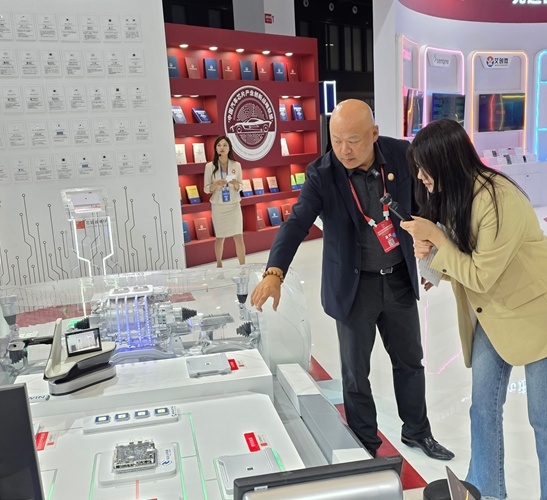
原诚寅:车企芯片全栈自研难闭环,生态构建是智能网联下半场关键
Huan Qiu Wang· 2025-10-17 07:16
Core Insights - The 2025 World Intelligent Connected Vehicle Conference opened in Beijing, focusing on the theme "Gathering Wisdom and Energy, Unlimited Connectivity" [1] - The Secretary-General of the China Automotive Chip Industry Innovation Strategic Alliance emphasized the importance of collaboration between automotive companies and chip manufacturers to meet new demands in the intelligent connected vehicle era [2] Group 1: Collaboration Between Automotive and Chip Companies - Future high-performance, high-security, and highly integrated chips will be developed collaboratively by automotive companies and chip manufacturers [2] - Understanding user needs is crucial for effective chip development, as standalone chip development may not meet user expectations [2][4] - The successful integration of various chips in a vehicle's architecture exemplifies the collaborative efforts between automotive and chip companies based on specific scene requirements [4] Group 2: Trends in Chip Development - The trend of "full-stack self-research" in some leading automotive companies is viewed with caution due to limitations in scale and cost [6] - The scale of vehicle production is insufficient to support a sustainable business model for self-developed chips, as compared to companies like Apple [6][7] - Automotive companies are encouraged to participate in product definition and invest in chip firms rather than pursuing full self-research unless they can achieve significant production volumes [7] Group 3: Key Investment Areas for Intelligent Connectivity - The focus for the second half of intelligent connectivity should be on building a robust industrial ecosystem rather than solely on technological research [9] - The integration of resources, including capital, talent, and technology, is essential for maintaining competitiveness in the automotive industry [9] - Establishing a collaborative ecosystem can enhance the efficiency of technology transfer and reduce individual companies' R&D costs and risks [9]