肉禽饲料

Search documents
促进民营经济高质量发展|搭平台破壁垒,三秦大地涌动创新潮
Ke Ji Ri Bao· 2026-02-11 05:53
Core Viewpoint - The article highlights the significant progress made by Shaanxi Province in supporting the development of the private economy, aiming for a historic increase in its value-added contribution to exceed 50.3% by 2025, thereby playing a crucial role in the province's overall economic landscape [1] Group 1: Policy Initiatives - Shaanxi has prioritized the private economy, with provincial leaders actively engaging in discussions and problem-solving for private enterprises, resulting in the efficient resolution of 326 business challenges through a closed-loop response mechanism [2] - The province has published a comprehensive "Support Policy Handbook" for private enterprises, containing 225 policies that are easily accessible and user-friendly, allowing businesses to find benefits akin to looking up a dictionary [2] - Financial relief measures have been implemented, including a 50% reduction in taxes and fees for small and micro enterprises, creating a market space of nearly 700 billion yuan for small businesses through government procurement [2] Group 2: Innovation and Development - Shaanxi is transforming enterprises from "bystanders" to "innovation partners" by identifying and promoting application scenarios across various sectors, with a total investment of nearly 900 million yuan [4] - The "Chang'an Twelve Hours: Joy of the City" project exemplifies this approach, investing 300 million yuan to create a cutting-edge cultural and technological performance complex, providing clear business opportunities for private enterprises in digital creativity and smart hardware [4] Group 3: Financial Support - To address financing challenges for private and small enterprises, Shaanxi has introduced a combination of "fiscal interest subsidies" and "credit empowerment," with the provincial government providing up to 3.5 percentage points in loan interest subsidies for new projects in manufacturing and high-tech sectors, mobilizing over 23 billion yuan in bank funds [5] - The "Qin Xin Rong" platform has aggregated 120 million credit records, assisting nearly 380,000 businesses in securing over 440 billion yuan in loans, significantly lowering financing barriers [5] Group 4: Systemic Reform and Ecosystem - The support for the private economy in Shaanxi is shifting from traditional management and support to deeper levels of empowerment and co-development, inviting broader societal participation to transform technological and industrial advantages into tangible growth [6]
【省发展改革委】去年陕西民营经济发展活力增强
Shan Xi Ri Bao· 2026-01-22 22:49
Group 1 - The core viewpoint of the news is the significant growth and contribution of the private economy in the province, with its value added to GDP reaching 50.3% by 2025, an increase of 0.8 percentage points from 2024 [1] - The proportion of private enterprises in large-scale industrial enterprises exceeds 80%, highlighting their role as a backbone in stabilizing the industrial sector [1] - Private investment has increased by 4.6% year-on-year, surpassing the national average by 11 percentage points, and the share of private investment in fixed asset investment has risen by 3 percentage points compared to the previous year [1] Group 2 - The establishment of the Private Economy Development Bureau aims to enhance the development mechanism for private enterprises, implementing seven major actions and measures for high-quality development [1] - The "Three-Year" initiative has created a more favorable environment for private enterprises, with over 600,000 total business entities in the province, of which nearly 98% are private [2] - The province's participation in national forums and the promotion of 18 projects seeking private capital indicate a proactive approach to attracting investment [2]
2025年中国肉禽饲料产业产量及企业现状简析:消费端禽肉需求增长推动产量高速增长[图]
Chan Ye Xin Xi Wang· 2025-06-09 02:15
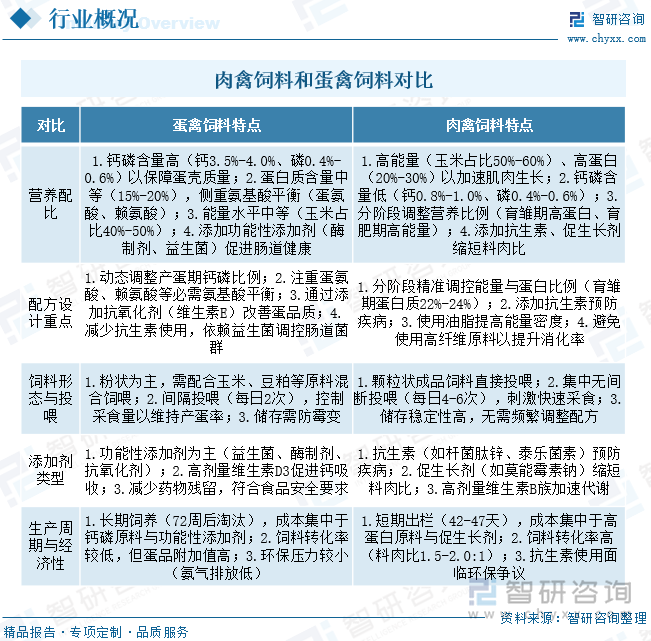
Core Insights - The poultry feed industry in China is experiencing significant growth, driven by the African swine fever's impact, increased penetration of large-scale farming, and advancements in feed formulation technology [1][11] - By 2024, poultry feed production is projected to reach 97.54 million tons, accounting for 75.1% of total poultry feed, indicating strong demand from the consumption side [1][11] Group 1: Industry Overview - Poultry feed is specifically designed to provide essential nutrients for the growth, development, reproduction, and health of meat poultry [2] - The industry focuses on high-energy and high-protein formulations, utilizing pelletized feed for continuous feeding and relying on antibiotics and growth promoters to shorten feed-to-meat ratios [2][4] - The production cycle for meat poultry is typically 42-47 days, while egg-laying poultry has a longer cycle of over 72 weeks [2][4] Group 2: Policy Background - China's poultry feed policies emphasize reducing soybean meal usage, enhancing quality, and optimizing layout, promoting low-protein diets and diversified formulation standards [5] - The government supports local supply chains and high-value transformation through subsidies and technological research, particularly in major soybean-producing regions [5][6] Group 3: Industry Chain - The upstream of the poultry feed industry relies on energy and protein raw materials like corn and soybean meal, with a focus on optimizing raw material structures through reduction technologies [7] - The midstream production is shifting towards functional and customized products, while the downstream sector is accelerating standardization and integration with processing enterprises [7][9] Group 4: Current Industry Status - Since 2012, the poultry feed production has maintained an average annual growth rate of approximately 4.5%, with a notable increase from 2019 to 2024 due to various market dynamics [11] - The concentration of production is primarily in Shandong, Henan, and Guangdong provinces, benefiting from established logistics networks and industrial clusters [11] Group 5: Competitive Landscape - The poultry feed market is characterized by leading enterprises like New Hope, Haida Group, and Wen's Group, which leverage full industry chain integration to enhance competitive advantages [13][15] - New Hope, as a major player, achieved a total feed sales volume of 25.96 million tons in 2024, maintaining a leading position in the domestic market [15] Group 6: Future Trends - The poultry feed industry is moving towards deep integration of biotechnology and automation, focusing on improving feed conversion rates and reducing environmental impacts [17] - The implementation of antibiotic bans is driving the development of alternative products, while smart production technologies are enhancing operational efficiency [17] - Market concentration is expected to continue rising, with leading companies expanding through mergers and acquisitions and focusing on customized services for large-scale farms [17]