脑机接口下肢康复设备

Search documents
当他第一次握住了那颗葡萄——“脑机接口”照进现实
He Nan Ri Bao· 2025-12-08 11:02
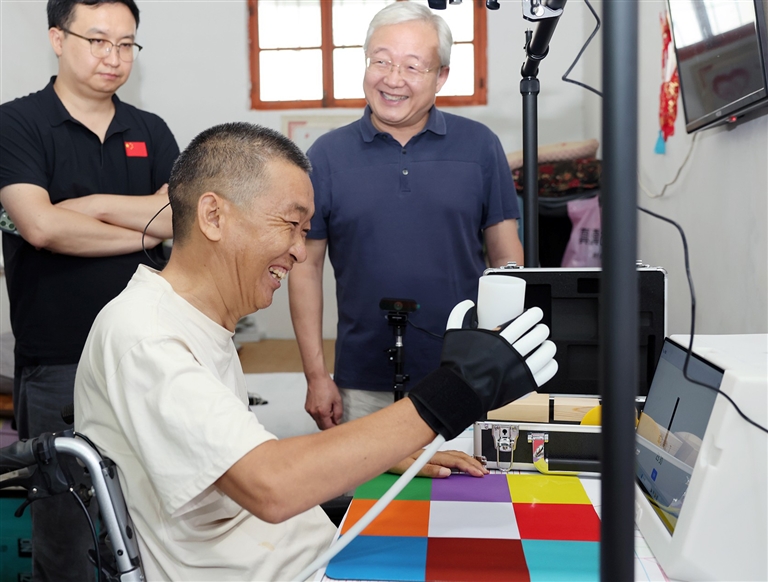
Core Insights - The article highlights the significant advancements in brain-computer interface (BCI) technology, particularly its potential for rehabilitation in patients with motor function impairments due to spinal cord injuries or strokes [1][6]. Group 1: Technological Developments - The brain-computer interface technology is moving towards industrialization, with specific mention of its application in clinical trials in Henan province [1][2]. - A notable clinical trial involved a semi-invasive BCI implanted in a patient, achieving a 95% accuracy rate in decoding motor intentions from brain signals [3][4]. - The technology aims to create a direct communication pathway between the brain and external devices, bypassing damaged spinal pathways [6][7]. Group 2: Clinical Applications - Patients are actively engaged in rehabilitation through BCI, where they can control devices by imagining movements, leading to significant improvements in their motor functions [4][5]. - Over 200 patients have participated in non-invasive BCI rehabilitation programs, demonstrating the technology's effectiveness in restoring motor capabilities [5][11]. Group 3: Research and Development - Collaborative efforts are underway in Henan to advance BCI technology, with partnerships between medical institutions and tech companies focusing on clinical applications and research [9][10]. - The development of BCI technology is seen as a transformative trend in rehabilitation, with ongoing improvements in device comfort and signal acquisition accuracy [9][11]. Group 4: Future Prospects - Experts believe that BCI technology is in its early stages, akin to the "brick phone" era of mobile communication, with expectations for future advancements to lead to more compact, intelligent, and versatile devices [13][14]. - The long-term vision includes establishing clinical standards, developing proprietary BCI devices, and integrating these technologies into comprehensive health management systems [14].
当他第一次握住了那颗葡萄 当“脑机接口”照进现实
He Nan Ri Bao· 2025-12-07 23:45
Core Insights - The article highlights the advancement of brain-computer interface (BCI) technology, which is transitioning from experimental stages to practical applications in rehabilitation for patients with motor disabilities [3][4][6]. - The successful implementation of BCI in clinical trials, particularly in Henan, demonstrates its potential to restore movement in patients with spinal cord injuries and other neurological conditions [6][7][10]. Industry Developments - The "14th Five-Year Plan" emphasizes the strategic importance of BCI technology, indicating a governmental push towards its industrialization [3]. - Clinical trials in Henan have seen significant progress, with patients like Mr. Lv achieving a 95% accuracy rate in decoding motor intentions through BCI systems [7][8]. Technological Mechanisms - BCI technology operates by capturing neural signals from the brain, which are then decoded to control external devices, effectively bypassing damaged spinal pathways [12][13]. - The process involves complex algorithms that translate brain signals into actionable commands, facilitating rehabilitation exercises for patients [12][14]. Clinical Applications - Over 200 patients have engaged in BCI-assisted rehabilitation, showcasing its effectiveness in promoting neural plasticity and improving motor functions [10][14]. - Various BCI devices are being tested, including non-invasive options like EEG caps and invasive systems that require surgical implantation of electrodes [16][17]. Future Prospects - The industry is optimistic about the future of BCI technology, likening its current state to the early days of mobile communication, with expectations for miniaturization and enhanced functionality [18]. - Ongoing research aims to improve the biocompatibility of implanted devices and establish standardized protocols for clinical applications, which are crucial for widespread adoption [17][18].