自主水下机器人

Search documents
“水下大疆”深之蓝闯关科创板,持续亏损下研发投入缩水
Xin Lang Cai Jing· 2026-01-08 00:30
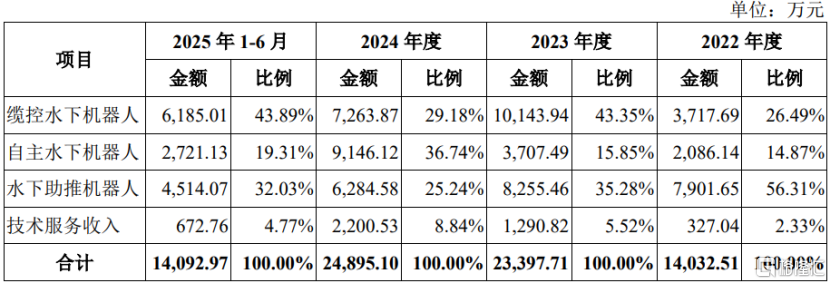
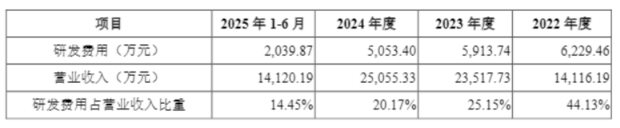
Group 1 - The company, Deep Blue Marine Technology Co., Ltd., known as "the underwater DJI," has submitted its prospectus to the Sci-Tech Innovation Board for an IPO despite ongoing losses and reduced R&D investment [1][3][24] - Established in 2013, the company gained attention for its narrative of breaking foreign monopolies and its involvement in national key projects, positioning itself as a rising star in the capital market [2][24] - However, the company faces multiple challenges, including continuous losses, shrinking R&D investments, product safety incidents, and compliance risks [3][24] Group 2 - Deep Blue's revenue is projected to grow steadily, with expected revenues of 141 million yuan, 235 million yuan, and 251 million yuan from 2022 to 2024, reflecting a compound annual growth rate of 33.23% [4][25] - Despite revenue growth, the company has not achieved profitability, reporting a net loss of 26.29 million yuan in the first half of 2025 and a cumulative undistributed profit of -622 million yuan as of June 2025 [4][25] - To address profitability challenges, Deep Blue opted for the second set of listing standards on the Sci-Tech Innovation Board, which does not require profitability but mandates a market value of at least 1.5 billion yuan and R&D investment accounting for at least 15% of revenue over the last three years [4][25] Group 3 - The company's R&D expenses have shown a significant decline, dropping from 62.29 million yuan in 2022 to 50.53 million yuan in 2024, with the R&D expense ratio decreasing from 44.13% to 20.17% during the same period [5][26] - In the first half of 2025, the R&D expense ratio fell below the critical threshold of 15%, reaching 14.45% [5][27] - The decline in R&D investment is concerning, especially as it may impact the company's ability to meet the cumulative R&D investment ratio required for listing [28] Group 4 - The company's product structure includes three main categories: tethered underwater robots, autonomous underwater robots, and underwater propulsion robots, with the latter being a core product for the consumer market [10][31] - The revenue share from underwater propulsion robots, which was 56.31% in 2022, has significantly decreased, with a 23.87% decline in revenue in 2024 [10][31] - A safety incident involving battery fires in the Mix series underwater propulsion robots has raised concerns about product quality and brand reputation, impacting the company's 2C business growth potential [12][33] Group 5 - Deep Blue's procurement practices have raised questions, particularly regarding the purchase of ROV unmanned boats from a supplier whose main business does not align with ROV production [12][36] - The company's largest customer, Ningbo Xingyu Marine Technology Co., Ltd., is linked to a competitor, raising compliance risk concerns regarding potential collusion in bidding processes [37][42] - The relationship between Deep Blue and its major customers, including shared ownership and participation in joint bids, may lead to scrutiny over compliance and ethical business practices [38][42]

天津冲出一家水下机器人IPO,国防科大80后校友任董事长,预计最早2026年盈利
3 6 Ke· 2025-12-29 13:40
Core Viewpoint - Underwater robots are becoming a significant tool in the digital economy, with the industry expected to grow due to government support and increasing market demand for underwater technology [1][21]. Company Overview - Deep Blue Ocean Technology Co., Ltd. (referred to as "Deep Blue") has submitted its IPO application for listing on the Sci-Tech Innovation Board, with CICC as the sponsor [1]. - The company focuses on the research, production, sales, and service of underwater robot products, projecting revenue of over 250 million yuan in 2024, but is currently operating at a loss [1][21]. Product Breakdown - Deep Blue's main products include cable-controlled underwater robots, autonomous underwater vehicles, underwater gliders, automatic profiling buoys, and underwater propulsion robots [2]. - Revenue contributions from various products in 2024 are as follows: cable-controlled underwater robots (29.18%), autonomous underwater robots (36.74%), underwater propulsion robots (25.24%), and technical services (8.84%) [2]. Financial Performance - Deep Blue's revenue has shown an upward trend, with figures of approximately 141 million yuan in 2022, 235 million yuan in 2023, and a projected 251 million yuan in 2024, but the company has incurred cumulative losses nearing 300 million yuan over three years [9][21]. - The company’s net profit for 2022, 2023, 2024, and the first half of 2025 were approximately -134 million yuan, -92.6 million yuan, -65.8 million yuan, and -2.08 million yuan, respectively [9]. Market Outlook - The global underwater robot market is projected to grow from 9.4 billion USD in 2024 to 12.3 billion USD in 2025, with a compound annual growth rate (CAGR) of approximately 37.29% from 2025 to 2030 [11][12]. - The Chinese underwater robot market is expected to expand from 10.2 billion yuan in 2024 to 14.6 billion yuan in 2025, with a CAGR of about 46.93% from 2025 to 2030 [12]. Competitive Landscape - The underwater robot industry is currently dominated by foreign companies, particularly in high-end cable-controlled and autonomous underwater vehicles, while domestic companies are still in the development phase [15]. - Deep Blue holds advantages in operational scale, product range, and R&D capabilities compared to other domestic private enterprises, leading in the observation and light-duty cable-controlled underwater robot sectors [16]. Management and Structure - Deep Blue was established in 2013 and has a workforce of 444 employees, with 69 in R&D [17][20]. - The company plans to raise approximately 1.5 billion yuan through its IPO to fund the expansion of its underwater robot production base and upgrade its technology research and experimental center [20].

深之蓝冲击科创板,聚焦水下机器人产品,三年累计亏损近3亿
Ge Long Hui· 2025-12-29 11:44
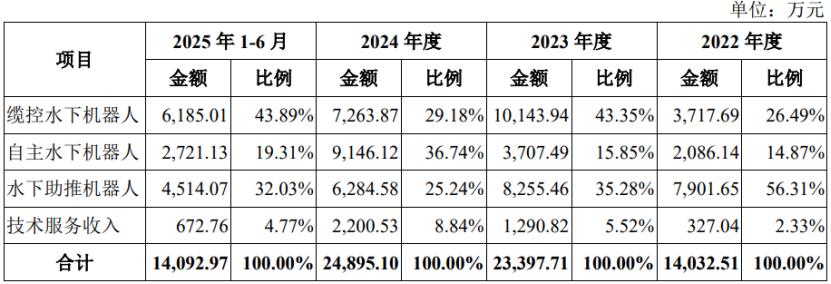
Core Viewpoint - Under the backdrop of the "2025 Government Work Report" designating "deep-sea technology" as a strategic emerging industry, the underwater robotics sector is poised for new growth opportunities, with companies like Deep Blue Ocean Technology Co., Ltd. (referred to as "Deep Blue") recently filing for an IPO [1][28]. Company Overview - Deep Blue primarily engages in the research, development, production, sales, and service of underwater robot products, with projected revenue exceeding 250 million yuan in 2024, although the company is still operating at a loss [1][28]. - The company’s main products include cable-controlled underwater robots, autonomous underwater vehicles, underwater gliders, automatic profiling buoys, and underwater propulsion robots [3][5]. Revenue Composition - In 2024, the revenue breakdown for Deep Blue is as follows: cable-controlled underwater robots (29.18%), autonomous underwater robots (36.74%), underwater propulsion robots (25.24%), and technical services (8.84%) [3][4]. Financial Performance - Deep Blue's revenue has shown an upward trend, with figures of approximately 141 million yuan in 2022, 235 million yuan in 2023, and a projected 251 million yuan in 2024. However, the company has incurred cumulative losses nearing 300 million yuan over three years, with expectations to achieve profitability by 2026 [11][12]. - The company's gross profit margins have been higher than comparable companies, with margins of 35.97%, 41.97%, 38.34%, and 43.96% over the past four years [13][14]. Market Outlook - The global underwater robotics market is expected to grow from 9.4 billion USD in 2024 to 12.3 billion USD in 2025, with a projected compound annual growth rate (CAGR) of approximately 37.29% from 2025 to 2030 [15]. - The Chinese underwater robotics market is anticipated to expand from 10.2 billion yuan in 2024 to 14.6 billion yuan in 2025, with a CAGR of about 46.93% from 2025 to 2030 [15]. Competitive Landscape - The underwater robotics industry is characterized by high prices and customization, with significant competition from established international players like Saab Seaeye and Bluefin Robotics, particularly in high-end applications [19]. - Domestic companies, including Deep Blue, are gradually closing the gap in performance and market presence, supported by national strategies promoting marine technology and local production [19][20]. IPO and Future Plans - Deep Blue plans to raise approximately 1.5 billion yuan through its IPO to fund the expansion of its underwater robot production base, upgrade its technology research and experimental center, and supplement working capital [27].