自动驾驶轨迹规划模型

Search documents
博世最新一篇长达41页的自动驾驶轨迹规划综述
自动驾驶之心· 2025-12-05 00:03
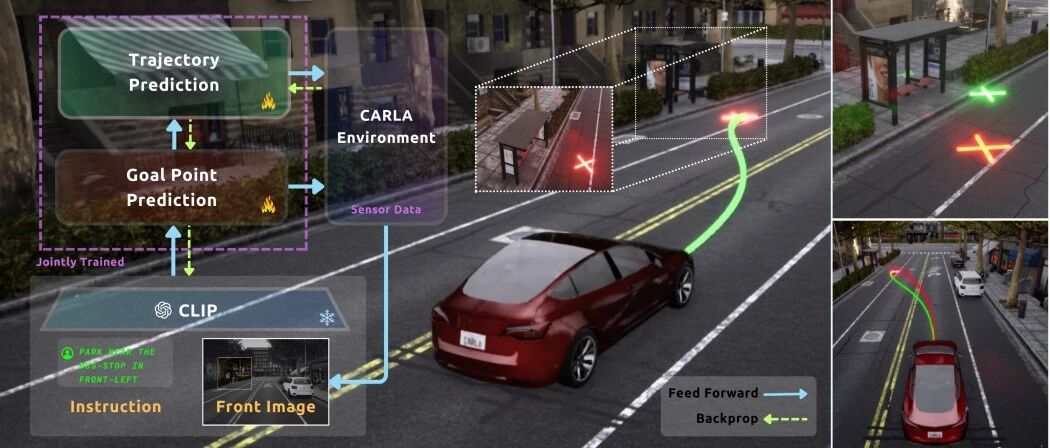
Core Insights - The article discusses the advancements and applications of foundation models (FMs) in trajectory planning for autonomous driving, highlighting their potential to enhance understanding and decision-making in complex driving scenarios [4][5][11]. Background Overview - Foundation models are large-scale models that learn representations from vast amounts of data, applicable to various downstream tasks, including language and vision [4]. - The study emphasizes the importance of FMs in the autonomous driving sector, particularly in trajectory planning, which is deemed the core task of driving [8][11]. Research Contributions - A classification system for methods utilizing FMs in autonomous driving trajectory planning is proposed, analyzing 37 existing methods to provide a structured understanding of the field [11][12]. - The research evaluates the performance of these methods in terms of code and data openness, offering practical references for reproducibility and reusability [12]. Methodological Insights - The article categorizes methods into two main types: FMs customized for trajectory planning and FMs that guide trajectory planning [16][19]. - Customized FMs leverage pre-trained models, adapting them for specific driving tasks, while guiding FMs enhance existing trajectory planning models through knowledge transfer [19][20]. Application of Foundation Models - FMs can enhance trajectory planning capabilities through various approaches, including fine-tuning existing models, utilizing chain-of-thought reasoning, and enabling language and action interactions [9][19]. - The study identifies 22 methods focused on customizing FMs for trajectory planning, detailing their functionalities and the importance of prompt design in model performance [20][32]. Challenges and Future Directions - The article outlines key challenges in deploying FMs in autonomous driving, such as reasoning costs, model size, and the need for suitable datasets for fine-tuning [5][12]. - Future research directions include addressing the efficiency, robustness, and transferability of models from simulation to real-world applications [12][14]. Comparative Analysis - The study contrasts its findings with existing literature, noting that while previous reviews cover various aspects of autonomous driving, this research specifically focuses on the application of FMs in trajectory planning [13][14]. Data and Model Design - The article discusses the importance of data curation for training FMs, emphasizing the need for structured datasets that include sensor data and trajectory pairs [24][28]. - It also highlights different model design strategies, including the use of existing visual language models and the combination of visual encoders with large language models [27][29]. Language and Action Interaction - The research explores models that incorporate language interaction capabilities, detailing how these models utilize visual question-answering datasets to enhance driving performance [38][39]. - It emphasizes the significance of training datasets and evaluation metrics in assessing the effectiveness of language interaction in trajectory planning [39][41].

基于深度强化学习的轨迹规划
自动驾驶之心· 2025-08-28 23:32
Core Viewpoint - The article discusses the advancements and potential of reinforcement learning (RL) in the field of autonomous driving, highlighting its evolution and comparison with other learning paradigms such as supervised learning and imitation learning [4][7][8]. Summary by Sections Background - The article notes the recent industry focus on new technological paradigms like VLA and reinforcement learning, emphasizing the growing interest in RL following significant milestones in AI, such as AlphaZero and ChatGPT [4]. Supervised Learning - In autonomous driving, perception tasks like object detection are framed as supervised learning tasks, where a model is trained to map inputs to outputs using labeled data [5]. Imitation Learning - Imitation learning involves training models to replicate actions based on observed behaviors, akin to how a child learns from adults. This is a primary learning objective in end-to-end autonomous driving [6]. Reinforcement Learning - Reinforcement learning differs from imitation learning by focusing on learning through interaction with the environment, using feedback from task outcomes to optimize the model. It is particularly relevant for sequential decision-making tasks in autonomous driving [7]. Inverse Reinforcement Learning - Inverse reinforcement learning addresses the challenge of defining reward functions in complex tasks by learning from user feedback to create a reward model, which can then guide the main model's training [8]. Basic Concepts of Reinforcement Learning - Key concepts include policies, rewards, and value functions, which are essential for understanding how RL operates in autonomous driving contexts [14][15][16]. Markov Decision Process - The article explains the Markov decision process as a framework for modeling sequential tasks, which is applicable to various autonomous driving scenarios [10]. Common Algorithms - Various algorithms are discussed, including dynamic programming, Monte Carlo methods, and temporal difference learning, which are foundational to reinforcement learning [26][30]. Policy Optimization - The article differentiates between on-policy and off-policy algorithms, highlighting their respective advantages and challenges in training stability and data utilization [27][28]. Advanced Reinforcement Learning Techniques - Techniques such as DQN, TRPO, and PPO are introduced, showcasing their roles in enhancing training stability and efficiency in reinforcement learning applications [41][55]. Application in Autonomous Driving - The article emphasizes the importance of reward design and closed-loop training in autonomous driving, where the vehicle's actions influence the environment, necessitating sophisticated modeling techniques [60][61]. Conclusion - The rapid development of reinforcement learning algorithms and their application in autonomous driving is underscored, encouraging practical engagement with the technology [62].