英伟达Alpamayo自动驾驶AI

Search documents
AI浪潮席卷下,金属资源迎来“算力时代”价值重估?
Xin Lang Cai Jing· 2026-01-07 11:02
Group 1 - The core viewpoint highlights the deep integration of technology and upstream resources, marking the beginning of a new era in the global industrial value chain, driven by the release of Nvidia's Vera Rubin superchip and the surge in metal prices like copper and nickel [1][2] - The demand for metals is significantly increasing due to technological innovations, with copper becoming a strategic resource in the AI era, as a high-end AI server requires 15-20 kg of copper, three times that of traditional servers [1][2] - The semiconductor industry is experiencing a global resonance, evidenced by the significant trading volume in the photoresist sector and the stock performance of companies like SanDisk and Micron, indicating a robust interconnection within the semiconductor supply chain [2] Group 2 - Supply-demand imbalances are exacerbating the revaluation of metals, with global copper demand projected to surge by 45% in 2026, while new copper mine production is only expected to grow by 1.4%, leading to a supply gap of over 300,000 tons [2] - The market is witnessing a long-term industrial transformation, with the "chip war" in the tech sector and the "resource competition" in the metals market clearly outlining the core trajectory of global industrial upgrades [3] - Companies that can accurately grasp the direction of technological upgrades and strategically position themselves in core metal resources are likely to gain a competitive advantage in this value revaluation [3]


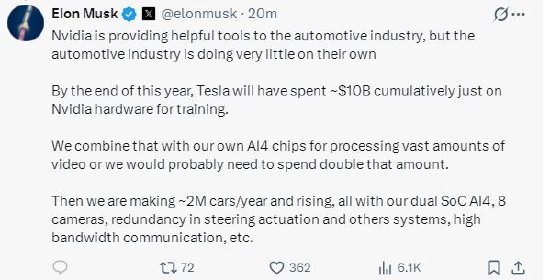
马斯克再评论英伟达自动驾驶AI:为汽车行业提供有用的工具
Xin Lang Cai Jing· 2026-01-06 23:39
Core Viewpoint - The release of NVIDIA's Alpamayo autonomous driving AI is not seen as a competitive threat to Tesla's Full Self-Driving (FSD) system, as the tools provided are primarily for aiding the development of Advanced Driver Assistance Systems (ADAS) rather than being fully functional systems themselves [1][4][5] Group 1: NVIDIA's Role and Tools - NVIDIA has released multiple generations of ADAS development kits and tools, which are intended to assist in the ADAS development process rather than serve as complete systems [1][4] - If companies successfully adopt these technologies and develop their own ADAS systems, it could be beneficial for the industry as a whole [1][4] - The construction of systems similar to FSD remains a highly complex, resource-intensive, and commercially risky endeavor, making it a significant achievement for any company to accomplish [1][5] Group 2: Tesla's Investments and Production - By the end of this year, Tesla's cumulative investment in NVIDIA hardware for training will reach approximately $10 billion [2][5] - Tesla combines this investment with its own AI4 chip to process large volumes of video data, potentially saving costs that could otherwise be double [2][5] - Tesla produces around 2 million vehicles annually, all equipped with dual SoC AI4 chips, eight cameras, steering control, and other redundant systems, indicating a robust and growing production capacity [2][5]