
苹果C1基带芯片

Search documents
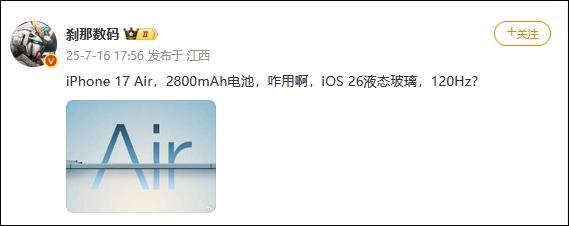
梦回十年前?苹果新手机电池被曝只有2800mAh
Guan Cha Zhe Wang· 2025-07-22 09:04
Core Viewpoint - The upcoming iPhone 17 Air is expected to have a battery capacity of only 2800mAh, which is lower than previous models and may lead to poor battery life, raising concerns among consumers [1][3][5] Group 1: Battery Capacity and Design - iPhone 17 Air's battery capacity of 2800mAh is less than the iPhone 7 Plus's 2900mAh and significantly lower than the iPhone 16 Plus's over 4000mAh [3] - The device's ultra-thin design at approximately 5.5mm is cited as the primary reason for the reduced battery size, which may negatively impact daily usage [3][4] - Reports suggest that only 60% to 70% of users may be able to use the iPhone 17 Air for a full day without charging, compared to 80% to 90% for other recent models [3][4] Group 2: Technical Specifications - iPhone 17 Air will feature a 120Hz display, A19 processor, 12GB of RAM, and a 48MP single rear camera, with iOS 26 pre-installed [3] - The device will not include a physical SIM card slot, opting for eSIM technology to save internal space [4] Group 3: Market Reception and Expectations - The announcement of a phone with a 2800mAh battery has led to disappointment in the market, with some questioning Apple's design logic [5] - There are concerns that heavy users may need to carry a power bank due to the low battery capacity, undermining the device's portability [5] - Analysts note that with advancements in battery technology, Apple could have increased the battery capacity by making the device slightly thicker [5]


C1基带实测网速拉胯 高通(QCOM.US)借第三方报告反击苹果(AAPL.US)“去高通化”
智通财经网· 2025-05-28 00:18
Core Insights - Qualcomm's baseband chip performance surpasses Apple's self-developed C1 chip, particularly benefiting users in densely populated urban areas [1] - Apple's C1 chip, while adequate in ideal conditions, significantly lags in real-world scenarios that highlight the advantages of next-generation baseband technology [1][2] - Qualcomm anticipates a complete revenue loss from Apple as the latter aims to replace Qualcomm's components across its product line [2] Group 1: Performance Comparison - The first iPhone 16e with Apple's C1 baseband underperformed in download and upload speeds compared to Qualcomm-equipped Android devices in a T-Mobile 5G network in New York City [1] - Research indicates that Qualcomm's Android devices can achieve download speeds up to 35% faster and upload speeds up to 91% faster than the C1 chip [2] - The report noted that the iPhone exhibited overheating and screen brightness reduction after two minutes of testing, although it did not clarify the impact on everyday communication quality [2] Group 2: Strategic Implications - Apple's long-term strategy involves replacing Qualcomm's products with its own self-developed technology, which has been a gradual process over several years [1][3] - Qualcomm emphasizes the complexity of baseband technology development, asserting its ability to simulate various network conditions to ensure stable chip performance [3] - Apple's vertical integration strategy has led to the incorporation of self-developed processors across its product range, enhancing functionality and cost control [3]
