触觉手套

Search documents
纤维芯片来了 衣服能变成随身电脑?
Ke Ji Ri Bao· 2026-02-02 01:18
Core Insights - The development of flexible fiber chips represents a significant breakthrough in the field of electronics, enabling the integration of information processing capabilities directly into fibers, thus addressing the limitations of traditional rigid silicon-based chips [1][2][6] Group 1: Technology and Innovation - The research team from Fudan University has successfully created a new type of information processor called fiber chips, which are highly flexible and can adapt to complex deformations, making them suitable for applications in brain-machine interfaces, electronic textiles, and virtual reality [1][2] - The innovative design approach involves a "multi-layer stacking architecture" that allows for the integration of a large number of transistors within the fiber, potentially exceeding the transistor count of traditional computer processors [2][3] - The team has achieved a high-density integration of 100,000 transistors per centimeter within the fibers, enabling both digital and analog circuit functionalities [3] Group 2: Manufacturing Process - The research team developed a novel fabrication method that allows for direct photolithography on elastic polymer fibers, overcoming challenges related to the rough surface and deformation of the fibers [3][4] - This new method is compatible with existing chip manufacturing processes, allowing for scalable production of fiber chips [4] Group 3: Applications and Future Prospects - The fiber chips are expected to facilitate the transition from embedded to woven smart systems, with potential applications in electronic textiles that integrate power generation, storage, sensing, display, and information processing [5][6] - In the field of brain-machine interfaces, the fiber chips can integrate high-density sensing and stimulation electrode arrays along with signal preprocessing circuits, enhancing the safety and efficacy of implanted devices [6] - The research team aims to collaborate with scholars from various disciplines to further enhance device integration density and information processing performance, while establishing a proprietary intellectual property system for broader industrial applications [7]
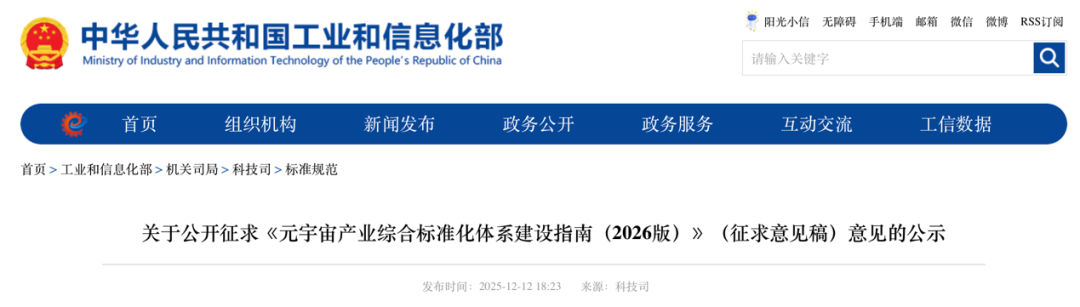
事关元宇宙产业!工信部公开征求意见
Zhong Guo Ji Jin Bao· 2025-12-12 12:38
Core Viewpoint - The Ministry of Industry and Information Technology (MIIT) has released a draft for public consultation on the "Guidelines for the Construction of a Comprehensive Standardization System for the Metaverse Industry (2026 Edition)", aiming to establish a standard system to support the innovative development of the metaverse industry by 2028 [1][2]. Summary by Sections Industry Overview - The metaverse is described as an immersive interconnected space that integrates digital and physical worlds, characterized by high immersion, real-time continuity, autonomous creation, and open interconnectivity. It plays a crucial role in promoting the high-end, intelligent, and green transformation of the manufacturing industry and improving the modern industrial system [9]. Overall Requirements - By 2028, the goal is to formulate over 20 national and industry standards to establish a foundational standard system for the metaverse industry. By 2030, this number is expected to exceed 50, with a focus on key standards that support high-quality future industrial development and promote the globalization of the metaverse industry [3][11]. Construction Ideas - The metaverse industry standard system will consist of six parts: 1. Basic Standards 2. Supporting Capability Standards 3. General Service Standards 4. Application Standards 5. Development and Operation Standards 6. Security and Governance Standards [10][11]. Construction Content - **Basic Standards**: Include terminology and definitions, reference architecture, classification and identification, management, and testing and evaluation standards [4][17]. - **Supporting Capability Standards**: Focus on infrastructure and enabling technologies, including standards for intelligent terminals, new networks, computing power, trusted storage, and data [5][19]. - **General Service Standards**: Cover standards for digital entities, digital identities, digital content, digital assets, digital scenes, and digital-physical interaction [6][20]. - **Application Standards**: Specify requirements for the application of the metaverse in various fields such as industry, culture and tourism, broadcasting, education, social interaction, healthcare, commerce, emergency response, sports, and urban management [6][21][22]. - **Development and Operation Standards**: Include standards for design and development, system integration, and service operation [6][23]. - **Security and Governance Standards**: Address security requirements throughout the lifecycle of technologies, products, systems, applications, and services, as well as compliance requirements [6][24]. Safeguard Measures - Emphasize the need for coordinated efforts to establish a standardization technical organization in the metaverse field, involving various stakeholders from industry, academia, and research to collaboratively advance standard formulation. It also highlights the importance of international cooperation to participate in global standardization activities [25].