
创新驱动发展战略

Search documents
社保基金又出手了!100亿科创基金落地上海
FOFWEEKLY· 2026-03-25 08:39
Core Viewpoint - The establishment of the Guotou Science and Technology Innovation Fund, with a scale of 10 billion yuan, is a significant step in promoting innovation-driven development and enhancing the financial services for technology in Shanghai [1] Group 1: Fund Establishment and Scale - The Guotou Science and Technology Innovation Fund is jointly established by the National Social Security Fund Council, National Development Investment Group, and several banks and investment companies, with a total scale of 10 billion yuan [1] - Since 2025, the National Social Security Fund Council has signed provincial-level social security science and technology innovation funds in various provinces, with a total initial scale of approximately 160 billion yuan [1] Group 2: Fund Focus and Objectives - The Guotou Science and Technology Innovation Fund aims to leverage long-term capital to support the development of new productive forces and modern industrial systems in Shanghai [1] - The fund will focus on expanding cooperation in equity investment funds and major strategic projects, establishing a new benchmark for cooperation between central and local governments [1] Group 3: Provincial Fund Developments - Zhejiang's social security science and technology innovation fund, with an initial scale of 50 billion yuan, aims to attract social capital into key innovation areas [2] - Jiangsu's fund, also with a scale of 50 billion yuan, focuses on national strategic emerging industry clusters and advanced manufacturing [2] - Hubei's fund, with a scale of 20 billion yuan, targets specific industries such as optoelectronics and automotive manufacturing [2] - Sichuan's fund, with a scale of 20 billion yuan, supports key technology breakthroughs and industrialization [2] - Fujian's fund, with a scale of 20 billion yuan, aligns with national industrial policies and focuses on artificial intelligence and high-end manufacturing [3]





100亿,社保基金落子上海
母基金研究中心· 2026-03-25 01:57
Group 1 - The National Social Security Fund (NSSF) is collaborating with various local governments to establish innovation-driven funds, with a total scale of 100 billion yuan for the Guotou Science and Technology Innovation Fund in Shanghai [2] - The Zhejiang Social Security Innovation Fund has been established with an initial scale of 50 billion yuan, focusing on key industries such as artificial intelligence and biomedicine [3] - The Fujian (Xiamen) Social Security Innovation Fund has been launched with an initial scale of 20 billion yuan, managed by Xiamen Chuangtou [3] - The Jiangsu Social Security Innovation Fund has been approved with a scale of 50 billion yuan, adopting a dual-layer management structure [3] - The Hubei Social Security Innovation Fund has been established with a scale of 20 billion yuan, targeting industries like optoelectronics and automotive manufacturing [4] - The Sichuan Social Security Innovation Fund has been signed with an initial scale of 20 billion yuan, focusing on strategic emerging industries [4] Group 2 - The entry of social security funds is expected to attract more private capital towards national strategic industries, providing stable funding support for technology enterprises with long innovation cycles [5]

日发精机(002520) - 2026年3月4日至6日投资者关系活动记录表
2026-03-09 09:02
Group 1: Company Overview - Zhejiang Rifa Precision Machinery Co., Ltd. is actively responding to the national innovation-driven development strategy by increasing R&D investment and promoting key technology breakthroughs, establishing a competitive advantage in the bearing equipment sector [2][3]. - The company has achieved a leading market share in China's bearing manufacturing equipment sector and is recognized as a significant supplier in the global bearing industry [2][3]. Group 2: Product Development - The company has made progress in its CNC thread grinding equipment, which is used for high-precision screw rods and nuts in industries such as new energy vehicles and industrial automation [3]. - Contracts and strategic partnerships have been signed with clients like Best, Wuzhou Xinchun, and Sanlian Forging, while ongoing technical exchanges are being conducted with potential clients [3]. Group 3: Future Plans - The company plans to continue focusing on core R&D, improving product details, optimizing process verification, and enhancing machine tool quality to accelerate product transformation and increase market competitiveness [4].

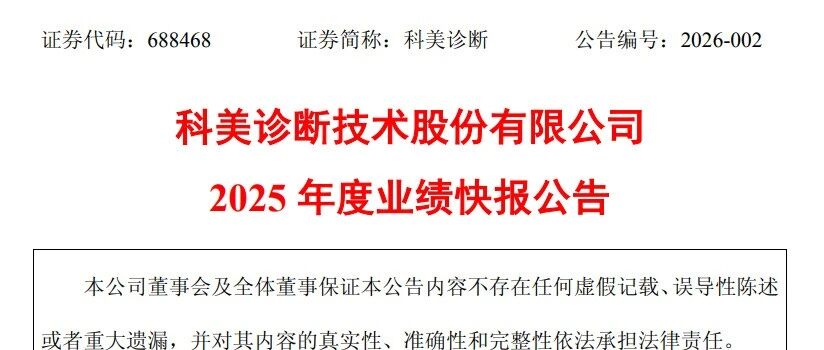
收入3.33亿,净利润下降65%,科美诊断发布业绩快报
思宇MedTech· 2026-03-01 08:16
Core Viewpoint - The company experienced significant declines in both revenue and profit during the 2025 fiscal year, primarily due to intensified industry procurement and increased expenditure [1][3]. Financial Overview - The company reported total revenue of 333 million yuan, a year-on-year decrease of 23.75% - The net profit attributable to shareholders was 44 million yuan, down 65.05% year-on-year - The net profit after deducting non-recurring gains and losses was 28 million yuan, a decline of 72.06% year-on-year - Operating profit decreased by 62.65%, while total profit fell by 63.45% - Basic earnings per share were 0.11 yuan, down 65.63% year-on-year - The weighted average return on equity dropped to 3.14%, a decrease of 6.04 percentage points from the previous year [3][5]. Business Analysis - The decline in performance was influenced by three main factors: 1. The nationwide implementation of centralized procurement in in vitro diagnostics, leading to sustained price pressure on core products, directly affecting main business revenue 2. Increased investment in innovation, with R&D expenses remaining high, further compressing profit margins amid declining revenue 3. A year-on-year reduction in government subsidies and other non-recurring gains, which added additional pressure on net profit [6][7]. Financial Structure - As of the end of 2025, total assets amounted to 1.76 billion yuan, a year-on-year decrease of 3.85% - Shareholders' equity attributable to the parent company was 1.41 billion yuan, down 0.35% year-on-year - The overall asset scale slightly contracted, but shareholder equity remained stable, with net assets per share at 3.52 yuan, a minor decrease of 0.28% [8]. Development Outlook - In response to changes in the industry environment, the company will continue to adhere to an innovation-driven development strategy, leveraging its proprietary LiCA® technology platform to advance a dual approach of "import substitution + clinical innovation" [9][10].

迎接全国两会特稿|向新:科技创新展现硬核实力
Jing Ji Ri Bao· 2026-02-28 02:18
Group 1 - China's technological innovation achievements have shown significant progress, including breakthroughs in manned lunar missions and advancements in high-temperature superconducting technology [1][3] - The "14th Five-Year Plan" has seen a steady increase in R&D investment, with an average annual growth rate of 10%, aiming for a R&D intensity of 2.8% by 2025, surpassing the OECD average [3][4] - The establishment of a national laboratory system and the reorganization of key laboratories have strengthened China's strategic scientific capabilities, with the total number of R&D personnel ranking first globally [4][5] Group 2 - The dual empowerment of technological innovation and industrial upgrading has been pivotal in forming new productive forces, driving high-quality economic development [5][6] - China has made significant strides in traditional industries transitioning to high-end, intelligent, and green production, with notable achievements in various sectors such as construction and mining [5][6] - The rapid development of strategic emerging industries and future industries has effectively compensated for growth gaps caused by traditional industry adjustments, supporting macroeconomic stability [6][7] Group 3 - The "15th Five-Year Plan" is a critical phase for building a strong technological nation, focusing on enhancing the overall effectiveness of the national innovation system and increasing independent innovation capabilities [7][8] - By 2025, the proportion of basic research funding is expected to reach 7.08%, with China leading in high-level international journal publications and patent applications [7][8] - The cultivation of over 600,000 technology and innovation SMEs and 50,400 high-tech enterprises is crucial for stabilizing the industrial supply chain [8]
邱锐:在更高起点上建设国际科技创新中心
Xin Lang Cai Jing· 2026-02-27 17:29
Core Viewpoint - The construction of international technology innovation centers in Beijing, Shanghai, and the Guangdong-Hong Kong-Macao Greater Bay Area is aimed at accelerating the formation of China's primary sources of original innovation, serving as a strategic guide for building a technology-driven strong nation and setting a benchmark for modernization supported by technology [1][3]. Group 1: Achievements in International Technology Innovation Centers - The international technology innovation centers are characterized by concentrated innovation resources, strong research capabilities, and advanced technology innovation culture, playing a crucial role in global technology development [2]. - Since the 18th National Congress, significant progress has been made in enhancing national strategic technology strength and original innovation capabilities in Beijing, Shanghai, and Guangdong, with R&D investment intensities reaching 6.58%, 4.35%, and 3.6% respectively in 2024 [3]. Group 2: Strategic Significance of Expanding Innovation Centers - The expansion of international technology innovation centers is a strategic decision by the central government to optimize the spatial layout and organizational model of the national innovation system, facilitating smoother connections in research, technology breakthroughs, and industrial applications [7]. - The expansion is essential for enhancing original innovation capabilities and creating a comprehensive innovation ecosystem that integrates basic research, technology breakthroughs, and industrial transformation [8]. Group 3: Enhancing Global Competitiveness - The expansion of innovation centers will help gather and allocate global innovation resources, increasing the attractiveness to international high-end talent and major research projects [9]. - The construction of these centers aims to create a model for innovation practices that align with Chinese-style modernization, facilitating breakthroughs in technology self-reliance and high-level openness [9]. Group 4: Systematic Advancement of Innovation Center Capabilities - The three major innovation centers must leverage regional advantages and enhance collaborative efforts to improve their core competitiveness and global influence [10]. - Fostering deep integration between technology and industry is crucial for reshaping industrial structures and leading development directions [11]. Group 5: Global Innovation Resource Configuration - The centers need to transition from "element aggregation" to "element hub" by creating a more internationalized and law-based innovation environment, enhancing their ability to attract global innovation entities [12]. - Active participation in international standard-setting and global technology governance is necessary to enhance the influence of China's innovation centers [13]. Group 6: Cultural and Soft Power Development - The competition among international technology innovation centers also involves innovation culture and academic reputation, necessitating the creation of an environment that respects science and encourages innovation [14]. - Building a robust talent evaluation system and enhancing support for young scientific talents are essential for establishing a competitive talent system [14].
中国气象局党组专题部署开年及“十五五”开局工作时强调以开满弓上满弦的精神状态 推动各项工作开好头起好步
Xin Lang Cai Jing· 2026-02-25 12:52
Core Viewpoint - The China Meteorological Administration (CMA) emphasizes the importance of enhancing responsibility and urgency in achieving the goals set for the year and the 14th Five-Year Plan, aiming for effective implementation of the Central Committee's decisions [1] Group 1: Key Work Focus Areas - The CMA will focus on providing robust meteorological services, especially during the flood season, by improving monitoring and early warning systems for extreme weather events [2] - The CMA aims to implement an innovation-driven development strategy, enhancing meteorological technology to support the effective start of the 14th Five-Year Plan, including organized scientific research and talent development [2] - The CMA will strengthen political self-awareness in party conduct and governance, ensuring strict supervision and accountability, particularly for key positions [3] Group 2: Educational and Development Initiatives - The CMA will conduct educational initiatives to promote a correct view of performance, linking it to high-quality meteorological development and risk prevention strategies [3] - The CMA plans to integrate risk management into all operations, maintaining a focus on bottom-line and extreme thinking as foundational principles [3]
奋起直追做强科技创新硬支撑
Xin Lang Cai Jing· 2026-02-24 22:23
Core Viewpoint - Guizhou province emphasizes the importance of technology innovation and aims to strengthen its innovation-driven development strategy to support high-quality economic growth [1][2] Group 1: Technology Innovation Focus - The "New Spring First Meeting" sets a clear direction for building technology innovation platforms, signaling a strong commitment to prioritize technology innovation as a core driver for industrial upgrading and economic vitality [1] - The meeting highlights the need for Guizhou to enhance its original innovation capabilities and become a strong engine for industrial development through effective technology innovation platform construction [1] Group 2: Industry Alignment - Guizhou's economic development is focused on new opportunities and sectors, with "six major industrial clusters" and "three characteristic industries" identified as key areas for deep integration of technology and industry innovation [2] - The strategy emphasizes aligning technology innovation efforts with industry demands, ensuring that innovation resources are concentrated where they are most needed [2] Group 3: Practical Approach - The meeting combines on-site research with motivational discussions to foster a collaborative environment among government, market, and social forces, aiming for breakthroughs in specific areas that will drive broader progress [2] - The focus on practical and results-oriented approaches is crucial for achieving significant advancements in technology innovation and overall economic development [2]
学习规划建议每日问答丨加紧国防科技创新和先进技术转化需要把握哪些重点
Xin Hua She· 2026-02-18 04:06
Group 1 - The core viewpoint emphasizes the necessity of accelerating defense technology innovation and the transformation of advanced technologies to maintain military competitiveness and modernize the armed forces [1] - The importance of science and technology as the core combat capability is highlighted, with advancements in various strategic high-tech fields such as artificial intelligence, big data, and quantum technology significantly impacting military development [2] - The need for independent and original innovation in defense technology is stressed, as core military technologies cannot be purchased, and there is a focus on optimizing the innovation environment and accelerating breakthroughs in key technologies [3] Group 2 - The article discusses the importance of effectively converting advanced technological achievements into combat capabilities, addressing the slow conversion rates and long cycles currently faced [4] - It emphasizes the necessity of aligning technological innovation with military development to enhance the speed of transformation and reduce the time required to generate combat capabilities [4] - The need for a comprehensive approach to improve the management and operational mechanisms of technology innovation is outlined, including the establishment of a robust evaluation system and policy reforms to facilitate rapid conversion of technological achievements [4]
基于aβγδ经济动力结构模型的中国经济改革历程分析
Jing Ji Guan Cha Bao· 2026-02-16 15:34
Core Insights - The article introduces the aβγδ economic dynamic structure model, which integrates various dimensions of economic reform in China, emphasizing the need for a comprehensive analytical framework to understand the structural transformations and collaborative logic behind the reforms [1][2]. Group 1: Economic Dynamic Structure Model - The aβγδ model posits that sustainable socio-economic development results from the organic combination and dynamic evolution of four driving forces: a (production factors), β (operational mechanisms), γ (innovation systems), and δ (systemic synergy) [2]. - Successful transformation is characterized by the sequential evolution of dominant forces (a→β→γ) and the continuous support of δ coupling throughout the process [2]. Group 2: Stages of China's Economic Reform - **First Stage: Reform Initiation and Exploration (1978-early 1990s)** - The focus was on activating a dynamics by restructuring the dual link of production factors, releasing suppressed foundational vitality, with δ coupling primarily based on "mutual adaptability" [3][5]. - **Second Stage: Market Economy System Construction (early 1990s-early 2010s)** - This stage established the β framework and empowered a upgrades, with key developments including: - a dynamics: The core is the capacity for output proliferation through the combination of production factors and their relationships [4]. - β dynamics: This refers to the ability to maintain stable and efficient resource allocation through market and governance mechanisms [4]. - γ dynamics: It represents the evolutionary capacity to break path dependence and achieve qualitative leaps through diverse innovation entities [4]. - δ dynamics: This involves the synergy of the three dynamics, ensuring stability, continuity, and efficiency in the reform process [4][9]. - **Third Stage: High-Quality Development (2010s-present)** - The focus shifted to innovation-driven growth, addressing challenges of traditional growth models, with δ coupling emphasizing "systemic and contradiction transformation" [7]. Group 3: Theoretical Insights and Policy Implications - The study highlights the importance of systematic thinking and structural awareness in promoting sustainable economic development, advocating for a precise understanding of dominant dynamics (currently γ) while reinforcing a foundations and improving β environments [8]. - The sequential evolution of dynamic structures reflects the internal logic of addressing survival, development, and future challenges, while δ coupling serves as a stabilizer and amplifier for successful reforms [9].