
话剧《金中都》

Search documents
京产大戏 新作佳作耀舞台
Xin Lang Cai Jing· 2025-12-24 22:53
Core Viewpoint - The article highlights the flourishing stage productions in Beijing, showcasing the city's rich cultural heritage and contemporary themes, while emphasizing the integration of performing arts with tourism and commerce [1][8]. Group 1: Cultural Heritage and Thematic Exploration - Beijing's stage creations are deeply rooted in its cultural soil, utilizing various art forms to explore themes related to the city's history and traditions [3][4]. - Notable works include the original play "Jin Zhong Du," which focuses on historical events, and adaptations like "Luo Tuo Xiang Zi," which revives classic narratives from old Beijing [3][4]. - Productions also reflect modern Beijing's vibrancy, such as "Yi Ri Ding Liu," which discusses artificial intelligence, and "Yuan Fang De La Sa He," based on real stories of aid workers [4] Group 2: Commemorative Works - A significant number of productions commemorate historical events, such as the 80th anniversary of the victory in the Anti-Japanese War, with works like "Ye Huo Chun Feng Dou Gu Cheng" and "Hong Gao Liang" [6][7]. - These productions aim to evoke national memory and resonate with contemporary audiences, reflecting on themes of resistance and identity [6][7]. Group 3: Awards and Market Performance - Beijing's cultural institutions have achieved notable recognition, with multiple awards at the 18th Wenhua Awards, indicating a strong foundation for stage creation [8]. - From January to September, the city hosted approximately 45,000 performances, attracting over 11.23 million attendees and generating ticket sales exceeding 4.198 billion yuan, reflecting a healthy demand for performing arts [8].


话剧《金中都》演绎“迁都”壮举:“混同华夏”的理想与现实
Xin Lang Cai Jing· 2025-12-20 00:32
Core Viewpoint - The original play "Jin Zhong Du" premiered at the National Centre for the Performing Arts, marking the beginning of the "Beijing Capital Trilogy," which explores the historical significance of the Jin Dynasty's capital relocation to Beijing [1][16]. Historical Context - The play focuses on the historical event of the Jin Dynasty's capital relocation in 1153, led by Emperor Wanyan Liang, who moved the capital from Shangjing to Yanjing (modern-day Beijing) [2][3]. Cultural Significance - "Jin Zhong Du" illustrates the transformation of Beijing from a city to a capital, emphasizing the cultural and ethnic integration during the Jin Dynasty [3][14]. - The play aims to reflect the historical and cultural lineage of Beijing, showcasing its evolution over 3,000 years and 870 years as a capital [3][16]. Dramatic Elements - The play consists of 10 acts, depicting key moments in Wanyan Liang's life, including his ascension to the throne, reforms, and the challenges faced during the capital relocation [8][12]. - The character of Wanyan Liang is portrayed as both a visionary leader and a tyrant, highlighting the complexities of his rule and the historical implications of his decisions [10][12]. Artistic Presentation - The production features meticulous costume and set design, reflecting the cultural fusion between the Jurchen and Han Chinese, and aims to create a visually immersive experience for the audience [13][14]. - The stage design incorporates significant historical symbols and visual elements to convey the grandeur of the capital relocation event [13][14]. Conclusion - "Jin Zhong Du" serves as a cultural artifact that encapsulates the historical narrative of Beijing's rise as a capital, contributing to the understanding of China's multi-ethnic and unified civilization [16].
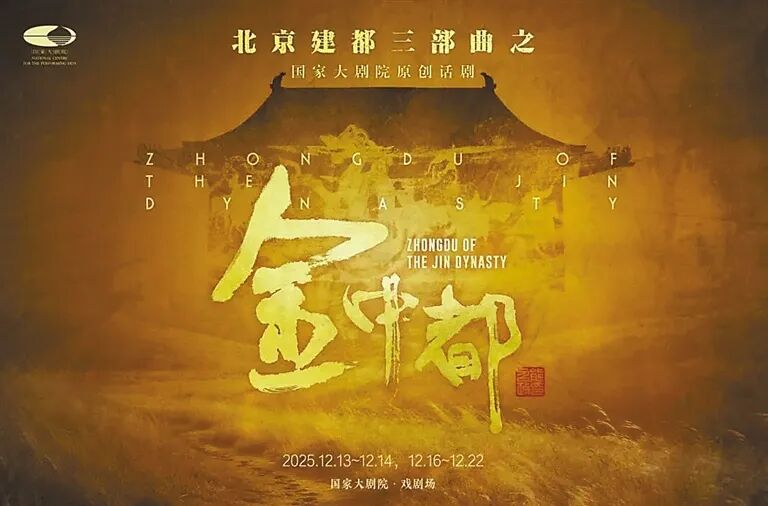
打卡北京文化金名片!国家大剧院原创话剧《金中都》走进金中都公园
Bei Jing Qing Nian Bao· 2025-11-20 04:48
Core Viewpoint - The National Grand Theatre's original play "Jin Zhong Du" is set to showcase the historical evolution of Beijing from a northern stronghold to a capital city, with performances scheduled from December 13 to 22 [1] Group 1 - The play "Jin Zhong Du" is part of the National Grand Theatre's "Beijing Capital Trilogy," which will also include "Yuan Da Du" and "Forbidden City" [1] - The historical exhibition at the Jin Zhong Du Park highlights the period from 1153, when Jin Zhong Du was established, to 1215, when it fell [1] - The media preview event featured historical consultant Li Jianping, who provided insights into the play's historical context [1]
