
豫芝ND837

Search documents
良种筑粮仓 油香入春馐——我国特色油料种业发展取得积极进展
Huan Qiu Wang· 2026-02-27 02:32
Core Viewpoint - The development of specialty oilseed industry in China is crucial for ensuring food oil supply security, with significant advancements in breeding, technology innovation, and variety promotion contributing to improved agricultural productivity and farmer satisfaction [1] Group 1: Seed Quality Innovation - Breakthrough innovations in sesame breeding have led to the creation of new varieties that significantly reduce harvest losses and labor costs, with machine harvesting loss rates dropping to around 5% compared to over 60% for traditional varieties [2] - The introduction of high oil content sesame varieties, such as '豫芝HO995' with 79% oil acid content, marks a significant advancement in both yield and quality [2] - The establishment of a comprehensive innovation system for oilseed breeding has positioned China as a global leader in sesame, sunflower, and flax production [3] Group 2: Economic Impact and Adoption - The planting area for machine-harvestable sesame varieties in Henan Province is expected to exceed 150,000 acres by 2025, doubling previous figures and enhancing the regional brand '项城白芝麻' [4] - The total industrial output value of sunflowers in Inner Mongolia has reached 19 billion yuan, with a 100% adoption rate of quality seeds [4] - The implementation of mechanized production models has resulted in significant economic benefits, with over 540,200 acres of sesame cultivated under this system, generating additional social and economic benefits exceeding 1.717 billion yuan [4] Group 3: Future Prospects - The ongoing "Fifteen Five" period is seen as critical for solidifying the foundation of seed industry revitalization, with a focus on breakthrough seed quality creation and major variety cultivation [5] - The technology and varieties developed are attracting international interest, with countries like Ethiopia, Tanzania, Nigeria, and Brazil expressing interest in introducing these innovations [4][5]
河南芝麻产业为啥“节节高”
He Nan Ri Bao· 2025-10-29 23:43
Core Insights - The traditional manual harvesting methods for sesame are labor-intensive and inefficient, leading to a significant limitation in planting area and high costs for farmers [1][5][6] - Despite being the largest producer and consumer of sesame, China faces a paradox of high demand and shrinking planting areas, with a notable increase in import dependency [3][4][11] Group 1: Market Dynamics - China is the world's largest sesame importer, with a total trade volume of 1.224 million tons in 2024, accounting for 24.04% of global trade [3] - The planting area for sesame has been in decline since 2000, dropping to less than one-third of the area in 2000 by 2017 [3][5] - Rising sesame prices, which peaked at over 8 yuan per jin, have not translated into increased planting area due to the challenges of traditional harvesting methods [4][5] Group 2: Technological Advancements - The development of machine-harvestable sesame varieties, such as Yu Zhi NS610 and Yu Zhi ND837, has been a significant breakthrough, allowing for easier harvesting and higher yields [7][8][10] - The introduction of these new varieties has led to a reduction in production costs from 600-800 yuan per mu to 300-400 yuan per mu, significantly enhancing profitability for farmers [11] - The adoption of machine-harvestable sesame varieties has increased rapidly, with over 60% of sesame planting area in certain regions now utilizing these varieties [9][11] Group 3: Industry Support and Growth - Local governments have implemented various support policies to promote sesame cultivation, but high costs and labor demands remain challenges [5][6] - The integration of mechanical harvesting with improved cultivation techniques has led to a resurgence in sesame planting, with average yields increasing from 106 kg/mu to over 118 kg/mu [11][12] - The rapid adoption of machine-harvestable sesame varieties has attracted interest from international markets, with countries like Ethiopia and Nigeria seeking to collaborate on sesame research and production [17][19] Group 4: Future Prospects - The ongoing development and promotion of innovative sesame varieties and mechanization techniques are expected to revitalize the sesame industry, enhancing its competitiveness on a global scale [20][21] - The establishment of international collaborations and technology sharing initiatives aims to foster sustainable development in the global sesame market [20][21]

山西芝麻种植迈入新阶段 为农民打开新的致富门
Zhong Guo Chan Ye Jing Ji Xin Xi Wang· 2025-07-07 06:34
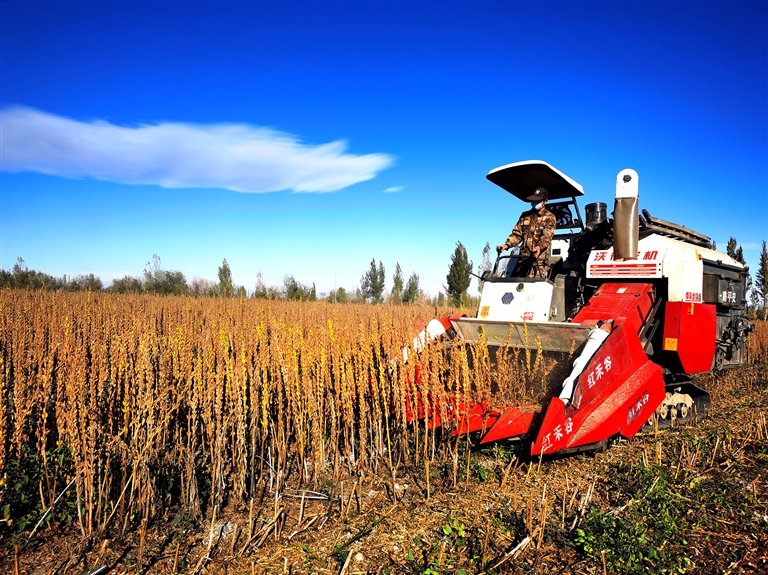
Core Viewpoint - The introduction of the new sesame variety "Jin Zhi 837" by Shanxi Agricultural University represents a significant advancement for sesame cultivation in Shanxi, enabling full mechanization from planting to harvesting and addressing long-standing issues of seed loss and low yield [1][4]. Group 1: Agricultural Innovation - The new sesame variety is the first in Shanxi suitable for mechanical harvesting, allowing farmers to avoid bending over during harvest [1]. - The variety exhibits resistance to splitting and seed loss, which has historically hindered sesame production [1][4]. - The research team has developed techniques for drought resistance and pest control, enhancing the viability of sesame cultivation in challenging conditions [3][4]. Group 2: Economic Viability - In 2023, a trial of the new sesame variety resulted in a yield of 183.2 kg per mu, translating to a net income of 2244.8 yuan per mu, surpassing the income from corn [2][3]. - The sesame planting area in Shanxi is currently around 100,000 mu, with a significant gap in meeting local processing capacity, indicating potential for growth [5][6]. Group 3: Training and Support - The research team has conducted extensive training sessions, reaching over 500 participants, to promote the new sesame cultivation techniques [8][10]. - A support network has been established for farmers, including a WeChat group for real-time assistance and guidance during the growing season [10]. Group 4: Future Prospects - The team plans to expand the cultivation of sesame in various regions of Shanxi, with projections for significant increases in planting areas in the coming years [9]. - The adaptability of sesame as a drought-resistant and short-growth period crop aligns well with the climatic conditions of Shanxi, making it a suitable option for local farmers [8][9].