贡献积分

Search documents
绿色积分平台集体崩盘?消费增值模式能否破局?
Sou Hu Cai Jing· 2026-02-10 05:48
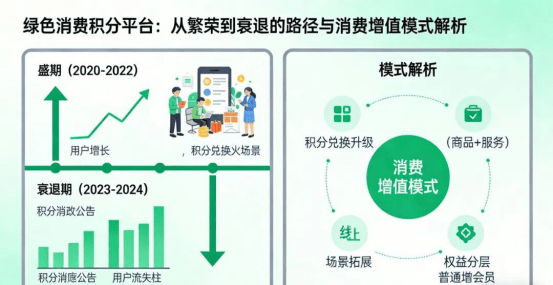
Core Viewpoint - The rise and fall of numerous platforms claiming "green consumption" and "points return/benefits" has led to significant consumer losses and a collapse of merchant trust, primarily due to misinterpretation and misuse of "green points" rather than the policies themselves [1] Group 1: Reasons for Frequent Failures of Green Points - Unsustainable profit sources: Most platforms rely solely on "merchant discounts" as their funding pool, lacking a self-sustaining profit model or a genuine consumption loop, leading to system collapse when user growth slows [2] - Lack of real benefits for merchants: Merchants seek customer acquisition and repeat purchases, but many platforms only offer "fake subsidies," failing to generate effective traffic or customer retention, which diminishes collaboration motivation [3] - Falling into a Ponzi scheme trap: Initially attracting speculators with high returns, these platforms later depend on new participants to sustain operations, creating a "first rich, then poor" design that is inherently unsustainable [4] Group 2: Sustainable Solutions - Consumption Value Model - Core mechanism: A one-sided increasing points pricing system where a fixed percentage (e.g., 30%) of each transaction goes into a "value pool" [8] - Value pool allocation: 70% of the value pool is used to mint "contribution points," distributed to consumers at real-time prices, with the number of new points decreasing as consumption increases, driving up the price [9][10] - User benefits: As point prices rise to 9.52 yuan, early users holding 210 points can see a market value of 2000 yuan, allowing for significant returns on early participation [11] Group 3: Risk Control and Long-term Operation - Risk control measures: Setting a cap on value appreciation (e.g., 1.5 times) to encourage timely redemption and prevent excessive accumulation, alongside an "activity period" operation to reset points and ensure orderly exits for all users [13] - Building diverse consumption scenarios: Relying solely on "cashback" is not sustainable; it is essential to integrate high-frequency usage paths, including virtual rights, physical exchanges, and local life services to create a regional consumption loop [14] - Light asset ecological operation: Collaborating with established supply chains to avoid building warehouses and quickly listing products, while forming a "consumption alliance" with local merchants to allow offline point accumulation [16] Group 4: Conclusion - The essence of the consumption value model is transforming traditional "one-time marketing expenses" into user-owned, appreciating, and tradable digital rights, fostering an internal cycle without external funding, thus enabling sustainable growth in the context of green consumption policy benefits [17]