
消费增值模式

Search documents
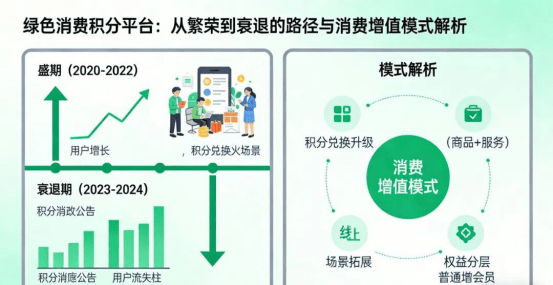
绿色积分平台集体崩盘?消费增值模式能否破局?
Sou Hu Cai Jing· 2026-02-10 05:48
Core Viewpoint - The rise and fall of numerous platforms claiming "green consumption" and "points return/benefits" has led to significant consumer losses and a collapse of merchant trust, primarily due to misinterpretation and misuse of "green points" rather than the policies themselves [1] Group 1: Reasons for Frequent Failures of Green Points - Unsustainable profit sources: Most platforms rely solely on "merchant discounts" as their funding pool, lacking a self-sustaining profit model or a genuine consumption loop, leading to system collapse when user growth slows [2] - Lack of real benefits for merchants: Merchants seek customer acquisition and repeat purchases, but many platforms only offer "fake subsidies," failing to generate effective traffic or customer retention, which diminishes collaboration motivation [3] - Falling into a Ponzi scheme trap: Initially attracting speculators with high returns, these platforms later depend on new participants to sustain operations, creating a "first rich, then poor" design that is inherently unsustainable [4] Group 2: Sustainable Solutions - Consumption Value Model - Core mechanism: A one-sided increasing points pricing system where a fixed percentage (e.g., 30%) of each transaction goes into a "value pool" [8] - Value pool allocation: 70% of the value pool is used to mint "contribution points," distributed to consumers at real-time prices, with the number of new points decreasing as consumption increases, driving up the price [9][10] - User benefits: As point prices rise to 9.52 yuan, early users holding 210 points can see a market value of 2000 yuan, allowing for significant returns on early participation [11] Group 3: Risk Control and Long-term Operation - Risk control measures: Setting a cap on value appreciation (e.g., 1.5 times) to encourage timely redemption and prevent excessive accumulation, alongside an "activity period" operation to reset points and ensure orderly exits for all users [13] - Building diverse consumption scenarios: Relying solely on "cashback" is not sustainable; it is essential to integrate high-frequency usage paths, including virtual rights, physical exchanges, and local life services to create a regional consumption loop [14] - Light asset ecological operation: Collaborating with established supply chains to avoid building warehouses and quickly listing products, while forming a "consumption alliance" with local merchants to allow offline point accumulation [16] Group 4: Conclusion - The essence of the consumption value model is transforming traditional "one-time marketing expenses" into user-owned, appreciating, and tradable digital rights, fostering an internal cycle without external funding, thus enabling sustainable growth in the context of green consumption policy benefits [17]

调味、酒水复购经销研究报告
见川· 2025-06-05 01:30
Investment Rating - The report does not explicitly state an investment rating for the industry Core Insights - The report emphasizes the importance of repurchase strategies in both the seasoning and beverage industries, highlighting the use of technology and innovative marketing methods to enhance customer loyalty and sales Summary by Sections Seasoning Industry Repurchase Strategies - The application of unique QR codes for each seasoning product enhances consumer trust and loyalty by allowing verification of authenticity and product information [8] - Incentive mechanisms such as rewards for scanning QR codes stimulate purchasing behavior and enable personalized marketing through data analysis [10] - The dual-driven marketing model involving both consumers and retailers increases brand awareness and product sales [11] - The integration of mobile internet and QR code activities improves brand image and consumer engagement, leading to increased sales [12] Beverage Industry Repurchase Strategies - A points system encourages repeat purchases by allowing customers to redeem points for rewards such as discounts or free drinks [29] - Membership programs enhance customer loyalty by offering tiered benefits based on spending levels [31] - Referral programs incentivize existing customers to bring in new customers, thereby expanding the customer base [33] - Promotional activities, including themed events and online contests, drive customer engagement and repeat purchases [35] Market Status of the Seasoning Industry - The seasoning e-commerce market is expanding, with a compound annual growth rate expected to rise significantly from 2025 to 2030 [48] - Traditional seasoning markets are also growing due to consumption upgrades and diverse dietary preferences [45] - Factors driving market growth include changing consumer habits favoring online shopping and improved supply chain efficiencies [50] Market Status of the Beverage Industry - The beverage market is large but experiencing structural changes, with a decline in the production of traditional spirits despite high market share [64] - The online penetration rate is increasing, but offline channels remain dominant [64] - The traditional multi-level distribution model faces challenges, prompting companies to seek transformation [64] Implementation Key Points for Repurchase Strategies - Collecting and managing customer information effectively is crucial for tailoring marketing strategies [75] - Innovative marketing activities should align with product characteristics and target demographics to maximize impact [77] - Continuous evaluation and adjustment of marketing strategies based on data analysis are essential for success [80] Case Studies - The "Yipin Weixiang" garlic sauce exemplifies successful repurchase strategies through health-focused product selection and experiential marketing [92][94] - A beverage brand's implementation of a points system and membership program demonstrates effective customer retention strategies [96] Conclusion and Outlook - The report concludes that leveraging technology, such as QR codes and data analytics, is vital for enhancing repurchase rates in both industries [100] - Future trends indicate a growing demand for health-conscious products in the seasoning sector and innovative marketing strategies in the beverage market [105][107]