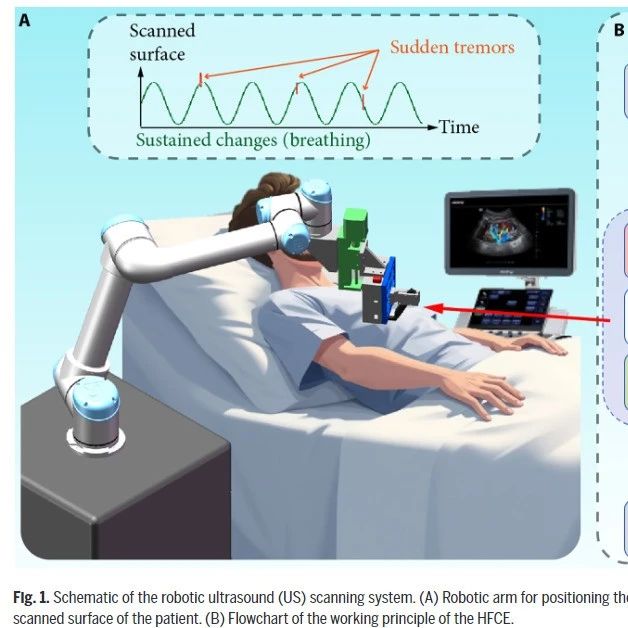
超声扫描机器人系统

Search documents
不再担心手抖!澳门大学新型超声机器人突破震动干扰,实现精准恒定接触力
机器人大讲堂· 2025-06-01 11:49
Core Viewpoint - The article discusses an innovative ultrasound scanning robot system developed by a research team at the University of Macau, which addresses the challenges of maintaining consistent contact force during ultrasound imaging, thereby improving image stability and diagnostic accuracy [1][12]. Group 1: Hybrid Active-Passive Control - The traditional force control systems are primarily of two types: active control, which adjusts actuator positions based on sensor feedback, and passive control, which uses specially designed springs to provide constant force [2]. - The innovative aspect of the University of Macau's system is the combination of both methods into a hybrid active-passive control end-effector (HFCE), which maintains stability over a wide dynamic range while responding effectively to rapid changes [2][12]. Group 2: Passive Force Mechanism - The passive force mechanism employs a parallel design of positive and negative stiffness components to create a zero-stiffness region, providing constant contact force within a deformation range [3]. - The active control system utilizes tilt sensors, strain gauges, and positioning devices to adjust the force magnitude and compensate for gravitational effects [3]. Group 3: Robust Anti-Interference Capability - The HFCE was tested under various vibration conditions, demonstrating its ability to maintain stable contact force even at a vibration frequency of 0.5Hz with a peak-to-peak amplitude of 12.8mm, which is significant given normal respiratory movements [6]. - In complex vibration conditions, the system maintained contact force stability when high-frequency noise was below 0.7mm, with a maximum average vibration speed tolerance of approximately 21mm/s [6][8]. Group 4: Ease of Use and High Repeatability - The HFCE can be integrated into a collaborative robotic arm with a tactile interface, allowing operators to easily control the system and maintain desired contact force, thus enhancing usability for inexperienced operators [9][12]. - Tests showed that even novice users could achieve more stable ultrasound images with the robotic system compared to manual operation, with a PSNR value of approximately 31-33dB indicating acceptable image quality across multiple scans [10][12]. Group 5: Future Applications and Developments - The research indicates that the HFCE system not only has potential applications in ultrasound scanning but also in other force-controlled tasks such as part polishing and physical rehabilitation [12]. - Future developments will focus on creating HFCE systems with varying force ranges to accommodate different tissues or organs and integrating semi-automated planning functions to further reduce the burden on healthcare professionals [12].