医疗机器人技术

Search documents
江西金达莱环保股份有限公司关于自愿披露对外投资的公告
Shang Hai Zheng Quan Bao· 2025-12-21 19:50
Core Viewpoint - Jiangxi Jindalai Environmental Protection Co., Ltd. plans to invest 30 million RMB in Beijing Zhongke Hongtai Medical Technology Co., Ltd., acquiring a 10% stake, aiming to optimize its industrial structure and explore new growth opportunities in the medical robotics sector [2][3][16]. Investment Overview - The investment amount is set at 30 million RMB, with 195.86895 thousand RMB allocated for the subscription of new registered capital and the remaining 28.04131 million RMB added to the capital reserve [3]. - The investment has been approved through internal procedures and does not require further approval from the board or shareholders, nor does it constitute a major asset restructuring or related party transaction [2][4]. Target Company Information - Zhongke Hongtai specializes in the research, production, and sales of medical robotics technology and systems, founded by a team of experts led by Professor Hou Zengguang [5]. - The company has a strong research background, having undertaken significant projects in the vascular interventional surgery robot field since 2008, and holds over 100 independent intellectual property rights [5]. - The target company is recognized as a national high-tech enterprise and has products in the special review process for innovative medical devices by the National Medical Products Administration [5][6]. Financial and Operational Aspects - The investment will be made in cash from the company's own funds, and the funds will be used for technology research and development, market promotion, and daily operations [12][16]. - The target company has completed 16 clinical trials for its multi-channel vascular interventional surgery robot, which is currently in the process of accelerating its clinical trials [6]. Strategic Impact - This investment aligns with the company's strategy to diversify into the healthcare sector, particularly in medical devices and biomanufacturing, enhancing its risk resilience and creating new profit growth points [16]. - The investment is expected to strengthen the company's competitive edge and influence in the market, promoting sustainable development without affecting its daily operations or shareholder interests [16].

不再担心手抖!澳门大学新型超声机器人突破震动干扰,实现精准恒定接触力
机器人大讲堂· 2025-06-01 11:49
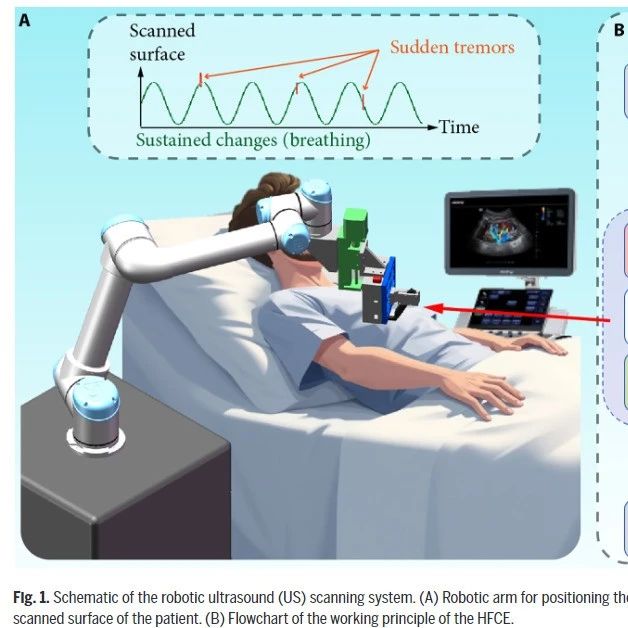
Core Viewpoint - The article discusses an innovative ultrasound scanning robot system developed by a research team at the University of Macau, which addresses the challenges of maintaining consistent contact force during ultrasound imaging, thereby improving image stability and diagnostic accuracy [1][12]. Group 1: Hybrid Active-Passive Control - The traditional force control systems are primarily of two types: active control, which adjusts actuator positions based on sensor feedback, and passive control, which uses specially designed springs to provide constant force [2]. - The innovative aspect of the University of Macau's system is the combination of both methods into a hybrid active-passive control end-effector (HFCE), which maintains stability over a wide dynamic range while responding effectively to rapid changes [2][12]. Group 2: Passive Force Mechanism - The passive force mechanism employs a parallel design of positive and negative stiffness components to create a zero-stiffness region, providing constant contact force within a deformation range [3]. - The active control system utilizes tilt sensors, strain gauges, and positioning devices to adjust the force magnitude and compensate for gravitational effects [3]. Group 3: Robust Anti-Interference Capability - The HFCE was tested under various vibration conditions, demonstrating its ability to maintain stable contact force even at a vibration frequency of 0.5Hz with a peak-to-peak amplitude of 12.8mm, which is significant given normal respiratory movements [6]. - In complex vibration conditions, the system maintained contact force stability when high-frequency noise was below 0.7mm, with a maximum average vibration speed tolerance of approximately 21mm/s [6][8]. Group 4: Ease of Use and High Repeatability - The HFCE can be integrated into a collaborative robotic arm with a tactile interface, allowing operators to easily control the system and maintain desired contact force, thus enhancing usability for inexperienced operators [9][12]. - Tests showed that even novice users could achieve more stable ultrasound images with the robotic system compared to manual operation, with a PSNR value of approximately 31-33dB indicating acceptable image quality across multiple scans [10][12]. Group 5: Future Applications and Developments - The research indicates that the HFCE system not only has potential applications in ultrasound scanning but also in other force-controlled tasks such as part polishing and physical rehabilitation [12]. - Future developments will focus on creating HFCE systems with varying force ranges to accommodate different tissues or organs and integrating semi-automated planning functions to further reduce the burden on healthcare professionals [12].