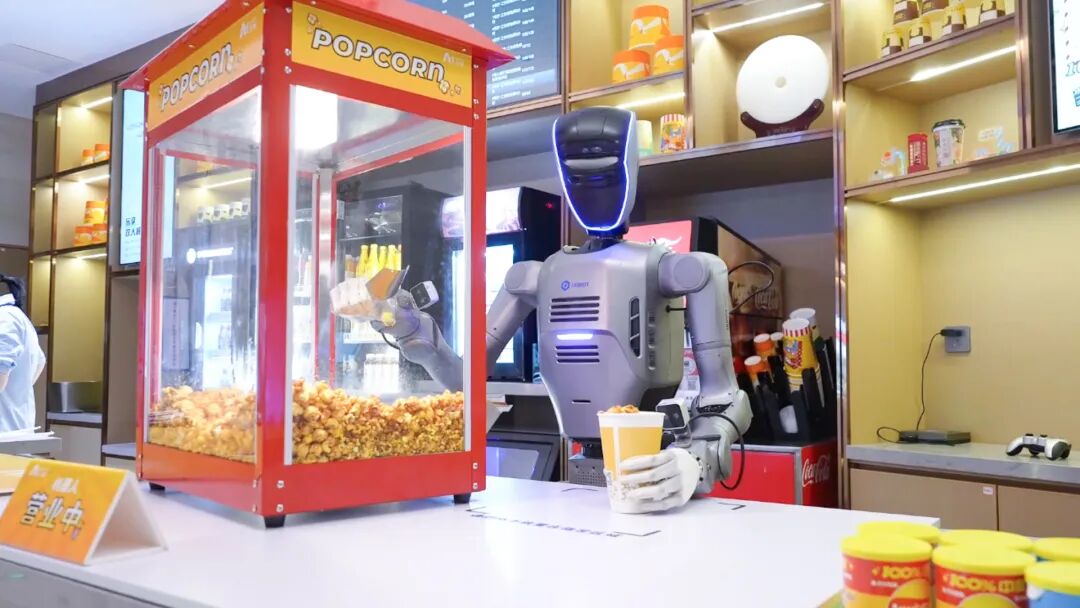
越疆Atom人形机器人

Search documents
全产业链布局 深圳竞逐具身智能赛道
Zhong Guo Zheng Quan Bao· 2026-01-07 20:50
Core Insights - Embodied intelligence is emerging as a new engine driving industrial transformation, differentiating itself from traditional AI by enabling physical entities to interact with their environment, thus achieving a closed loop of "perception-decision-action" [1][2] Industry Developments - In January 2025, the Yujian Atom humanoid robot achieved full autonomous operation at a cinema in Shenzhen, capable of selling over 1,000 cups of popcorn daily and handling unexpected situations [1] - In April 2025, the "Tiangong Ultra" robot won a half-marathon in Beijing, showcasing its ability to autonomously adjust running direction and speed [2] - The "Kuafu" humanoid robot, developed by Leju Robotics, served as the torchbearer at the Shenzhen National Games, demonstrating advanced capabilities in complex scenarios [2] Technological Advancements - Shenzhen's embodied intelligence industry is marked by significant technological breakthroughs, including the first human-like robot to perform a front flip and advancements in motion control and stability [2] - The local industry has seen the application of humanoid robots in various sectors, including industrial manufacturing and elder care, enhancing operational efficiency and service quality [2][3] Ecosystem Advantages - Shenzhen's robust ecosystem supports the growth of the embodied intelligence sector, with a concentration of over 100 robot companies, including leading firms like UBTECH and Yujian Technology [3] - The "Robot Valley" in Shenzhen features a complete supply chain, with high localization rates for core components, enhancing the speed of technology transfer from research to production [3][5] Future Outlook - By 2027, Shenzhen aims for its embodied intelligence robot industry to achieve international leadership, with a target industry scale exceeding 100 billion yuan and over 1,200 related enterprises [5][6] - The city is fostering a conducive environment for future industrial development through legislative and planning initiatives, enhancing its innovation capabilities in the embodied intelligence field [6] Investment and Policy Support - Shenzhen has established a comprehensive financial service system to support technology innovation, including various funds aimed at fostering long-term investments in hard technology sectors [5] - The city is also promoting collaborative innovation across the Greater Bay Area, enhancing its competitive edge in artificial intelligence and robotics [4][6]


打工机器人在电影院正式“上班”!卖了1000杯还零失误 一台19.9万元起
Mei Ri Jing Ji Xin Wen· 2026-01-05 12:01
Core Insights - The article highlights the successful deployment of the fully autonomous humanoid robot by Yuejiang Robotics at the K11 Art House cinema in Shenzhen, marking a global first in complex commercial environments [1][3]. Group 1: Company Achievements - Yuejiang's humanoid robot can operate continuously for 14 hours a day, independently producing and selling over 1,000 cups of popcorn without human assistance [1][3]. - The robot operates with "zero errors," demonstrating capabilities in recognizing commands, grasping items, and executing tasks with high precision, showcasing its adaptability in confined spaces [3]. - The breakthrough is attributed to Yuejiang's self-developed "big and small brain" collaborative intelligent system, which allows the robot to perceive its environment and adapt to changes [3]. Group 2: Technical Capabilities - The robot features advanced task planning and real-time error correction systems, enabling it to autonomously decompose complex tasks like selling popcorn into manageable steps [3]. - It can identify and respond to unexpected disturbances, such as refilling popcorn if it spills or adjusting to moved containers without external instructions [3]. - The robot's design includes millimeter-level grasping force control, ensuring it can handle items without damage and operate effectively in narrow spaces [3]. Group 3: Industry Context - The humanoid robot market is expected to see significant growth, with companies like Yushutech and others projected to achieve mass production by 2025, and Tesla expected to produce 50,000 to 100,000 units by 2026 [21]. - The humanoid robot industry has made milestone advancements over the past year, transitioning from product development to initial commercialization, with projections indicating a shipment of 14,000 units in China by 2026 [22]. - The market is anticipated to grow exponentially, potentially reaching over one million units by 2034, with annual sales expected to match the scale of the Chinese passenger car market [22].