
轻舟乘风2.0辅助驾驶解决方案

Search documents
轻舟智航:L2与L4本质上技术同源
Jing Ji Guan Cha Wang· 2026-01-25 08:22
Core Insights - QCraftDAY2026 event showcased QCraft's next-generation autonomous driving technology and future development plans, marking the mass production of the first city NOA solution based on Horizon's 6M chip [2] - The company aims to expand its partnerships, targeting over 50 new vehicle models equipped with city NOA by 2026 and plans to achieve 3 million units of intelligent driving systems by 2027 [2] Technology Developments - QCraft introduced the "VLA+ World Model" unified architecture, which enhances decision-making, remote takeover, and human-machine interaction through language capabilities [2] - The company emphasized that L2, L3, and L4 technologies share the same AI model foundation, with a focus on safety, comfort, and predictability [3][4] Product Offerings - QCraft launched the "QCraft Chengfeng 2.0" driver assistance solution, creating a three-tier product matrix: Chengfeng AIR for highway NOA, Chengfeng PRO for urban NOA, and Chengfeng MAX integrating VLA and world model technologies [2] - The "Robo-X" autonomous driving open platform was unveiled, aiming to become the "Android of the autonomous driving field," providing comprehensive tools for Robobus, Robovan, and Robotaxi [4] Market Strategy - The company is expanding its business from passenger vehicles to more L4 commercial scenarios, establishing a dual-line layout of passenger vehicle intelligent driving and commercial vehicle automation [4] - QCraft plans to initiate small-scale operations of Robotaxi in 2026, with a broader deployment expected in 2027, while acknowledging potential delays in China compared to the U.S. due to various factors [5]

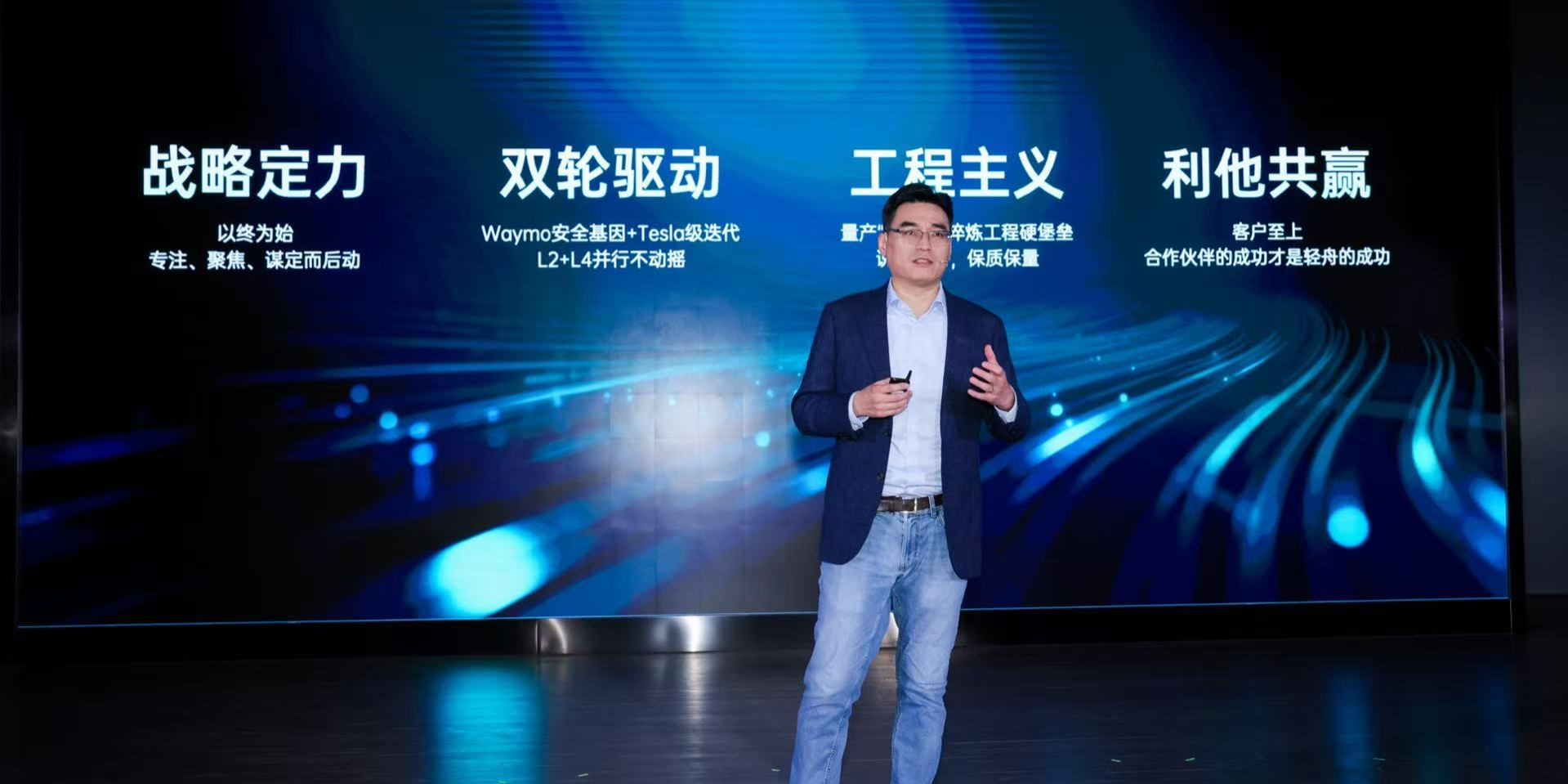
轻舟智航董事长于骞:公司辅助驾驶系统搭载量突破100万台 正式进入L4无人物流领域
Zhong Zheng Wang· 2026-01-25 03:27
Core Insights - The company Lightyear has officially entered the L4 unmanned logistics sector and has begun deployment operations in multiple locations, marking a new phase of large-scale implementation for its passenger vehicle assistance systems, which have surpassed 1 million units in deployment [1][2]. Group 1: Industry Trends - The evolution of autonomous driving technology is undergoing profound changes, transitioning from a "machine intelligence" phase to a "human-like intelligence" phase, with 2026 identified as a critical turning point for the industry [2]. - The introduction of end-to-end architecture and models like VLA and world models will drive a comprehensive understanding of the real world, allowing autonomous systems to surpass human driving capabilities [2]. - The next decade is expected to be a golden era for autonomous driving, with significant advancements in technology and market penetration anticipated [2]. Group 2: Product Development - Lightyear plans to launch its first end-to-end urban NOA solution based on a single journey 6M platform by April 2025, with the official vehicle integration occurring in January 2026 [3]. - The new generation "Lightyear Sailing 2.0" assistance solution will focus on safety and explainability, achieving a driving experience equivalent to 256 TOPS with only 128 TOPS of computing power [3]. - The company aims to promote high-level assistance driving solutions to the 100,000 yuan market by 2026, expanding its coverage from 80,000 to 400,000 yuan models [3]. Group 3: Future Deployment Plans - Lightyear has outlined a product evolution roadmap that includes the large-scale deployment of Robotaxi by 2027, supported by the Robo-X autonomous driving open platform [5]. - The Robo-X platform aims to become the "Android of the autonomous driving field," providing a universal technology base and comprehensive tools for various autonomous driving scenarios [5]. - Strategic partnerships, such as with Chery Commercial Vehicles, are being formed to create benchmark L4 logistics products and services [5].