达唯珂

Search documents
从“灵魂砍价”到“价值共赢” 医保与创新药的双向奔赴
Zhong Guo Jing Ji Wang· 2026-01-21 09:18
Core Insights - The new national medical insurance drug list and the first commercial insurance innovative drug list will be implemented nationwide starting January 1, 2026, marking the largest expansion of innovative drugs in the history of the medical insurance directory [1] - The adjustment of the medical insurance directory represents a dual benefit for the innovative drug industry in China, with significant changes in the inclusion of innovative drugs and the establishment of a commercial insurance innovative drug directory [1][2] Summary by Sections Innovative Drug Inclusion - A total of 114 new drugs have been added to the national medical insurance drug list, including 111 new products launched within the last five years and 50 Class I new drugs, both of which set historical highs in terms of quantity and proportion [1][2] - The newly included drugs generally possess three common characteristics: they either fill a treatment gap, are superior alternatives, or offer better cost-effectiveness [2] Commercial Insurance Innovative Drug Directory - The first commercial insurance innovative drug directory includes 19 drugs, covering treatments for various conditions such as CAR-T therapies for tumors, rare diseases like Gaucher disease, and Alzheimer's disease, complementing the basic medical insurance [2][3] - The selection mechanism for the commercial insurance directory emphasizes high innovation, significant clinical value, strong irreplaceability, and adaptability to a multi-tiered payment system [3] Payment System and Market Impact - The medical insurance fund has paid over 460 billion yuan for negotiated drugs by the end of October 2025, benefiting 1 billion patients and driving related drug sales exceeding 670 billion yuan [4] - The new dual-directory system aims to clarify the boundaries of basic medical insurance coverage while allowing space for commercial insurance development, thus supporting a multi-tiered payment system [3][4] Innovation Ecosystem - The integration of the commercial insurance innovative drug directory with the national medical insurance drug list is crucial for building a multi-layered medical security system, focusing on high-innovation and clinically significant drugs that exceed basic insurance coverage [5] - The successful inclusion of breakthrough therapies like Alpelisib not only provides hope for patients but also signals strong support for genuine innovation within the pharmaceutical industry [5]
和黄医药:达唯珂 获纳入首版国家商业健康保险创新药品目录
Zheng Quan Shi Bao Wang· 2025-12-08 09:48
Group 1 - The core point of the article is that Hutchison China MediTech has successfully renewed three of its drugs, which will continue to be included in the updated National Medical Insurance Drug List effective from January 1, 2026 [2] - The three drugs mentioned are Aiyoute, Vorinostat, and Sutai Da, indicating the company's ongoing commitment to maintaining its product offerings in the healthcare market [2] - Additionally, the drug Daviq has successfully entered the first edition of the National Commercial Health Insurance Innovative Drug List, expanding the company's market access [2]
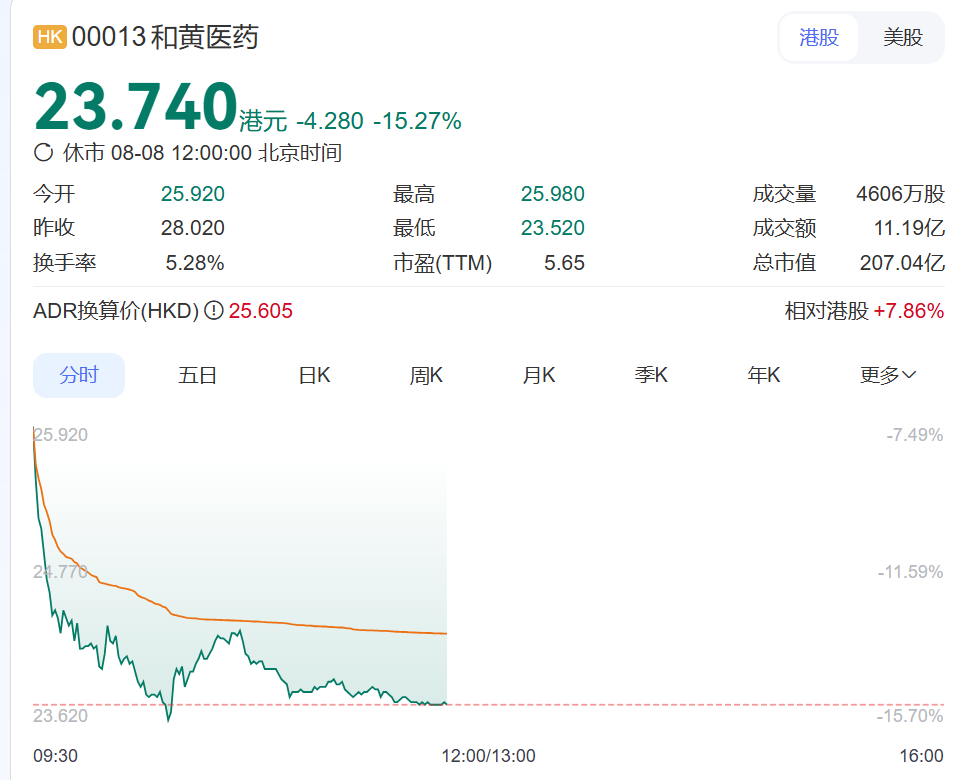
李嘉诚旗下和黄医药,股价闪崩!公司囤积现金近百亿元,大幅减少在中国以外的研发投资,此前大手笔出售中药资产套现
Mei Ri Jing Ji Xin Wen· 2025-08-08 05:36
Core Viewpoint - The stock price of Hutchison China MediTech (00013.HK) plummeted over 15% following the release of disappointing mid-term results, leading to a total market capitalization of HKD 20.721 billion [1][3]. Financial Performance - For the first half of 2025, the company reported total revenue of USD 277.677 million, a year-on-year decrease of 9.16%, while net profit surged to USD 455.555 million, a significant increase of 1663.32% due to the sale of a 50% stake in Shanghai Hutchison Pharmaceuticals [4][10]. - The company's research and development expenses decreased by 24.4% to USD 71.99 million, with overseas R&D investments halved [4][7]. - The company held cash and cash equivalents totaling USD 1.365 billion (approximately RMB 9.8 billion) at the end of the reporting period, up from USD 836 million at the end of the previous year [7]. Strategic Focus - The company is shifting its focus from traditional Chinese medicine to innovative drugs, having sold stakes in its Chinese medicine assets to invest in its internal product pipeline [12][13]. - The company aims to accelerate the development of its innovative ATTC platform candidates and has 13 oncology candidates in various clinical trial stages, with four already approved in mainland China [9][10]. - The company plans to utilize proceeds from the sale of its Chinese medicine assets to further develop its core business in targeted therapies and immunotherapies [13][14]. Market Outlook - The company anticipates a recovery in sales growth in the second half of 2025, driven by the expansion of indications in China and increased penetration in overseas markets [9]. - Recent improvements in China's drug policies and pricing environment are expected to support the development of innovative drugs, with a new commercial insurance drug list anticipated to be released later this year [8].