
量子直接通信

Search documents
用量子说“悄悄话”,解锁保密通信硬核新技术
Xin Hua Wang· 2026-02-07 00:29
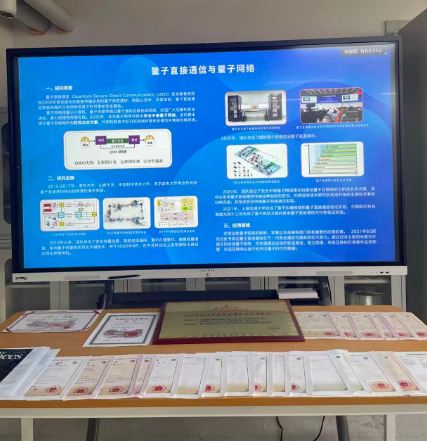
Core Viewpoint - The recent advancements in quantum direct communication by Tsinghua University’s Professor Long Guilu's team have transformed the concept from basic quantum telegrams to real-time quantum telephony, enhancing secure communication methods significantly [1][3]. Group 1: Quantum Direct Communication Technology - Quantum direct communication utilizes the unique properties of quantum states to ensure secure transmission without the need for traditional encryption methods [3][4]. - The concept is likened to a "quantum envelope" that self-destructs if tampered with, ensuring that any attempt to eavesdrop results in the destruction of the information [4]. Group 2: Performance Improvements - In early 2025, the performance of quantum direct communication was significantly enhanced, achieving a stable transmission rate of 2.38 kbps over a distance of 104.8 km, marking a nearly 5000-fold increase compared to the previous year [5]. - This improvement allows for the real-time transmission of confidential text and image information, indicating a shift from theoretical demonstration to practical application [5]. Group 3: Future Applications and Market Integration - Future developments aim to establish a global quantum communication network through quantum satellites, enhancing security against eavesdropping [6]. - Currently, quantum terminals are designed for specialized fields such as government and finance, with broader public access expected to evolve through chip integration and service offerings [7]. - The unique contribution of quantum direct communication lies in its ability to provide inherent security during transmission, marking a new paradigm in secure communication [7].

量子算力跨越临界点
2025-06-19 09:46
Summary of Quantum Computing and Communication Conference Call Industry Overview - The conference focused on the **quantum computing** and **quantum communication** industries, highlighting their current status, challenges, and future potential [1][2][16]. Key Points and Arguments Quantum Computing - **Quantum Computing Basics**: Quantum computing utilizes quantum bits (qubits) that can exist in multiple states simultaneously, allowing for exponential speedup in specific algorithms compared to classical computing [5][14]. - **Current Technologies**: The main technologies in quantum computing include: - **Superconducting**: Used by companies like Google and IBM, known for high gate fidelity and long coherence times [6]. - **Trapped Ions**: Represented by companies like INQ, offering higher fidelity but facing scalability challenges [6]. - **Neutral Atom Optical Tweezers**: Lower environmental requirements but longer operation times [6]. - **Industry Stage**: The quantum computing industry is still in its early stages, primarily serving the education and research markets, with potential applications in materials, chemicals, biomedicine, and finance [1][21]. Quantum Communication - **Key Technologies**: Quantum communication includes: - **Quantum Key Distribution (QKD)**: Ensures secure key distribution using quantum properties, making interception detectable [9][33]. - **Quantum Teleportation**: Transfers quantum states using entangled particles, with significant implications for future information transmission [10]. - **Advantages**: Quantum communication offers enhanced security due to its fundamental properties, although it still relies on classical channels for information transmission [15]. Challenges and Development - **Key Issues**: The development of quantum computing faces challenges such as: - Environmental noise affecting qubits [17]. - The need for quantum error correction to achieve fault-tolerant quantum computing [4][53]. - Weak upstream supply chains, particularly for dilution refrigerants [17][18]. - **Measurement Systems**: Current measurement systems require optimization for low-temperature environments, and specialized equipment is needed for effective quantum control [19]. Market and Future Outlook - **Market Applications**: The primary market for quantum technologies is currently in education and research, but significant potential exists in materials science, biomedicine, and finance due to their complex computational needs [21][28]. - **Future Projections**: By 2025-2030, specialized quantum computers for optimization problems are expected to emerge, with general-purpose quantum computers gradually becoming more prevalent [23]. - **Technological Maturity**: Technologies like quantum key distribution and quantum random number generators are nearing practical application, particularly in high-security sectors [24]. Notable Companies and Developments - **Leading Companies**: Key players in the quantum computing space include IBM, Google, and IONQ, with significant advancements in superconducting and trapped ion technologies [30][32]. - **Investment Trends**: The potential for breakthroughs in quantum technology could lead to significant shifts in funding towards successful companies, particularly if major milestones are achieved [46]. Additional Important Content - **Quantum Measurement**: Quantum measurement technologies are advancing rapidly, with applications in military and research fields [27]. - **Economic Challenges**: Each technology route faces unique economic challenges, and the lack of a decisive breakthrough currently prevents a clear funding shift [46]. - **Security and Commercial Value**: Enhancing security through quantum technologies can create commercial value, particularly in sectors requiring high security [47]. This summary encapsulates the key insights from the conference call, providing a comprehensive overview of the quantum computing and communication landscape, its challenges, and future opportunities.