金融资产收益权(盛磊绍兴)

Search documents
百亿富豪俞发祥,深陷泥潭:持股遭300%冻结,本人已被采取刑事强制措施!
Sou Hu Cai Jing· 2026-02-27 13:46
Core Viewpoint - The financial troubles of Yu Faxiang, the head of the "Xiangyuan system," have intensified following a criminal investigation, leading to an unprecedented level of share freezing that indicates a severe debt crisis [1][5]. Group 1: Share Freezing Details - Yu Faxiang's shares in Xiangyuan Tourism Development Co., Ltd. have been subject to a rare triple-level freezing, with a total of 1,138,288,927 shares frozen, which represents 107.94% of the total share capital [2][4]. - The total shares held by the controlling shareholder and its affiliates amount to 612,433,915 shares, accounting for 58.08% of the company's total share capital, all of which have been judicially frozen [2][4]. - The shares frozen include 207,360,000 shares that are pledged, representing 19.66% of the total share capital [2][4]. Group 2: Debt Crisis Background - The share freezing is a consequence of a debt default crisis involving the Xiangyuan system, which has led to significant financial liabilities exceeding 10 billion yuan [5]. - In December 2025, Yu Faxiang was placed under criminal detention, and multiple financial products backed by Xiangyuan Holdings faced repayment failures, with the total amount due reaching over 10 billion yuan [5][10]. - The financial structure involved transferring receivables from a subsidiary to a related party, which then sold financial products to the public, effectively shifting internal risks to external investors [6][7]. Group 3: Impact on Listed Companies - Xiangyuan Tourism, along with other listed companies like Jiaojian Co. and Haichang Ocean Park, have distanced themselves from the financial troubles, asserting that their operations remain unaffected [8][9]. - However, Jiaojian Co. has projected a significant loss for 2025, estimating a net profit of between -700 million yuan and -350 million yuan due to bad debt risks associated with receivables from Xiangyuan Holdings [10].


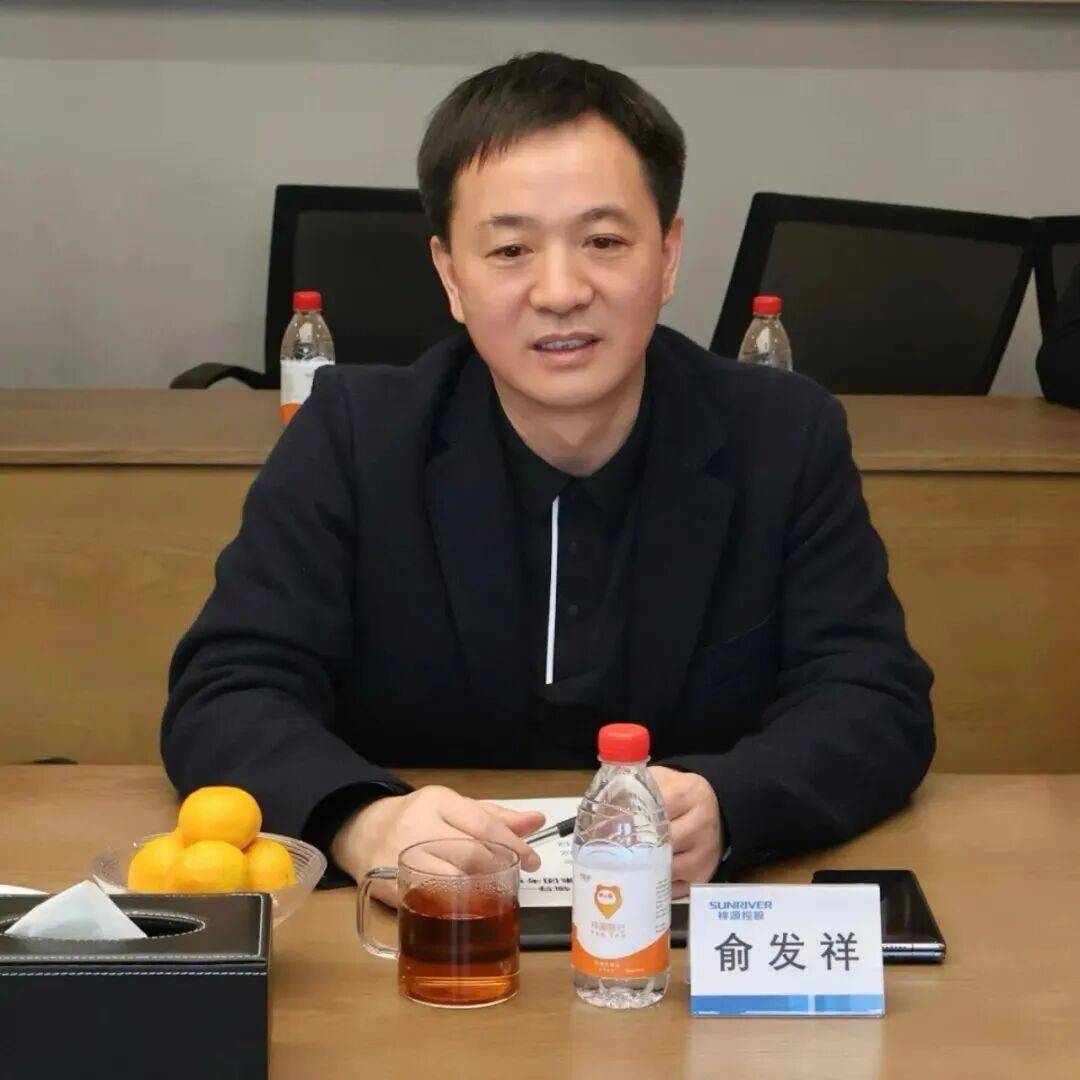
“祥源系”掌舵人俞发祥被刑拘!3家上市公司连夜“切割”
Xin Lang Cai Jing· 2025-12-23 09:51
Core Viewpoint - A significant payment crisis involving over 10 billion yuan has erupted, leading to the criminal detention of Yu Faxiang, the chairman of Xiangyuan Holdings, which has triggered a major upheaval in the "Xiangyuan system" capital empire [3][37]. Group 1: Company Announcements and Market Reactions - On December 22, Xiangyuan Cultural Tourism, Jiaojian Co., and Haichang Ocean Park simultaneously announced that their actual controller, Yu Faxiang, had been criminally detained by the Shaoxing Public Security Bureau [3][39]. - As of December 23, Xiangyuan Cultural Tourism's stock closed at 5.91 yuan per share, down 2.8%, with a total market value of 6.2 billion yuan; Jiaojian Co. closed at 7.58 yuan per share, down 4.89%, with a market value of 4.7 billion yuan; Haichang Ocean Park closed at 0.445 HKD per share, down 7.29%, with a market value of approximately 5.3 billion yuan [5][39]. - The three companies stated that they had not received any requests from authorities for assistance in investigations and that their operational control had not changed [42]. Group 2: Legal and Financial Implications - Yu Faxiang is expected to bear unlimited joint liability for debts exceeding 10 billion yuan, and Xiangyuan Holdings will share the same responsibility [5][39]. - If Yu is found guilty, he will be barred from holding any senior management positions in listed companies, and the control of Xiangyuan Cultural Tourism and Jiaojian Co. may change due to his substantial debts [44][45]. - The crisis has led to a significant drop in stock prices, with Xiangyuan Cultural Tourism down 20.67%, Jiaojian Co. down 41.65%, and Haichang Ocean Park down 35.51% from December 3 to December 23 [51]. Group 3: Background of the Crisis - The crisis began in late November when reports surfaced about overdue financial products linked to Xiangyuan Holdings, with investors claiming that over 10 billion yuan was owed [47][49]. - By December 3, a large number of these financial products were unable to make payments, leading to widespread investor concern [47][49]. - The Zhejiang Financial Assets Exchange Center, where these products were listed, has seen its assets controlled, and its chairman has been detained since December 12 [57]. Group 4: Company Operations and Future Outlook - Despite the turmoil, the companies have claimed that their operations remain normal and that they are independent of the issues surrounding their actual controller [42][51]. - However, the long-term viability of these companies is in question, as Yu Faxiang's assets may be subject to seizure, potentially leading to a struggle for control over the companies [45][67]. - The financial strain on the real estate sector, which has historically been the main revenue source for Xiangyuan Holdings, is exacerbating the situation, as the tourism sector has not generated sufficient cash flow [33][67].


上百亿待兑付!140亿富豪的资本局,崩了 || 深度
Sou Hu Cai Jing· 2025-12-10 09:24
Core Viewpoint - Xiangyuan Cultural Tourism confirmed overdue payments on financial products guaranteed by its actual controller, Yu Faxiang, while distancing itself from any liability related to these products [1][4][11]. Group 1: Company Announcements - On December 7, Xiangyuan Cultural Tourism, along with two other listed companies, issued urgent announcements to clarify their positions regarding overdue financial products linked to Xiangyuan Holdings [7][8]. - The announcements stated that the overdue financial products are unrelated to the listed companies and that they do not bear any repayment or guarantee obligations [9][10]. - The companies emphasized that their operations remain normal and independent, aiming to isolate themselves from the risks associated with the overdue payments [11]. Group 2: Financial Crisis Background - The crisis began in late November, with reports of overdue payments on various financial products linked to Xiangyuan Holdings, affecting hundreds of investors and potentially involving over 100 billion yuan in unpaid funds [6][12]. - By December 3, a significant number of these products failed to make scheduled payments, leading to widespread concern among investors [6][7]. - The overdue products are primarily tied to real estate projects under Xiangyuan Holdings, indicating a broader financial strain within the group [6][12]. Group 3: Market Reaction - Following the announcements, the stock prices of Xiangyuan Cultural Tourism, Jiaojian Co., and Haichang Ocean Park dropped significantly, with declines of 14.23%, 16.32%, and 27.54% respectively [11][29]. - The market's reaction reflects deep concerns about the potential transmission of financial risks from the controlling shareholder to the listed companies [4][11]. Group 4: Financial Structure and Risks - The financial products in question involve complex arrangements where Xiangyuan Holdings has transferred receivables to affiliated entities, which then issue financial products to the public [12][13]. - Yu Faxiang, as the actual controller, provided guarantees for these products, raising questions about the sustainability of this financial structure amid liquidity challenges [14][28]. - The underlying issue stems from the real estate sector's downturn, which has historically been the main revenue source for the group, now facing cash flow problems [28][29]. Group 5: Broader Implications - The crisis highlights the risks associated with the "Xiangyuan system," where significant off-balance-sheet debts pose a threat to the stability of the listed companies [29]. - Regulatory bodies are reportedly investigating the financial products and the associated risks, indicating potential repercussions for the involved parties [14][29].
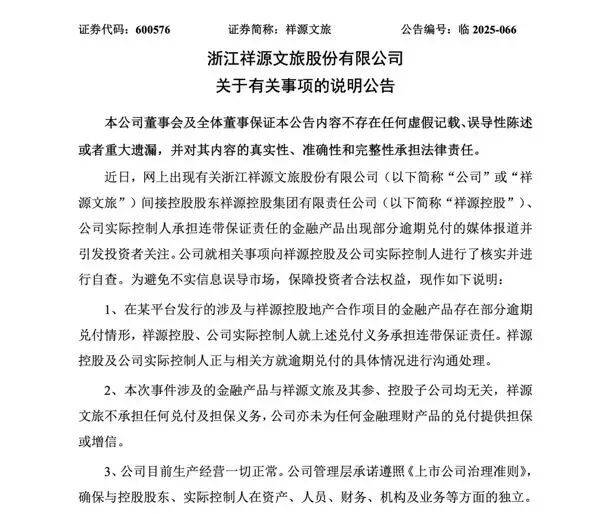
祥源系三公司紧急公告撇清实控人担保逾期风波
Sou Hu Cai Jing· 2025-12-09 01:30
Core Viewpoint - The recent credit crisis involving Xiangyuan Cultural Tourism (600576.SH) and its related companies has raised significant concerns in the capital market, leading to urgent clarifications from the companies to distance themselves from the financial products linked to their actual controller, Yu Faxiang [3][5][9]. Group 1: Company Announcements - On December 7, Xiangyuan Cultural Tourism confirmed that financial products guaranteed by its actual controller Yu Faxiang had experienced overdue payments, but stated that these products were unrelated to the company and that it bore no repayment or guarantee obligations [3][9]. - On the same day, related companies, including Jiaojian Co. (603815.SH) and Haichang Ocean Park (2255.HK), issued similar statements to clarify their positions and mitigate market concerns [5][9]. - The announcements emphasized that the companies' operations remained normal and independent, aiming to isolate the risks associated with the actual controller [9]. Group 2: Market Reaction - Following the crisis rumors, the stock prices of Xiangyuan Cultural Tourism, Jiaojian Co., and Haichang Ocean Park fell significantly, with declines of 14.23%, 16.32%, and 27.54% respectively from December 3 to December 8 [9]. - The market's reaction reflects deep concerns about the potential transmission of risks from the controlling shareholder to the listed companies [5][9]. Group 3: Financial Product Crisis - Reports indicated that overdue financial products linked to Xiangyuan Holdings had not been paid as expected, with investors estimating the total amount of unpaid funds to exceed 10 billion yuan, involving hundreds of products [7][9]. - The overdue products were primarily associated with various financial asset income rights issued by companies under Xiangyuan Holdings, indicating a broader liquidity issue within the group [6][10]. Group 4: Background of Xiangyuan Holdings - Xiangyuan Holdings, controlled by Yu Faxiang, has been involved in complex financial operations, including transferring receivables to affiliated entities to raise funds through public offerings [10][12]. - Despite a recent "AA+" credit rating from Hangzhou United Credit Rating Co., the company faces significant debt pressures and liquidity challenges, particularly in its real estate sector [13][15]. - The company's shift towards the cultural tourism sector has not compensated for the cash flow issues stemming from its real estate operations, which historically provided the bulk of its revenue [22].