银行ETF汇添富

Search documents
ETF收评 | A股午后大涨,中韩半导体ETF大涨8%
Ge Long Hui· 2026-02-03 10:07
Market Performance - The three major A-share indices collectively rose, with the Shanghai Composite Index increasing by 1.29%, the Shenzhen Component Index by 2.19%, and the ChiNext Index by 1.86%. The North Star 50 Index saw a significant rise of 3.27% [1] - The total trading volume in the Shanghai, Shenzhen, and Beijing markets reached 25,656 billion yuan, a decrease of 410 billion yuan compared to the previous day, with over 4,800 stocks rising across the three markets [1] Sector Performance - Leading sectors included photovoltaic equipment, CPO, commercial aerospace, engineering machinery, rare earth permanent magnets, cloud gaming, storage chips, cultivated diamonds, and epoxy propylene, all showing significant gains [1] - The banking, insurance, and agricultural products sectors lagged behind in performance [1] ETF Performance - The storage chip sector experienced a major surge, with the Huatai-PB Fund's China-Korea Semiconductor ETF rising by 8% [1] - The photovoltaic sector rebounded strongly, with the Guotai and Fuguo Fund's Sci-Tech Innovation Board New Energy ETF increasing by 7.42% and 6.84%, respectively [1] - The non-ferrous metals sector also saw a rebound, with the Southern Fund's Non-Ferrous Metals ETF rising by 6.84% [1] - The engineering machinery sector saw afternoon gains, with the GF Fund's Engineering Machinery ETF and the Dachen Engineering Machinery ETF increasing by 6.6% and 6.51%, respectively [1] - The New Economy ETF from Yinhua fell by 6.9%, while the Hong Kong stock market weakened, with the Hong Kong Stock Connect Technology ETF from Ping An declining by 1% [1] - Banking stocks fell, with the Banking ETF and the Huatai Banking ETF decreasing by 1% and 0.88%, respectively [1]
上证指数收跌2.48%,险守4000点,银行ETF逆势收红
Ge Long Hui A P P· 2026-02-02 08:10
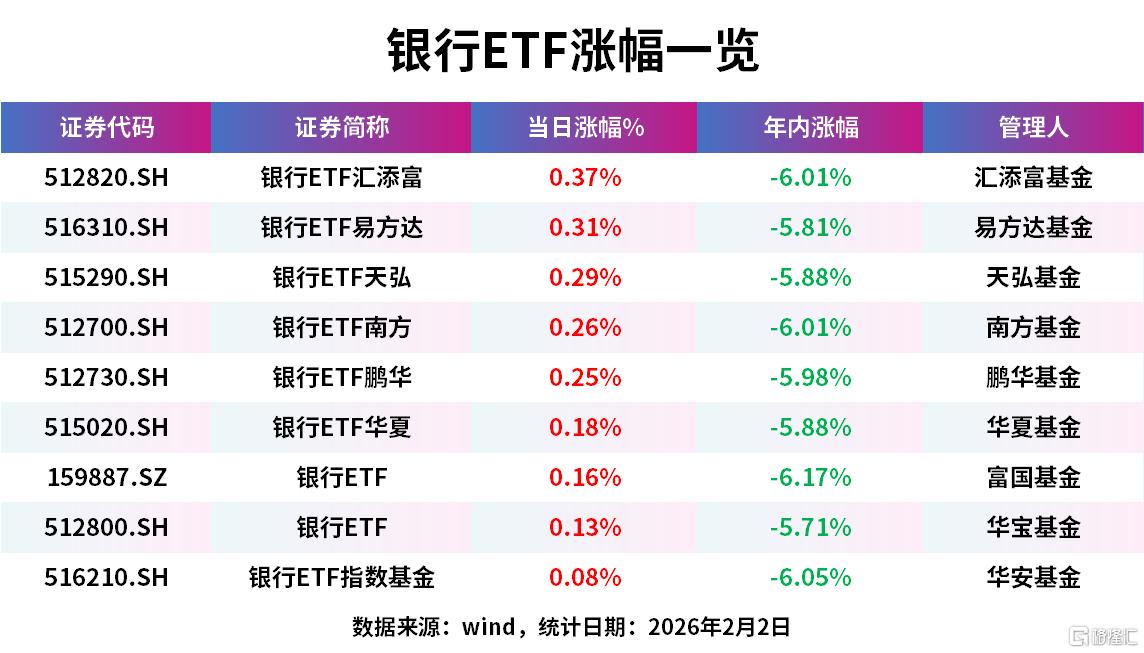
Market Overview - The Shanghai Composite Index fell by 2.48%, narrowly holding above the 4000-point mark, while the ChiNext Index dropped by 2.46%. A significant decline was observed in sectors such as gold and non-ferrous metals, with resource stocks including oil, coal, steel, and chemicals experiencing widespread losses. Conversely, high-voltage concept stocks, liquor stocks, and bank stocks showed resilience, with over 4600 stocks declining overall [1]. ETF Performance - Several bank ETFs, including those managed by Huatai-PB, E Fund, Tianhong, Southern, Penghua, and Huaxia, saw gains despite the overall market downturn. The performance of these ETFs ranged from a 0.08% to 0.37% increase, although their year-to-date performance remains negative, with declines between 5.71% and 6.17% [3]. Fund Holdings Analysis - By the end of 2025, actively managed equity funds held a total market value of 1.61 trillion yuan in A-shares, with 30.367 billion yuan allocated to the banking sector, representing 1.89% of the total. This allocation is below the historical averages of 3.02% and 3.89% over the past 5 and 10 years, respectively. The proportion of active funds in the banking sector remained stable at 1% [5]. Individual Bank Holdings - The concentration of holdings among individual banks has decreased, with the top five banks—China Merchants Bank, Ningbo Bank, Chongqing Rural Commercial Bank, Jiangsu Bank, and Industrial and Commercial Bank of China—accounting for 57.6% of the total holdings. There were 23 banks with increased holdings and 15 banks with decreased holdings in the fourth quarter [5]. Investment Outlook - According to Xinyi Securities, the banking sector may face selling pressure due to net outflows from broad-based ETFs. However, the impact is expected to ease as the banking index has returned to its low point from the third quarter of 2025. Many quality stocks are now considered to have high cost-performance ratios, with projected dividend yields for major state-owned banks in 2026 expected to rise to between 4.4% and 5%, and some quality regional banks exceeding 6% [6]. Long-term Investment Strategy - Huachuang Securities emphasizes the importance of long-term capital inflows and public fund reforms, suggesting that the banking sector remains under-allocated. The expectation for 2026 is a systematic recovery in bank valuations, transitioning from defensive to a balanced approach. The investment logic for bank stocks is anticipated to shift from purely dividend defense to a dual focus on dividends and growth [7]. Key investment themes include state-owned banks and quality regional banks benefiting from regional policies and improved performance [7].