
锡山教育缴费APP

Search documents
破立并举抓减负(人民时评)
Ren Min Ri Bao· 2026-02-11 23:20
Core Viewpoint - The article emphasizes the importance of a dialectical approach to "breaking" ineffective practices and "establishing" effective ones in order to reduce burdens on grassroots levels and combat formalism in governance [2][3]. Group 1: Government Initiatives - Recent actions in Jiangsu, Sichuan, and Guangdong demonstrate a trend of canceling redundant government service apps to improve efficiency for citizens and businesses [2]. - The State Council's issuance of the "Regulations on the Standardized Management of Government Mobile Internet Applications" aims to eliminate "facade projects" in government services [2][4]. Group 2: Challenges and Solutions - The persistence of formalism complicates the reduction of burdens, necessitating a focus on identifying and addressing the core issues faced by grassroots [4][5]. - A systematic approach is required to ensure that efforts to reduce burdens do not inadvertently shift responsibilities to other departments, highlighting the need for clear boundaries and responsibilities [5]. Group 3: Performance Evaluation - The article criticizes the use of superficial metrics, such as learning hours and social media engagement, for evaluating performance, advocating for more meaningful assessments that reflect actual contributions [4][5]. - The focus should be on achieving tangible results that resonate with grassroots experiences, ensuring that the reduction of burdens is felt by both officials and the public [5].
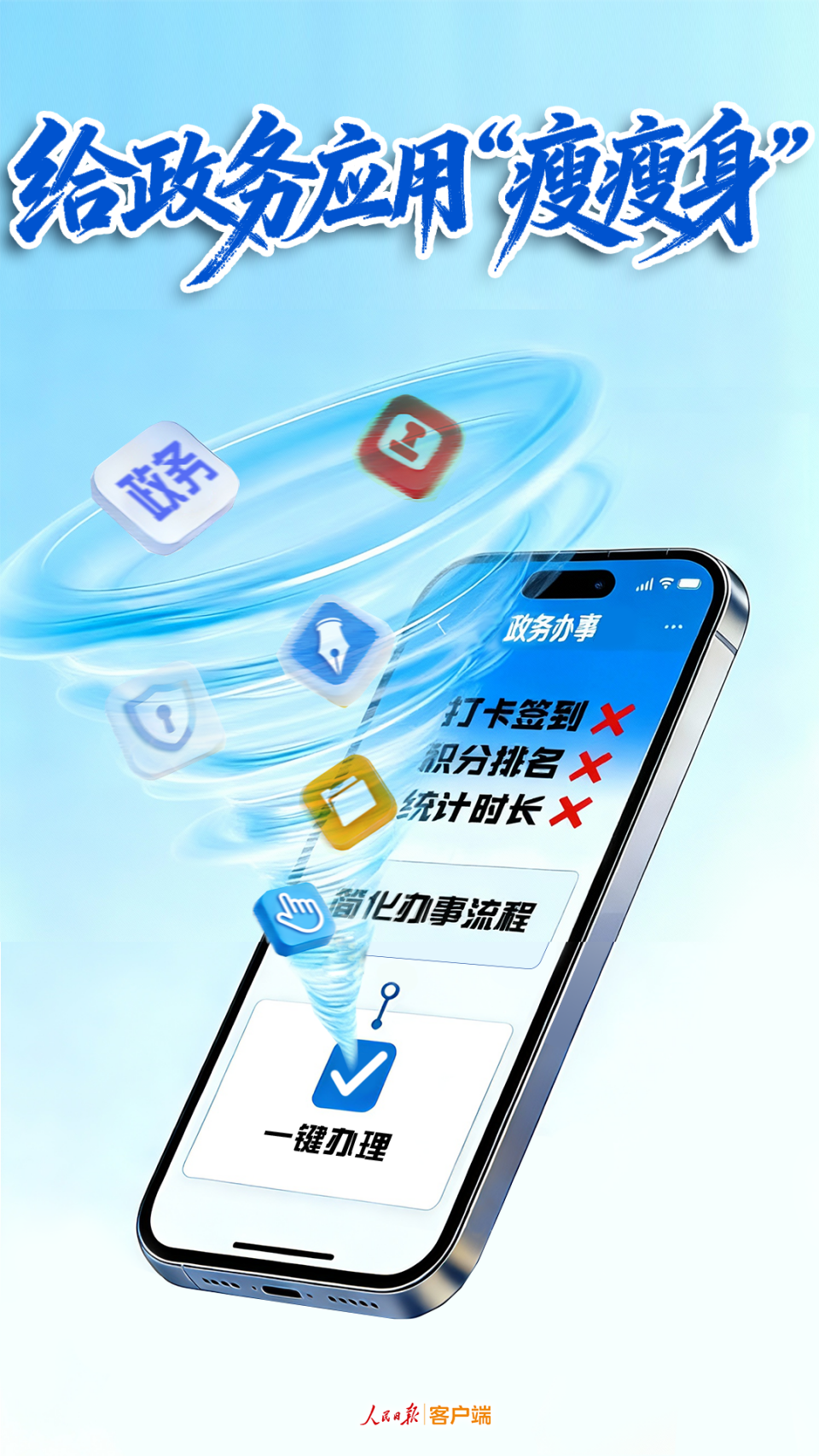
给政务应用“瘦瘦身”
Jing Ji Wang· 2026-02-06 02:31
Core Viewpoint - The recent shutdown of the "Xishan Education Payment" APP in Wuxi, Jiangsu Province, marks the cancellation of all county-level and below government service apps in Jiangsu, with necessary services being consolidated into the "Su Service Office" APP, aimed at reducing burdens on grassroots and improving efficiency [1][4]. Group 1: Issues with Government Apps - Government service apps were intended to enhance efficiency and convenience for the public, but issues such as "unused apps," "redundant construction," high operational costs, and inconvenience for users have been prevalent [1]. - Grassroots officials are overwhelmed with various reporting and material submission requirements, while citizens face the hassle of downloading multiple apps that lack data interoperability [1]. Group 2: Regulatory Measures - In 2023, the Central Cybersecurity and Informatization Commission issued guidelines to combat "formality at the fingertips," and the State Council released the "Regulations on the Standardized Management of Government Mobile Internet Applications" to streamline services and reduce burdens [4]. - The regulations emphasize that government apps must be functional, with unnecessary or counterproductive apps being eliminated or integrated [4]. Group 3: Prohibited Practices - The regulations outline five prohibited practices for government apps, including the arbitrary requirement for grassroots to fill out forms, mandatory features like check-ins and rankings, forced promotion of app downloads, and using metrics like likes or online time for evaluations [5]. - The emphasis is on avoiding the proliferation of apps at the grassroots level, which adds to the maintenance burden, leading to a directive that county-level units should not develop their own government apps [5]. Group 4: Future Directions - Post-consolidation, government apps need to focus on being useful and user-friendly, prioritizing citizen satisfaction and continuously optimizing service content [6]. - There is a call for a more integrated government platform to enhance data sharing and communication between departments, improving efficiency and safeguarding personal and public data [5].

江苏县级及以下政务服务APP,全部取消!
Xin Lang Cai Jing· 2026-01-30 23:51
Core Viewpoint - Jiangsu Province has eliminated all county-level and below government service apps, consolidating necessary services into the "Su Fu Ban" app for improved efficiency and convenience for citizens and businesses [1][2] Group 1: Policy Changes - The "Xishan Education Payment" app in Wuxi City has been taken down, marking the end of all county-level and below government service apps in Jiangsu [1] - A directive from four departments in Jiangsu mandates that by the end of 2025, all existing government service apps must migrate to the "Su Fu Ban" app [1] Group 2: Operational Efficiency - The transition aims to shift from a "scattered and multi-end" approach to a "one-door integration" model, enhancing the efficiency of government services [1] - A total of 22 government service apps have been identified and cleaned up, with 12 apps shut down due to low utility and user numbers, while 10 apps with necessary functions will have their services migrated before closure [1] Group 3: Data Security Management - Jiangsu Province has strengthened data security management for the discontinued apps, implementing strict protocols for data migration, archiving, and destruction [2] - Each app will have a tailored management plan to ensure data traceability and compliance, with necessary data being migrated to the "Su Fu Ban" platform for centralized management [2]
【民声】为政务服务“瘦身提质”点赞
Xin Lang Cai Jing· 2026-01-30 19:46
Core Viewpoint - The integration and reduction of government service apps in Jiangsu province aims to streamline processes, enhance efficiency, and improve user experience, particularly for the elderly and businesses, by consolidating services into a single platform [1][2][3] Group 1: Government Service Integration - The removal of various county-level government service apps in Wuxi and the consolidation into the "Su Service Office" platform represents a significant step towards reducing bureaucratic complexity and enhancing user convenience [1][2] - The initiative addresses the issue of fragmented services that previously required multiple app downloads, thus simplifying the process for users [1][2] - The integration is expected to lower transaction costs for businesses and improve operational efficiency for government departments through centralized management and data sharing [2] Group 2: User Experience and Accessibility - The consolidation of apps is designed to lower the digital barrier for less tech-savvy populations, particularly the elderly, by providing a single platform for multiple services [2] - Continuous upgrades and feedback mechanisms are essential to ensure that the integrated services meet the evolving needs of users and do not create new barriers [3] - The success of the government service integration will ultimately be measured by user satisfaction and the perceived benefits of the streamlined processes [3]