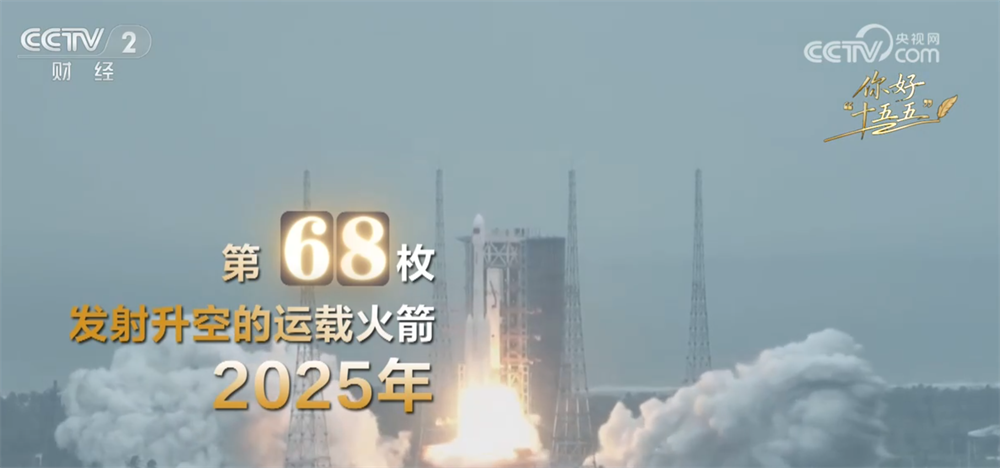
长征七号甲火箭

Search documents
奋进“十五五” 续写新篇章|“航天强国”建设按下“加速键” 中国航天启征程
Yang Shi Wang· 2025-11-14 06:35
Core Viewpoint - The article highlights China's ambitious plans to strengthen its space industry as part of the "14th Five-Year Plan," marking a significant shift towards becoming a space power with a focus on commercial space activities and increased launch frequency [1][4]. Group 1: Achievements and Developments - On November 3, 2025, the Long March 7A rocket successfully launched the Yaogan-46 satellite, marking the 68th launch of the year, which matches the total number of launches in 2024 [1]. - The Long March 8A rocket is being developed to meet the demands of large low-orbit internet satellite constellations, aiming for low-cost and high-frequency launches [2]. - The Hainan commercial space launch site, built during the "14th Five-Year Plan," has successfully completed seven launch missions and is equipped for dual-position, multi-model, and high-frequency launches [2]. Group 2: Infrastructure and Industry Growth - A new rocket factory in Wenchang has been established, with an investment of 900 million yuan, aiming to produce reusable liquid rockets by mid-2026 [3]. - Wenchang has attracted over 700 aerospace-related companies, creating a collaborative ecosystem of "rocket chain, satellite chain, and data chain" [3]. - The integration of space activities with tourism is evident, with facilities like observation platforms and meteorite museums boosting local tourism [3]. Group 3: Future Prospects - The "14th Five-Year Plan" signals a transition from technology breakthroughs to an industry-supported model, which is crucial for developing new productive forces [4]. - The next five years are expected to witness more frequent launches and advanced satellite technologies, with aspirations for ordinary people to experience space travel [5]. - By 2030, there are expectations for Chinese astronauts to launch aboard the Long March 10 rocket, fulfilling a long-held national dream of lunar exploration [5].
奋进“十五五” 续写新篇章|“航天强国”建设按下“加速键” 中国航天启征程
Yang Shi Wang· 2025-11-13 05:13
Core Insights - The article emphasizes China's ambition to become a space power, as highlighted in the "14th Five-Year Plan," marking the first time this goal has been included in a national planning document [1][20] - The frequency of rocket launches in China is set to increase significantly, with 2025 expected to see a record number of launches, surpassing previous years [3][9] - The establishment of a comprehensive space industry ecosystem in Wenchang, Hainan, is underway, with over 700 aerospace companies now present [18][16] Group 1: Launch Achievements - The Long March 7A rocket successfully launched the Yaogan-46 satellite on November 3, 2025, marking the 68th launch of the year, equaling the total number of launches in 2024 [3][1] - The Wenchang Space Launch Site and Hainan Commercial Space Launch Site are set to complete four launches in November alone, indicating a busy schedule [3][9] Group 2: Technological Advancements - The Long March 8A rocket is being developed for commercial purposes, aiming for low-cost and high-frequency launches to meet the growing demand for satellite networks [7][9] - The design and production processes of rockets are becoming more modular and scalable, with plans to increase launch frequency from one per month to three every two months [9][11] Group 3: Infrastructure Development - The Hainan Commercial Space Launch Site, built during the "14th Five-Year Plan," has successfully completed seven launch missions and is enhancing its capabilities with an autonomous measurement and control system [11][13] - A new rocket factory in Wenchang has been established with an investment of 900 million yuan, aiming to produce reusable rockets by mid-2026 [15][16] Group 4: Industry Ecosystem - Wenchang is developing a synergistic industrial ecosystem comprising rocket, satellite, and data chains, with facilities like observation platforms and museums enhancing tourism [18][20] - The shift from technology-driven breakthroughs to industry-supported development is a key focus in the "14th Five-Year Plan," aiming to foster new productive forces [20][22] Group 5: Future Aspirations - Industry leaders express optimism about the future of commercial space launches in China, with expectations for more frequent launches and advanced technologies [25][20] - There are aspirations for Chinese astronauts to land on the moon by 2030, symbolizing a significant milestone in the nation's space exploration journey [25][22]