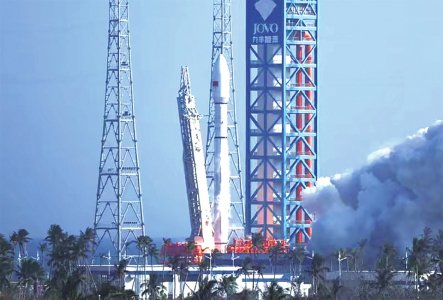
长征八号甲火箭

Search documents
春节见闻⑳ | 一份情怀和期许:从渔耕故里到航天小镇的蝶变
申万宏源研究· 2026-02-22 06:43
Group 1 - The article highlights the transformation of Wenchang into a significant hub for commercial aerospace, driven by national strategy and local pride [4][5] - Wenchang Commercial Launch Site has achieved a remarkable record of "ten launches, ten successes" since the first flight of Long March 12 on November 30, 2024, showcasing its rapid launch capabilities [4] - The aerospace industry in Wenchang has attracted nearly 3,000 enterprises, with over 700 related to aerospace, creating a collaborative ecosystem that includes rocket assembly, satellite manufacturing, and data application [5] Group 2 - The local economy has shifted from traditional fishing to a diversified model incorporating aerospace, tourism, and services, with the number of guesthouses increasing from about 5 in 2016 to over 60 currently [22] - During peak launch periods, local hotels and restaurants experience high occupancy rates, with tourism revenue reaching 60 million yuan and over 400,000 visitors expected in 2025 [22] - The article notes the need for improved infrastructure and services to sustain the growth of the aerospace industry and enhance the experience for both tourists and local residents [24] Group 3 - Local banks are offering competitive deposit rates, with some institutions providing rates as high as 1.65% for one-year deposits, which is significantly higher than the approximately 1% offered by major state-owned banks [29][31] - The financial landscape in Hainan is characterized by a slow growth rate in credit, with local banks needing to enhance their service offerings and customer engagement to better serve the community [32] - The article suggests that local banks should focus on developing unique financial products tailored to the aerospace industry and leverage innovative service models to improve their market position [33]


【申万宏源研究春节见闻】一份情怀和期许:从渔耕故里到航天小镇的蝶变
Xin Lang Cai Jing· 2026-02-22 06:00
Group 1 - The Wenchang commercial space launch site has achieved a remarkable record of "ten battles, ten victories" since the launch of the Long March 12 rocket on November 30, 2024, showcasing a rapid launch and recovery capability of "7 days launch, 7 days recovery" [1][27] - The local aerospace industry has attracted nearly 3,000 enterprises, with over 700 related to aerospace, creating a collaborative ecosystem of "rocket chain, satellite chain, and data chain" [2][28] - The expected production capacity of the new satellite factory is projected to reach 1,000 satellites annually, potentially driving an upstream and downstream industry scale exceeding 500 billion [2][28] Group 2 - The transformation of Longlou Town from a fishing village to a space town has led to a significant increase in local tourism, with over 40 million yuan in tourism revenue expected in 2025 and hotel occupancy rates exceeding 90% during launch events [2][44] - The local economy is experiencing a shift towards a diversified structure, integrating aerospace with tourism and services, as evidenced by the growth of local accommodations from about 5 to over 60 in recent years [2][44] - The local community is witnessing benefits from the aerospace industry, with residents creating rocket viewing platforms on their rooftops to generate income [2][44] Group 3 - Local financial institutions are facing challenges in attracting deposits, with interest rates for one-year deposits at local banks like Hainan Rural Commercial Bank reaching 1.47% for 200,000 yuan, compared to around 1% at state-owned banks [19][21] - The total credit volume of financial institutions in Hainan is approximately 1.4 trillion yuan, with a slow growth rate compared to national averages, indicating a need for enhanced financial vitality [23][53] - Local banks are encouraged to innovate by developing specialized financial products tailored to the aerospace industry, such as equipment financing and satellite data pledges, to improve their competitive edge [24][54]

高密度发射 我国商业航天何以迎来突破?
Xin Lang Cai Jing· 2026-01-26 18:59
Core Insights - The recent launch of 19 low-orbit satellites by China's commercial space sector marks a significant step in the country's ambition to become a "space power" as outlined in the 14th Five-Year Plan [2][8] - The rapid advancements in technology and the increasing capabilities of private space companies are driving the commercialization of space, transitioning from supplementary forces to strategic pillars [2][7] Group 1: Launch and Technology Developments - The Long March 12 rocket, used for the recent satellite launch, is China's first 4-meter single-core rocket with a near-Earth orbit capacity of at least 12 tons, supporting various launch missions [3] - Galaxy Space successfully launched its second group of self-developed low-orbit satellites, incorporating advanced technologies such as low-cost phased array antennas and automated production processes to enhance efficiency [2][3] Group 2: Reusable Rocket Technology - The development of reusable rocket technology is seen as a key factor in reducing launch costs and increasing launch frequency, with both state-owned and private enterprises collaborating on this front [5][7] - By the end of 2025, attempts at first-stage recovery tests for the Zhuque-3 and Long March 12A rockets are planned, indicating progress in this area [5] Group 3: Market and Policy Drivers - The rapid growth of China's commercial space sector is driven by favorable policies, capital investment, and technological breakthroughs, with a focus on satellite internet and 6G technology [6][7] - China has submitted applications for an additional 203,000 satellites, with major telecom operators like China Mobile and China Telecom entering the satellite constellation market [7][8] Group 4: Industry Ecosystem - The commercial space industry in China is developing a complete ecosystem from rocket and satellite manufacturing to launch services and communication operations, creating internal momentum for growth [8] - The successful integration of key technologies and the expansion of large-scale applications position China's commercial space sector to play an increasingly important role in the global space economy [8]
商业航天概念继续强势,大业股份5连板
Ge Long Hui· 2025-12-30 03:04
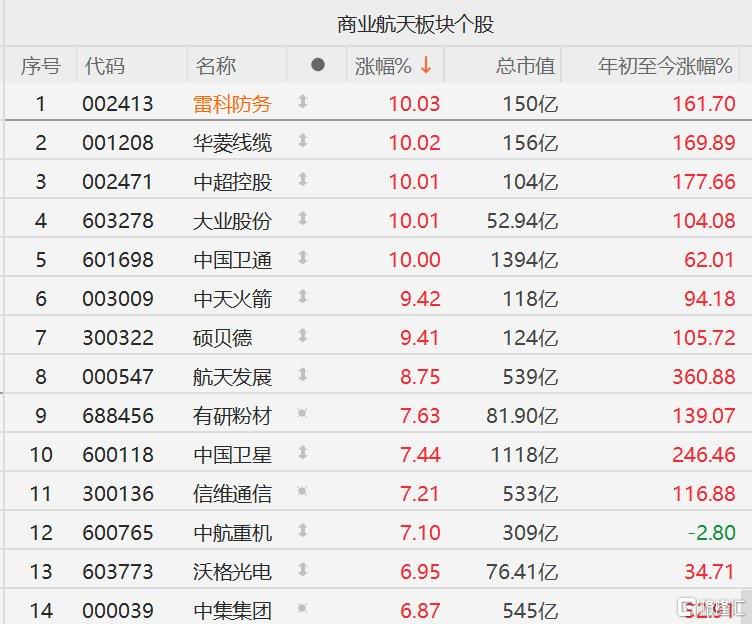
Group 1 - The A-share commercial aerospace concept stocks continue to show strong performance, with several companies experiencing significant price increases, including LeiKe Defense, Hualing Cable, and Zhongchao Holdings, among others [1] - Notable stock performances include LeiKe Defense with a 10.03% increase and a market capitalization of 15 billion, and China Satellite with a 7.44% increase and a market capitalization of 111.8 billion [2] - The commercial aerospace sector is witnessing a surge in stock prices, with multiple companies achieving consecutive trading limits, indicating strong investor interest and confidence in the sector [1][2] Group 2 - The Chinese commercial aerospace industry is entering a new phase characterized by high-frequency launches and systematic breakthroughs, as evidenced by the successful launches of the Long March 12 and Long March 8 rockets [1] - According to the "China Commercial Aerospace Industry Development Report (2025)," the global average monthly launches have exceeded 26, with China conducting 87 launches (84 successful) in 2025, showcasing a significant increase in launch frequency [3] - The commercial aerospace industry in China has reached a scale of 2.5 to 2.8 trillion, with an annual compound growth rate exceeding 20%, and the number of commercial aerospace companies surpassing 600 [3]



我国三大万颗星座计划,推动商业航天进入高速发展期
Huan Qiu Wang· 2025-12-06 01:21
Core Insights - The global satellite internet constellation is rapidly developing, with major players including Starlink, GW constellation, G60, Honghu-3, OneWeb, and Kuiper, particularly highlighting the advancements of SpaceX's Starlink project which has launched over 10,000 satellites as part of a planned 42,000 satellites [1] - China is also making significant strides with three major satellite constellation plans, including China Star Network (GW constellation), Shanghai Yuanxin (G60 Qianfan constellation), and Blue Arrow Hongqing Technology (Honghu-3 constellation), aiming to launch a total of 116 satellites by October 2025 [1] - The commercial space industry is characterized by market-driven activities where enterprises, including private and mixed-ownership companies, invest, operate, and bear risks across the entire aerospace value chain, covering technology R&D, manufacturing, launching, and application [1] Industry Developments - The report indicates that the launch schedule for national rockets like Long March 12, Long March 8A, and Long March 6 modified is tight due to other national space missions, leading to slower than expected overall launch progress [3] - There is an urgent need for high-capacity, low-cost, and reliable reusable rockets, with new commercial rocket models such as Zhuque-3, Tianlong-3, and others expected to debut by the end of 2025, which could accelerate the deployment of domestic low-orbit satellite constellations [3] - The satellite manufacturing process is evolving towards modular design, automated testing, and mass assembly, which is expected to release production capacity, while rocket launches are transitioning to reusable, low-cost, and high-capacity models, indicating a shift from validation to engineering application and large-scale development [3]
奋进“十五五” 续写新篇章|“航天强国”建设按下“加速键” 中国航天启征程
Yang Shi Wang· 2025-11-14 06:35
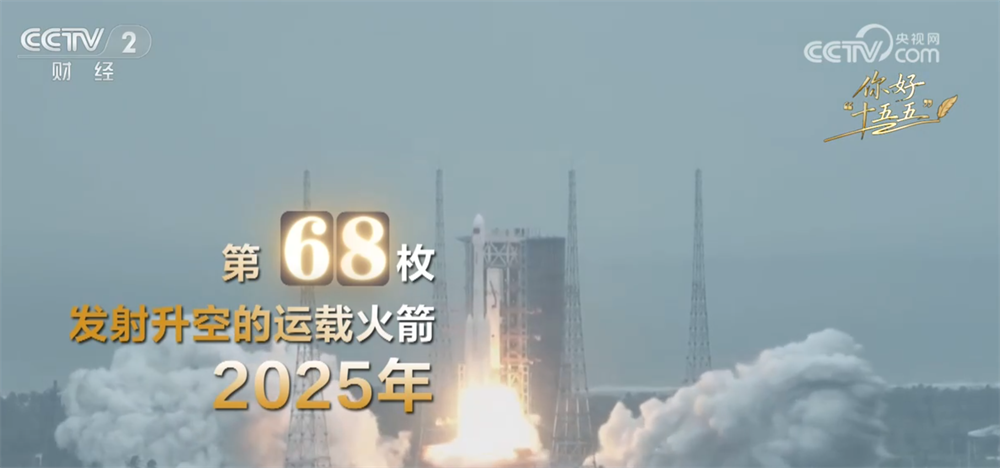
Core Viewpoint - The article highlights China's ambitious plans to strengthen its space industry as part of the "14th Five-Year Plan," marking a significant shift towards becoming a space power with a focus on commercial space activities and increased launch frequency [1][4]. Group 1: Achievements and Developments - On November 3, 2025, the Long March 7A rocket successfully launched the Yaogan-46 satellite, marking the 68th launch of the year, which matches the total number of launches in 2024 [1]. - The Long March 8A rocket is being developed to meet the demands of large low-orbit internet satellite constellations, aiming for low-cost and high-frequency launches [2]. - The Hainan commercial space launch site, built during the "14th Five-Year Plan," has successfully completed seven launch missions and is equipped for dual-position, multi-model, and high-frequency launches [2]. Group 2: Infrastructure and Industry Growth - A new rocket factory in Wenchang has been established, with an investment of 900 million yuan, aiming to produce reusable liquid rockets by mid-2026 [3]. - Wenchang has attracted over 700 aerospace-related companies, creating a collaborative ecosystem of "rocket chain, satellite chain, and data chain" [3]. - The integration of space activities with tourism is evident, with facilities like observation platforms and meteorite museums boosting local tourism [3]. Group 3: Future Prospects - The "14th Five-Year Plan" signals a transition from technology breakthroughs to an industry-supported model, which is crucial for developing new productive forces [4]. - The next five years are expected to witness more frequent launches and advanced satellite technologies, with aspirations for ordinary people to experience space travel [5]. - By 2030, there are expectations for Chinese astronauts to launch aboard the Long March 10 rocket, fulfilling a long-held national dream of lunar exploration [5].
奋进“十五五” 续写新篇章|“航天强国”建设按下“加速键” 中国航天启征程
Yang Shi Wang· 2025-11-13 05:13
Core Insights - The article emphasizes China's ambition to become a space power, as highlighted in the "14th Five-Year Plan," marking the first time this goal has been included in a national planning document [1][20] - The frequency of rocket launches in China is set to increase significantly, with 2025 expected to see a record number of launches, surpassing previous years [3][9] - The establishment of a comprehensive space industry ecosystem in Wenchang, Hainan, is underway, with over 700 aerospace companies now present [18][16] Group 1: Launch Achievements - The Long March 7A rocket successfully launched the Yaogan-46 satellite on November 3, 2025, marking the 68th launch of the year, equaling the total number of launches in 2024 [3][1] - The Wenchang Space Launch Site and Hainan Commercial Space Launch Site are set to complete four launches in November alone, indicating a busy schedule [3][9] Group 2: Technological Advancements - The Long March 8A rocket is being developed for commercial purposes, aiming for low-cost and high-frequency launches to meet the growing demand for satellite networks [7][9] - The design and production processes of rockets are becoming more modular and scalable, with plans to increase launch frequency from one per month to three every two months [9][11] Group 3: Infrastructure Development - The Hainan Commercial Space Launch Site, built during the "14th Five-Year Plan," has successfully completed seven launch missions and is enhancing its capabilities with an autonomous measurement and control system [11][13] - A new rocket factory in Wenchang has been established with an investment of 900 million yuan, aiming to produce reusable rockets by mid-2026 [15][16] Group 4: Industry Ecosystem - Wenchang is developing a synergistic industrial ecosystem comprising rocket, satellite, and data chains, with facilities like observation platforms and museums enhancing tourism [18][20] - The shift from technology-driven breakthroughs to industry-supported development is a key focus in the "14th Five-Year Plan," aiming to foster new productive forces [20][22] Group 5: Future Aspirations - Industry leaders express optimism about the future of commercial space launches in China, with expectations for more frequent launches and advanced technologies [25][20] - There are aspirations for Chinese astronauts to land on the moon by 2030, symbolizing a significant milestone in the nation's space exploration journey [25][22]
卫星通信将在更多领域落地!“宇宙级”大机遇来了
Qi Lu Wan Bao· 2025-09-20 01:45
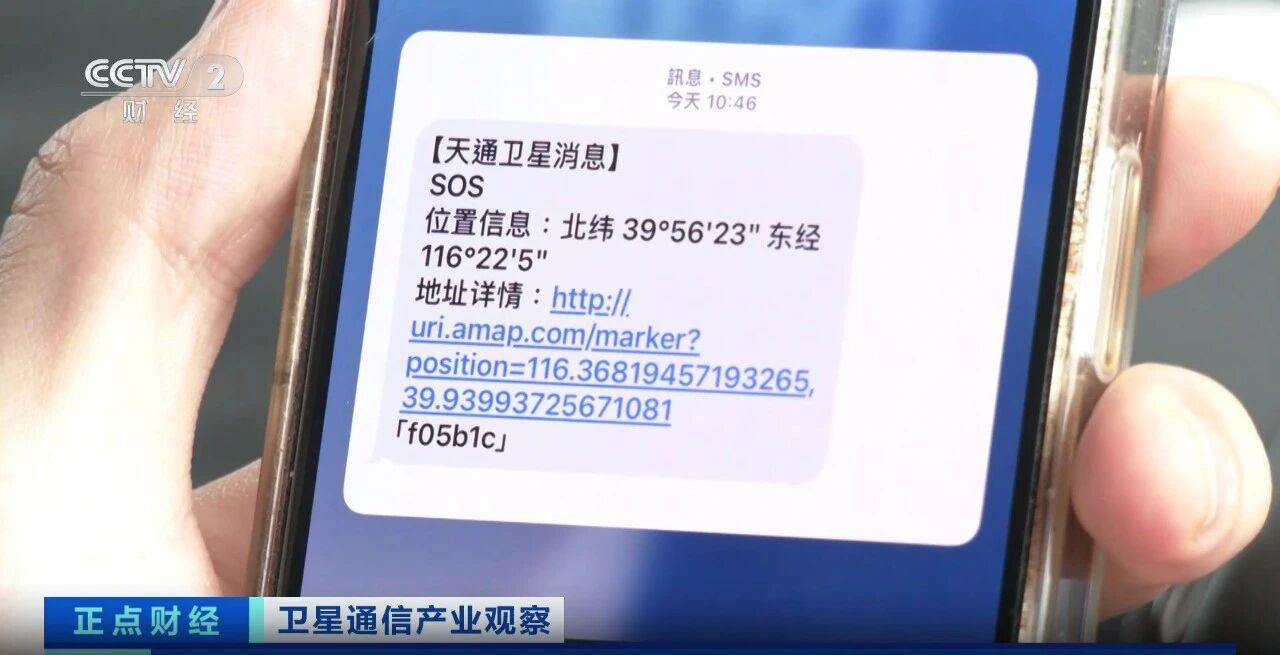
Core Viewpoint - The Ministry of Industry and Information Technology (MIIT) has issued guidelines to optimize business access and promote the development of the satellite communication industry, aiming to stimulate commercial space innovation and enhance high-quality development in related sectors [1] Group 1: Satellite Communication Development - Satellite communication allows direct connection without the need for ground base stations, enabling services like phone calls and messaging in areas lacking mobile network coverage [1] - As of September 2023, China Telecom has opened satellite direct connection services for mobile phones and vehicles, with nearly 3 million users of the Tian Tong satellite [3] - In July 2023, the monthly call minutes for the Tian Tong satellite exceeded 1 million, with 35 models of satellite direct connection phones launched, totaling over 23 million units shipped [5] - The MIIT has granted China Unicom a satellite mobile communication business license, with China Mobile's license expected soon, indicating an expansion of direct satellite services to a broader user base [6] Group 2: Integration with Ground Communication - Future developments in satellite communication are expected to integrate with ground mobile communication, expanding applications across various industries, including mobile phones, vehicles, and drones [8] Group 3: Satellite Internet Launches - China has planned to launch over 10,000 satellites to provide global network services, with recent successful launches of multiple low-orbit internet satellites [9] - The Long March 8 rocket has demonstrated high-density launch capabilities, with plans for five more launches before the Lunar New Year [14] - The industry is currently developing new rockets to meet the demand for launching thousands of low-orbit satellites, with several new rocket designs expected to achieve their first flights by the end of 2025 [20][24]
上天→入地→下海!“大国重器”捷报频传 为经济发展再添“硬核”动力
Yang Shi Wang· 2025-08-27 03:21
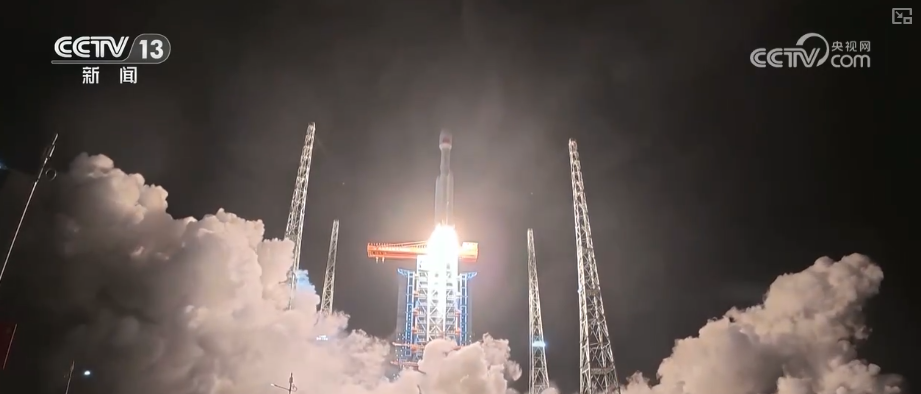
Group 1: Long March 8 Rocket Launch - The Long March 8 rocket successfully launched 10 low-orbit satellites for satellite internet on August 26, 2025, marking its third mission of the year [1][3] - The Long March 8 is an upgraded version designed for medium-sized liquid launch vehicles, capable of high-density launches and multiple concurrent missions [3][4] - The rocket implemented several technological innovations, including full-process automation and active drift control during takeoff, enhancing launch efficiency and flight stability [5][6] Group 2: Jiangmen Neutrino Experiment - The Jiangmen Neutrino Experiment, located 700 meters underground, officially began operations on August 26, 2025, after over ten years of preparation [7] - The core detector of the experiment is a 20,000-ton liquid scintillator detector, which has met or exceeded performance expectations during initial testing [9] - Neutrinos, fundamental particles of matter, are crucial for exploring the universe, and the experiment aims to capture these elusive particles using advanced technology [10][12] Group 3: Large Dredging Vessels - Two self-designed large dredging vessels, "Tongzhen" and "Junguang," were launched on August 26, 2025, after over three years of development [17][18] - Each vessel measures approximately 198 meters in length and has a maximum dredging depth of 120 meters, with a capacity of 35,000 cubic meters, equivalent to filling 18 standard swimming pools [20] - The vessels feature advanced systems for efficient dredging operations, including a powerful mud pump and an intelligent dredging control system, enhancing operational efficiency and environmental sustainability [22][24]
商业航天跟踪11期:双曲线一号遥十运载火箭发射成功,商业航天指数单周上涨0.75%
GUOTAI HAITONG SECURITIES· 2025-08-06 09:07
Investment Rating - The report does not explicitly provide an investment rating for the commercial aerospace industry Core Insights - The commercial aerospace index increased by 0.75% in the week of July 28 to August 1, 2025, with a trading volume increase of 11.40% [2][23] - Significant advancements in satellite internet and rocket technology were highlighted, including the successful launch of the Long March 8A rocket and the successful flight of the Dual Curve No. 10 rocket [7][12] - The report emphasizes the growing importance of commercial aerospace in China, showcasing innovations that enhance launch capabilities and reduce costs [8][19] Summary by Sections 1. Industry Development Dynamics - The Long March 8A rocket successfully launched a group of low-orbit satellites on July 30, 2025, marking a significant achievement in China's commercial aerospace capabilities [7] - The Dual Curve No. 10 rocket successfully completed its mission on July 29, 2025, validating the performance of new products and the safety of the launch vehicle [12] - The YH-1000 unmanned transport aircraft completed a successful cargo verification flight in complex terrain in Chongqing, demonstrating its operational capabilities [14] - The Falcon 9 rocket successfully launched multiple Starlink satellites, showcasing the ongoing advancements in commercial satellite deployment [17] 2. Industry Financing Progress - Taihu Xingyun completed over 50 million RMB in Series A financing, which will accelerate its development in satellite technology and applications [19] - Tianyu Hangtong secured several hundred million RMB in financing to support the production and delivery of its unmanned aircraft systems [20] 3. Capital Market Performance - The commercial aerospace index reached a high of 14672.2 and a low of 14383.3 during the week, with 43.94% of companies in the industry seeing stock price increases [23][26] - Notable stock performers included Guanshang Technology, Aerospace Power, and Aileda, with weekly increases of 18.80%, 13.95%, and 13.22% respectively [23][26] 4. Industry Conference Preview - Upcoming conferences include the 21st Academic Annual Meeting on Deep Space Exploration Technology in July and the 42nd Academic Annual Meeting on Solid Rocket Propulsion in August [31]