
长青系列信托产品

Search documents
收割了6800个百万富豪200亿,“雪松案”宣判
Xin Lang Cai Jing· 2026-02-11 00:40
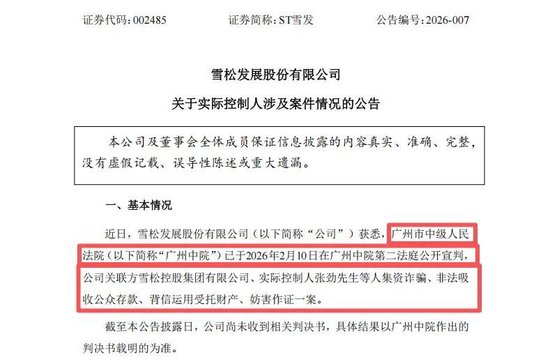
Core Viewpoint - The court has publicly announced the verdict regarding the case of fundraising fraud and illegal public deposit absorption involving Xuesong Holdings Group and its actual controller Zhang Jin, marking a significant legal development for the company [1][8]. Legal Proceedings - On February 10, 2026, the Guangzhou Intermediate People's Court announced the verdict in the case against Xuesong Holdings and Zhang Jin, with sentences ranging from life imprisonment to 14 years for various individuals involved [2][10]. - The company has not yet received the official judgment document, and the specific details will be based on the court's written ruling [2][10]. Company Background - Xuesong Holdings was once the largest private enterprise in Guangzhou after Evergrande and was listed among the Fortune Global 500 for four consecutive years [2][10]. - In 2021, Xuesong Holdings reported a revenue of 233.4 billion yuan, ranking 359th [2][10]. - The company faced significant issues in early 2022 when it was revealed that many of its financial products were overdue, involving approximately 20 billion yuan and around 6,800 investors, with an average investment of 2.94 million yuan per person [2][10]. Financial Misconduct - Investigations revealed that Xuesong Holdings had fabricated underlying assets for its financial products, leading to accusations of self-financing without real asset support [4][12]. - The company was accused of transferring approximately 100 million yuan overseas through underground banks and maintaining a "small treasury" of 8.4 billion yuan for personal luxury purchases [4][12]. Business Model Concerns - Xuesong Holdings acquired Zhongjiang Trust in 2019, rebranding it as Xuesong Trust, and launched various financial products promising high annual returns of 8% to 12% to attract small and medium investors [5][13]. - From January 2020, the company issued 1,490 financial products, raising 59.6 billion yuan, with 20 billion yuan unable to be repaid, indicating a closed-loop self-financing scheme [5][13]. Revenue Integrity Issues - Industry analysis has raised concerns about the legitimacy of Xuesong's revenue figures, noting a net profit of only 4.96 million dollars in 2020, with a net profit margin of 0.15%, indicating weak self-sustaining capabilities [6][14]. - Following the financial scandals, Xuesong Holdings, along with other companies like Evergrande, has fallen off the Fortune Global 500 list [6][14].

穿透158亿“自融”迷局:雪松信托案的刑事风险警示
Xin Lang Cai Jing· 2026-01-23 05:36
Core Viewpoint - The downfall of Xuesong Trust is attributed to a self-financing scheme disguised as "trust innovation," leading to significant financial losses for over 6,800 investors and exposing criminal risks within the trust industry [1][2][3]. Timeline of Events - In 2019, Xuesong Holdings acquired Zhongjiang Trust for 5.6 billion yuan, marking the beginning of a self-financing scheme under the guise of trust innovation [21]. - By late 2021, multiple "Changqing" products announced payment delays, revealing the falsity of underlying assets, with approximately 20 billion yuan in unpaid funds affecting over 6,800 investors [22]. - In 2024, criminal investigations were initiated, leading to charges against the actual controller Zhang Jin and 18 core personnel for various financial crimes, including the misuse of entrusted property [24][25]. - A court hearing in September 2025 focused on the misuse of entrusted property, with evidence indicating that 15.8 billion yuan was misappropriated for the benefit of Xuesong Holdings [6][25]. Legal Framework and Crime Analysis - The case exemplifies the crime of "misuse of entrusted property," which is a unit crime under Article 185-1 of the Criminal Law, applicable only to financial institutions and their responsible personnel [26][27]. - The crime's four key elements include the subject (financial institutions), subjective intent (knowledge of fiduciary duty), objective behavior (breach of fiduciary duty), and severity of circumstances (involving over 15.8 billion yuan) [27][28]. Judicial Considerations - The judicial process emphasizes the need to establish whether the breach of trust reflects the collective intent of the unit, with key evidence including company resolutions and decision-making records [29][30]. - The principle of "dual punishment" applies, holding both the unit (Xuesong Trust) and individual responsible parties accountable, ensuring comprehensive legal consequences for both institutional and personal misconduct [30]. Social Implications - The case serves as a warning for the trust industry to return to its core principle of fiduciary responsibility, highlighting the risks of using trust licenses for self-financing [31]. - It establishes a judicial benchmark for dual-line accountability, providing a reference for future cases involving similar financial misconduct [32]. Future Predictions - The likelihood of conviction is high, with potential severe penalties for the actual controller due to the significant amounts involved and the nature of the crimes [34]. - The recovery of assets is expected to be challenging, with investor compensation likely to be less than 30% due to the misappropriation of funds and the financial instability of Xuesong Holdings [35]. - Regulatory measures are anticipated to tighten, increasing compliance costs for the trust industry and promoting a shift towards more standardized practices [35].