自融

Search documents
“广州前首富”被判无期!“雪松系”200亿集资窟窿何偿?
Xin Lang Cai Jing· 2026-02-11 12:42
Core Viewpoint - The collapse of Xuesong Holdings, once a prominent enterprise in Guangzhou and a member of the "Fortune Global 500," is attributed to a massive financial fraud scheme that resulted in significant losses for investors and severe legal consequences for its executives [3][22][23]. Group 1: Legal Proceedings and Consequences - On February 10, the Guangzhou Intermediate People's Court sentenced Zhang Jin, the actual controller of Xuesong Holdings, to life imprisonment and confiscated all his personal assets due to charges of fundraising fraud and illegal public deposit acceptance [3][25][27]. - Nineteen core executives of Xuesong Holdings were also implicated, with sentences ranging from 5 to 14 years for various financial crimes, and the company itself was fined 1.1 billion yuan [6][26][27]. - The court found that Xuesong Holdings had illegally raised hundreds of billions of yuan, with 84 billion yuan misappropriated by Zhang Jin for personal use [9][27]. Group 2: Financial Mismanagement and Fraud Mechanisms - Xuesong Holdings' financial troubles began with its reliance on "financing trade," where it falsely represented trade activities to secure loans, leading to inflated revenue figures [10][30]. - The company issued approximately 1,490 illegal financial products, affecting nearly 8,000 investors and resulting in over 20 billion yuan in losses for more than 6,800 participants [10][30][38]. - The firm was also found to have engaged in self-financing practices, which are illegal and increased financial risks [12][32]. Group 3: Historical Context and Growth - Xuesong Holdings was established from the reorganization of Junhua Group in 2015, achieving rapid revenue growth from 593 billion yuan in 2015 to 2.21 trillion yuan in 2017, which contributed to its recognition as a "Fortune Global 500" company [14][34]. - The ambitious "three trillion" goals set by Zhang Jin aimed for a trillion in sales, assets, and market value within five years, leading to aggressive expansion and acquisitions [15][35][37]. - Despite its initial success, the company's aggressive strategies and lack of risk management ultimately led to its downfall as market conditions changed [17][37].

穿透158亿“自融”迷局:雪松信托案的刑事风险警示
Xin Lang Cai Jing· 2026-01-23 05:36
Core Viewpoint - The downfall of Xuesong Trust is attributed to a self-financing scheme disguised as "trust innovation," leading to significant financial losses for over 6,800 investors and exposing criminal risks within the trust industry [1][2][3]. Timeline of Events - In 2019, Xuesong Holdings acquired Zhongjiang Trust for 5.6 billion yuan, marking the beginning of a self-financing scheme under the guise of trust innovation [21]. - By late 2021, multiple "Changqing" products announced payment delays, revealing the falsity of underlying assets, with approximately 20 billion yuan in unpaid funds affecting over 6,800 investors [22]. - In 2024, criminal investigations were initiated, leading to charges against the actual controller Zhang Jin and 18 core personnel for various financial crimes, including the misuse of entrusted property [24][25]. - A court hearing in September 2025 focused on the misuse of entrusted property, with evidence indicating that 15.8 billion yuan was misappropriated for the benefit of Xuesong Holdings [6][25]. Legal Framework and Crime Analysis - The case exemplifies the crime of "misuse of entrusted property," which is a unit crime under Article 185-1 of the Criminal Law, applicable only to financial institutions and their responsible personnel [26][27]. - The crime's four key elements include the subject (financial institutions), subjective intent (knowledge of fiduciary duty), objective behavior (breach of fiduciary duty), and severity of circumstances (involving over 15.8 billion yuan) [27][28]. Judicial Considerations - The judicial process emphasizes the need to establish whether the breach of trust reflects the collective intent of the unit, with key evidence including company resolutions and decision-making records [29][30]. - The principle of "dual punishment" applies, holding both the unit (Xuesong Trust) and individual responsible parties accountable, ensuring comprehensive legal consequences for both institutional and personal misconduct [30]. Social Implications - The case serves as a warning for the trust industry to return to its core principle of fiduciary responsibility, highlighting the risks of using trust licenses for self-financing [31]. - It establishes a judicial benchmark for dual-line accountability, providing a reference for future cases involving similar financial misconduct [32]. Future Predictions - The likelihood of conviction is high, with potential severe penalties for the actual controller due to the significant amounts involved and the nature of the crimes [34]. - The recovery of assets is expected to be challenging, with investor compensation likely to be less than 30% due to the misappropriation of funds and the financial instability of Xuesong Holdings [35]. - Regulatory measures are anticipated to tighten, increasing compliance costs for the trust industry and promoting a shift towards more standardized practices [35].
多家私募沦为违规债券发行通道 协助自融或返费 监管部门集体出手处罚
智通财经网· 2025-08-10 22:40
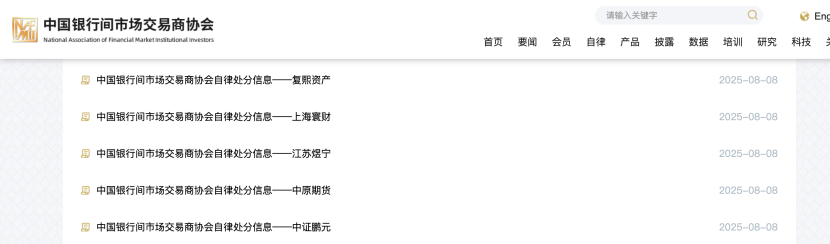
Core Viewpoint - The China Interbank Market Dealers Association has issued multiple disciplinary announcements targeting private equity firms, highlighting violations in the bond issuance process, particularly focusing on "self-financing" and "rebate" practices [1][8]. Group 1: Disciplinary Actions - On August 8, the Association disclosed five self-regulatory disciplinary actions, with three directed at private equity institutions, including severe warnings for Shanghai Fuxi and Jiangsu Yuning, and a warning for Shanghai Huancai [1][2]. - The involved private equity firms face multiple penalties from local securities regulatory authorities, the Asset Management Association of China, and the Dealers Association [3]. Group 2: Violations Identified - The violations can be categorized into three main types: 1. Assisting in "self-financing" issuance, exemplified by Shanghai Huancai, which raised funds for itself or related parties bypassing normal financing reviews [4]. 2. Engaging in "rebate" issuance, where firms like Shanghai Fuxi and Jiangsu Yuning assisted multiple issuers in non-market-based issuance, receiving substantial financial support or service fees, distorting bond pricing mechanisms [4]. 3. Cross-business violations and conflicts of interest, with some private equity firms engaging in conflicting businesses or profiting from fund assets, as seen with Shanghai Fuxi [4]. Group 3: Previous Penalties - Prior to the recent actions, these firms had already faced penalties from local securities regulators and the Asset Management Association of China, with Jiangsu Yuning and Shanghai Huancai having their registrations revoked [5][6]. - Shanghai Fuxi was previously sanctioned for utilizing fund assets for profit and engaging in unrelated or conflicting business activities, leading to a suspension of its private equity fund product registration for 12 months [7]. Group 4: Broader Context - The Association has intensified its crackdown on non-market-based bond issuance practices, which disrupt market order and allow entities lacking the ability to issue bonds to increase their debt scale, thereby accumulating credit risk [9]. - The Association has issued guidelines to regulate such behaviors and has taken strict measures against institutions involved in "self-financing" and "rebate" issuance, including severe penalties and business suspensions [9].
金融圈罕见!密集出手了
Zhong Guo Ji Jin Bao· 2025-07-14 13:03
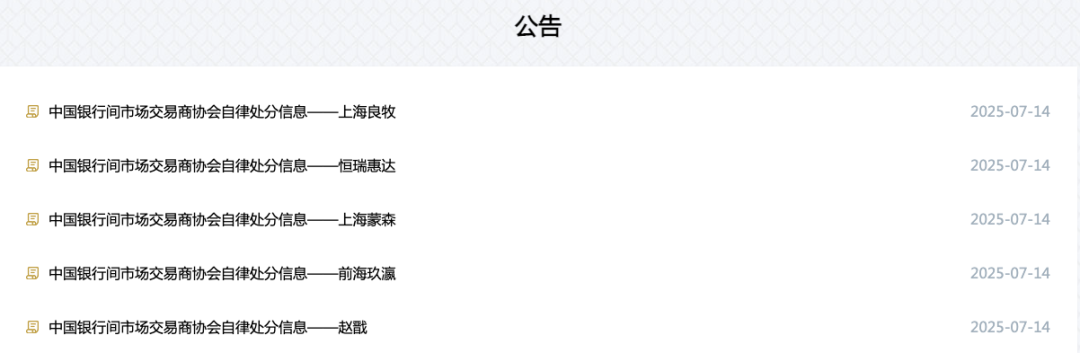
Core Viewpoint - The China Interbank Market Dealers Association has issued five self-discipline announcements, warning four asset management companies and one individual for engaging in "self-financing" and "rebate" issuance practices, as well as violating regulations by holding debt financing tools on behalf of related parties [1] Group 1: Self-Discipline Announcements - Shanghai Liangmu Investment Management Co., Ltd. was severely warned for assisting an issuer in "self-financing" and "rebate" issuance through asset management products, collecting large service fees [2] - Beijing Hengrui Huida Investment Management Co., Ltd. received a severe warning for signing agreements with an issuer to assist in "rebate" issuance through related party subscriptions, also collecting large service fees [2] - Mengsen (Shanghai) Investment Management Co., Ltd. was warned for using nested trust products to assist an issuer in "rebate" issuance and collecting large service fees [3] - Shenzhen Qianhai Jiuying Asset Management Co., Ltd. was warned for illegally holding debt financing tools on behalf of related parties, affecting market trading order [3] - A private fund manager, Zhao Jian, was warned for assisting an issuer in "self-financing" issuance and arranging multiple institutions for "holding" transactions, impacting market trading order [3] Group 2: Regulatory Context - "Self-financing" refers to issuers purchasing their own bonds through subscription or buyback, while "rebate" involves issuers providing additional compensation to investors to achieve lower coupon rates [3] - Industry insiders indicate that "self-financing" and "rebate" practices can distort issuance rates and disrupt market order, potentially leading to corruption [4] - The Dealers Association's intervention aims to curb malicious competition in the industry and promote a return to professionalism and market-oriented practices [4] Group 3: Regulatory Measures - The Dealers Association has intensified supervision of violations in the bond underwriting process, issuing a notice in June that prohibits issuers and underwriters from pre-agreeing on bond issuance rates and using "rebate" methods to distort market prices [4] - The notice also states that underwriters must not quote below cost for underwriting fees and must fulfill payment obligations according to commercial agreements [4] - Investors are prohibited from assisting issuers in "self-financing" and engaging in insider trading, market manipulation, and non-market-based issuance activities [4] - Previous regulatory documents from 2022 and 2023 have reiterated that underwriters must not quote below cost and must not provide additional compensation through rebates or disguised forms [5]
金融圈罕见!密集出手了
中国基金报· 2025-07-14 12:40
Core Viewpoint - The China Interbank Market Dealers Association has issued five self-discipline announcements, warning four asset management companies and one individual for engaging in "self-financing" and "rebate" issuance practices, as well as for violating regulations by holding debt financing tools on behalf of related parties [2][3]. Group 1: Self-Discipline Announcements - Shanghai Liangmu Investment Management Co., Ltd. was severely warned for assisting an issuer in "self-financing" and "rebate" issuance through asset management products, collecting large service fees [2]. - Beijing Hengrui Huida Investment Management Co., Ltd. received a severe warning for signing an agreement with an issuer to assist in "rebate" issuance through related party subscriptions, also collecting large service fees [2]. - Mengsen (Shanghai) Investment Management Co., Ltd. was warned for using nested trust products to assist an issuer in "rebate" issuance and collecting large service fees [3]. - Shenzhen Qianhai Jiuying Asset Management Co., Ltd. was warned for illegally holding debt financing tools on behalf of related parties, affecting market trading order [3]. - A private fund manager, Zhao Jian, was warned for assisting an issuer in "self-financing" issuance and arranging multiple institutions for "holding" transactions, impacting market trading order [3]. Group 2: Definitions and Implications - "Self-financing" refers to the behavior where issuers buy back their own bonds through subscription or post-listing methods for self-use of funds [3]. - "Rebate" involves issuers providing additional compensation to investors to achieve lower coupon rates, distorting issuance rates and market order [3]. - Industry insiders indicate that practices like "self-financing" and "rebate" can distort issuance rates, affect market operations, and potentially lead to corruption [3]. Group 3: Regulatory Measures - The Dealers Association has intensified its regulatory efforts on bond underwriting violations, issuing a notice in June that prohibits issuers and underwriters from pre-agreeing on bond issuance rates and using "rebate" methods to distort market prices [4]. - The notice also states that underwriters must not quote below cost in bond project bidding and must fulfill payment obligations as per commercial agreements [4]. - Previous regulatory documents from 2022 and 2023 have reiterated the prohibition of low-cost bidding and the use of rebates or disguised rebates to interfere with market rate formation [4].