
韦布空间望远镜

Search documents
天文学家首次观察到恒星直接坍缩成黑洞,为解释黑洞起源提供关键线索
Ke Ji Ri Bao· 2026-02-22 10:31
Core Findings - Astronomers have observed a massive star, M31-2014-DS1, directly collapsing into a black hole without undergoing a supernova explosion, marking a significant advancement in understanding stellar evolution into black holes [2][3] - The research, published in the journal Science, is based on over a decade of monitoring and analysis of historical data, providing the most comprehensive physical picture of how stars evolve into black holes [2] Observation Details - The star M31-2014-DS1 is located approximately 2.5 million light-years away in the Andromeda galaxy, with infrared radiation showing abnormal brightness since 2014, followed by a sharp decline in brightness in 2016 [2] - By 2022-2023, the star became nearly invisible in visible and near-infrared wavelengths, with brightness reduced to one ten-thousandth of its original level, only retaining a weak signal in the mid-infrared range [2] Theoretical Implications - The sudden drop in brightness and eventual disappearance strongly indicates that the star's core underwent gravitational collapse to form a black hole, providing direct evidence for a theoretical process where if an outward shock wave fails to eject outer material, it falls back onto the neutron star, leading to black hole formation [3] - The study highlights the role of convective motions in the star's outer layers, which impede material from directly falling into the black hole, with only about 1% of the star's outer material ultimately being consumed [3] Broader Impact - This research has garnered significant attention in the astronomical community as it validates and refines theoretical models of massive star collapse into black holes, offering crucial insights into the origins of black holes [4] - The newly formed black hole will continue to emit infrared radiation from surrounding dust and debris for decades, allowing for long-term monitoring of similar celestial bodies with advanced telescopes like the James Webb Space Telescope [5]

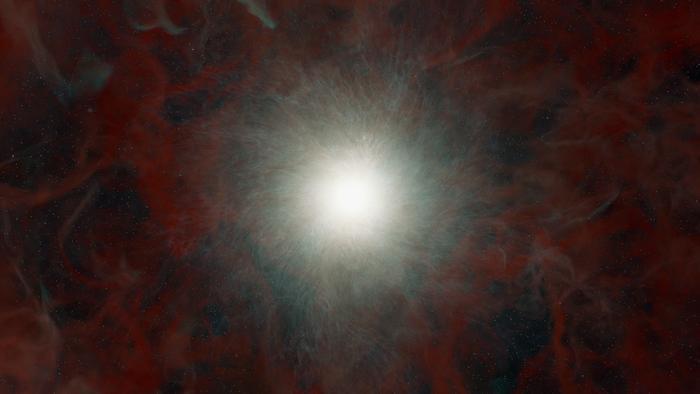
SPHEREx望远镜绘出102色全天空红外图谱
Huan Qiu Wang Zi Xun· 2025-12-23 01:36
Core Insights - NASA's SPHEREx space telescope has successfully created the first all-sky infrared map with 102 colors, aiding in the understanding of physical processes post-Big Bang and the evolution of galaxies over nearly 14 billion years [1][2] - The telescope, launched in March, orbits the Earth approximately 14.5 times a day and captures around 3,600 images daily, achieving full-sky coverage after six months of operation [1] - SPHEREx's unique capability lies in its ability to capture a wide range of infrared colors simultaneously, providing detailed information about star and planet formation regions [2] Group 1 - SPHEREx was launched in March and has completed a full-sky survey, producing a panoramic image by December [1] - The telescope operates with six detectors, each equipped with specially designed filters to capture 17 gradient colors, resulting in images composed of 102 different color layers [1] - The combination of wide field of view and multi-color detection distinguishes SPHEREx from other survey projects, such as NASA's Wide-field Infrared Survey Explorer [2] Group 2 - SPHEREx captures infrared light that is not visible to the human eye, providing unique insights into the universe's structure and the distribution of key materials for life within the Milky Way [2] - Previous projects have created all-sky maps, but none have matched SPHEREx's ability to capture such a rich array of colors simultaneously [2] - The telescope's observations will enhance the understanding of cosmic phenomena and the conditions necessary for life [1][2]
地球附近“三体”星系中观测到宜居带候选行星
Xin Hua She· 2025-08-11 06:47
Core Points - An international research team has observed a candidate exoplanet located in the habitable zone of the Alpha Centauri star system using NASA's James Webb Space Telescope [1] - The Alpha Centauri system is approximately 4 light-years away from Earth and consists of three stars, with the brightest star, A, being similar to the Sun [1] - The observed candidate exoplanet is a gaseous planet orbiting star A within the habitable zone, which is the region where conditions may be suitable for life [1] - Most exoplanets have been discovered through indirect methods, but this observation utilized direct imaging techniques to capture high-resolution images of the planet [1] - The research team plans to conduct further observations to confirm their findings, which, if validated, would mark the first direct imaging of an exoplanet in a star's habitable zone [1] - Although the gaseous planet itself is unlikely to support life, it raises exciting possibilities for assessing the habitability of its moons [1] Publication Information - The related paper has been published in the Astrophysical Journal Letters [2]