
风和

Search documents
研发语料库,气象服务可定制(创新故事)
Ren Min Ri Bao· 2026-01-08 22:51
Group 1 - The core viewpoint of the news is the launch of "Fenghe," China's first generative AI meteorological service language model, which provides personalized and intelligent weather-related services [1] - Fenghe has a high-quality meteorological service corpus of 50 million tokens and a question-answer instruction set of 490,000, offering various data interfaces and personalized tools for sectors like energy, transportation, and tourism [1] - The AI model is already being applied in various meteorological departments, including its integration with the "Sui Xiao Tian" mini-program during the 15th National Games in Guangzhou [1] Group 2 - The development of Fenghe involved breakthroughs in four key technologies: corpus construction, knowledge enhancement and scene fine-tuning, deep reasoning, and multi-agent collaboration [2] - The corpus construction technology converts vast meteorological data into a specific format for the model to learn, while the fine-tuning technology enhances the model's ability to understand user needs and execute complex tasks [2] - The team faced challenges during the development process but remained committed to innovation and recognized the need for further technical support to embrace the AI era in meteorological services [2] Group 3 - Looking ahead to the 14th Five-Year Plan, the training, reasoning, and iteration of AI models will require stronger computing capabilities and large-scale high-quality corpora [3] - There is a need to continuously enhance learning, highlight advantages, and refine the application of intelligent agents in various scenarios to promote the deep integration of "AI+" in meteorological services [3]
气象人工智能预报模型上新升级 五大模型分工协作赋能千行百业
Jing Ji Ri Bao· 2026-01-03 23:44
Core Viewpoint - The article discusses the advancements in artificial intelligence (AI) models for meteorological services in China, highlighting the launch of new AI models that enhance weather forecasting and disaster warning capabilities in response to increasingly complex climate conditions. Group 1: AI Model Developments - The China Meteorological Administration (CMA) has released the AI model "Fengyuan" and upgraded three other models: "Fengqing," "Fenglei," and "Fengshun," to improve weather forecasting and warning capabilities [1][2] - The newly launched "Fenghe" model, with a trillion parameters, collaborates with the other models to provide personalized weather services across various sectors [1][2] Group 2: Applications and Services - AI is deeply integrated into meteorological services, providing personalized travel and health guidance, and supporting decision-making in agriculture, energy, and transportation [2] - The "Fenghe" model can offer tailored solutions based on intelligent analysis, covering multiple scenarios related to weather [2] Group 3: Precision and Efficiency - The upgraded "Fengshun" model focuses on key agricultural and energy needs, adding over ten critical meteorological factors to enhance service precision [3] - The "Fenglei" model has shown a 25% improvement in the quality of severe weather predictions, demonstrating its effectiveness in real-time disaster warnings [4] Group 4: Future Directions - The CMA's strategy for 2025-2035 emphasizes the integration of numerical forecasting with AI to enhance simulation and prediction capabilities of Earth's systems [7] - The AI models are expected to significantly improve forecasting accuracy and computational efficiency, with the "Fengqing" model capable of generating 15-day global weather forecasts in just three minutes [7]
气象人工智能预报模型上新升级
Xin Lang Cai Jing· 2026-01-03 22:20
Core Insights - The article discusses the advancements in artificial intelligence (AI) models for meteorological services in response to increasing climate variability and extreme weather events, highlighting the launch of new AI models by the China Meteorological Administration (CMA) [2][3][4] Group 1: AI Model Developments - The CMA has released the AI model "Fengyuan" and upgraded three other models: "Fengqing," "Fenglei," and "Fengshun," enhancing the precision and timeliness of weather forecasts [2][3] - The "Fenghe" model, with a trillion parameters, is designed to provide personalized weather services across various sectors, including transportation and agriculture [3][4] Group 2: Enhanced Forecasting Capabilities - The upgraded "Fengshun" model focuses on key meteorological factors such as daily maximum/minimum temperatures and solar radiation, significantly improving the ability to respond to agricultural weather disasters [4][5] - The "Fenglei" model has shown a 25% improvement in the quality of severe weather predictions, particularly for thunderstorms and short-term heavy rainfall [5][6] Group 3: Integration of AI in Meteorology - AI technology is becoming a crucial link between weather forecasting, disaster warning, and emergency response, addressing the challenges posed by extreme weather events [5][6] - The "Fengyuan" model can directly analyze real-time observational data from satellites and weather stations, aiming to enhance the accuracy of weather predictions [6][7] Group 4: Future Directions - The CMA's strategy for 2025-2035 emphasizes the integration of numerical forecasting with AI, aiming to improve the simulation and prediction capabilities of Earth system interactions [7] - The AI models are expected to provide higher resolution forecasts and longer prediction periods, significantly enhancing disaster response and decision-making processes [7]

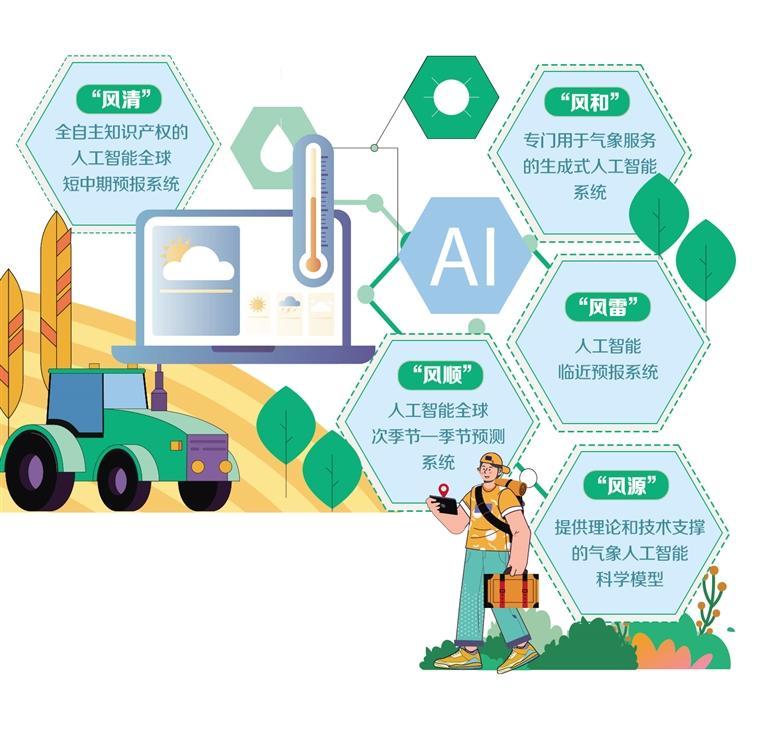
气象人工智能预报模型上新升级——五大模型分工协作赋能千行百业
Jing Ji Ri Bao· 2026-01-03 22:01
Core Viewpoint - The article discusses the advancements in artificial intelligence (AI) models for meteorological services in China, highlighting the launch of new AI models by the China Meteorological Administration (CMA) to enhance weather forecasting and disaster warning capabilities in the context of increasingly complex climate conditions. Group 1: AI Model Developments - The CMA has released the "Fengyuan" AI model and upgraded three other models: "Fengqing," "Fenglei," and "Fengshun," to improve weather forecasting and warning capabilities [1][2] - The "Fenghe" model, with a trillion parameters, is designed for personalized weather services across various sectors, including transportation and health [2] Group 2: Applications and Benefits - The upgraded "Fengshun" model focuses on agricultural, renewable energy, and water resource needs, adding over ten key meteorological factors such as daily maximum and minimum temperatures [3] - The "Fenglei" model has shown a 25% improvement in the quality of severe weather predictions, particularly for thunderstorms and heavy rainfall [4] Group 3: Technological Integration - AI technology is becoming a crucial link between weather forecasting, disaster warning, and emergency response, addressing the challenges posed by extreme weather events [4] - The "Fengyuan" model can directly analyze real-time observational data from satellites and weather stations, enhancing the accuracy of global weather forecasts [5] Group 4: Future Directions - The CMA's strategy for 2025-2035 emphasizes the integration of numerical forecasting with AI to improve simulation and prediction capabilities of Earth's systems [7] - The AI models are expected to significantly enhance forecasting precision and efficiency, with the "Fengqing" model capable of generating 15-day global weather forecasts in just three minutes [7]
气象服务系统“风和”有多智能?一文了解
Yang Shi Xin Wen· 2025-10-29 10:26
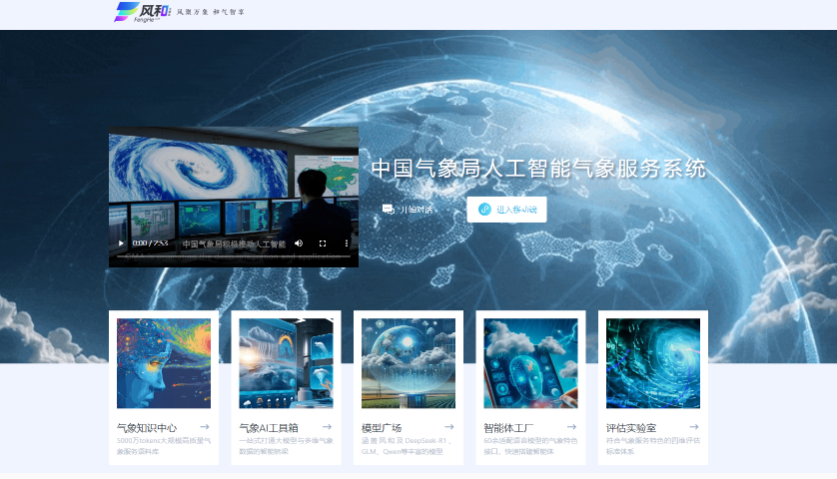
Core Insights - The China Meteorological Administration has launched an AI meteorological service system named "Fenghe," which significantly enhances smart meteorological service capabilities, featuring data fusion, real-time human-machine interaction, and intelligent tool invocation [1][4]. Group 1: Features and Capabilities - "Fenghe" allows users to input weather-related queries and receive automated responses, providing personalized suggestions across various scenarios such as travel, health, and logistics [3][4]. - The system includes five major modules: Meteorological Knowledge Center, Model Plaza, Meteorological AI Toolbox, Intelligent Agent Factory, and Evaluation Laboratory, which collectively enhance its service capabilities [4]. Group 2: Technical Framework - The design of "Fenghe" is based on a unique "1+1+N" technical framework, integrating a foundational model with professional meteorological knowledge and a large-scale meteorological service corpus of 550 billion tokens [5]. - The system employs advanced technologies such as LoRA for fine-tuning, reinforcement learning from human feedback (RLHF) for deep reasoning, and multi-agent collaborative technology to improve understanding of user needs and adaptability to various scenarios [5].
国内首个!千亿级!会让天气预报更准吗?
Huan Qiu Wang Zi Xun· 2025-10-29 04:41
Core Insights - The China Meteorological Administration has launched the "Fenghe" model, a billion-parameter meteorological service model that integrates AI technology with meteorological expertise, aiming to transform traditional weather services into an intelligent new phase [1][2]. Group 1: Technical Features of "Fenghe" - "Fenghe" is a generative AI system specifically designed for meteorological services, built on a large language model architecture, distinguishing it from traditional numerical weather prediction models [2]. - The model boasts a powerful core with a trillion parameters, indicating its strong learning and expressive capabilities, allowing it to capture intricate atmospheric phenomena [2]. - Through multimodal integration and generative AI technology, "Fenghe" aims to provide more accurate forecasts, achieving high resolution, efficiency, and rapid response in intelligent meteorological services [2]. Group 2: Comparison with Previous Models - Previous models like "Fengqing," "Fenglei," and "Fengshun" were primarily designed for internal meteorological forecasting systems, focusing on enhancing the core technology of large model predictions [3]. - "Fenghe" is targeted at the public and industry, addressing the limitations of existing general models in understanding meteorological service needs and generating professional content [3]. - The model aims to deliver reliable, usable, and trustworthy meteorological decision-making information, surpassing the capabilities of general models in terms of professionalism, precision, safety, and cost-effectiveness [3]. Group 3: Impact on Public Services - "Fenghe" is expected to revolutionize public travel services by providing unprecedented precision and detail in travel decision support, moving beyond traditional weather forecasts [5]. - For example, it can simulate microclimate conditions in complex areas, offering specific forecasts for different locations, such as predicting sunny conditions on one slope while rain occurs on another [5]. - The service will transition from regional forecasts to point-to-point forecasts, enabling proactive intelligent interventions for optimal travel decision-making [6].