
风清

Search documents
AI让气象预报更准确,期待人工智能更好地落地生根
Ren Min Ri Bao· 2026-01-27 01:36
Core Insights - Artificial intelligence (AI) is rapidly transforming various sectors, including agriculture, healthcare, and logistics, by enhancing productivity and service delivery [1] - The "Fenghe" system represents a significant advancement in AI-driven meteorological services in China, showcasing the integration of complex knowledge systems with diverse user needs [1] - The future of AI in industries hinges on the effective connection between technology and demand, aiming to elevate AI from being merely usable to truly transformative [1] Group 1: AI in Meteorology - The application of AI in meteorology is expanding, with new models emerging to enhance the industry's capabilities [2] - Prior to "Fenghe," the China Meteorological Administration launched several AI models, including "Fenglei" for severe weather prediction and "Fengqing" for global forecasting [2] - The introduction of AI technology, combined with traditional forecasting methods and expert experience, is improving the accuracy of weather predictions [2] Group 2: Advancements in Meteorological Services - AI models are being developed for extreme precipitation forecasting, severe weather warnings, and data assimilation, contributing to the digital and intelligent transformation of meteorological services [3] - These advancements are providing essential support for better meteorological services, enhancing their role in daily life and production [3]
让创新技术更好地落地生根(快评)
Ren Min Ri Bao· 2026-01-08 22:50
Core Insights - Artificial intelligence (AI) is rapidly transforming various sectors, including agriculture, healthcare, and logistics, by enhancing productivity and service delivery [1] - The Fenghe system represents a significant advancement in AI-driven meteorological services, showcasing the integration of complex knowledge systems with diverse user needs [1] Group 1: AI in Meteorology - The application of AI in meteorology is expanding, with new models and scenarios emerging to empower the industry [2] - Prior to Fenghe, the China Meteorological Administration launched several AI models, including Fenglei for severe weather forecasting and Fengqing for global short to medium-term forecasting [2] - In 2024, the China Meteorological Administration will initiate a demonstration plan for AI weather forecasting models, highlighting the integration of forecasting models with innovative meteorological services [2] Group 2: Enhancements in Weather Forecasting - The integration of AI with traditional meteorological techniques and the expertise of forecasters has improved forecasting accuracy [3] - AI models have emerged in areas such as extreme precipitation prediction, severe convective weather warnings, and meteorological data assimilation, driving the digitalization and intelligence of meteorological services [3] - These advancements provide crucial support for enhancing meteorological services that benefit production and daily life [3]
气象人工智能预报模型上新升级 五大模型分工协作赋能千行百业
Jing Ji Ri Bao· 2026-01-03 23:44
Core Viewpoint - The article discusses the advancements in artificial intelligence (AI) models for meteorological services in China, highlighting the launch of new AI models that enhance weather forecasting and disaster warning capabilities in response to increasingly complex climate conditions. Group 1: AI Model Developments - The China Meteorological Administration (CMA) has released the AI model "Fengyuan" and upgraded three other models: "Fengqing," "Fenglei," and "Fengshun," to improve weather forecasting and warning capabilities [1][2] - The newly launched "Fenghe" model, with a trillion parameters, collaborates with the other models to provide personalized weather services across various sectors [1][2] Group 2: Applications and Services - AI is deeply integrated into meteorological services, providing personalized travel and health guidance, and supporting decision-making in agriculture, energy, and transportation [2] - The "Fenghe" model can offer tailored solutions based on intelligent analysis, covering multiple scenarios related to weather [2] Group 3: Precision and Efficiency - The upgraded "Fengshun" model focuses on key agricultural and energy needs, adding over ten critical meteorological factors to enhance service precision [3] - The "Fenglei" model has shown a 25% improvement in the quality of severe weather predictions, demonstrating its effectiveness in real-time disaster warnings [4] Group 4: Future Directions - The CMA's strategy for 2025-2035 emphasizes the integration of numerical forecasting with AI to enhance simulation and prediction capabilities of Earth's systems [7] - The AI models are expected to significantly improve forecasting accuracy and computational efficiency, with the "Fengqing" model capable of generating 15-day global weather forecasts in just three minutes [7]
气象人工智能预报模型上新升级
Xin Lang Cai Jing· 2026-01-03 22:20
Core Insights - The article discusses the advancements in artificial intelligence (AI) models for meteorological services in response to increasing climate variability and extreme weather events, highlighting the launch of new AI models by the China Meteorological Administration (CMA) [2][3][4] Group 1: AI Model Developments - The CMA has released the AI model "Fengyuan" and upgraded three other models: "Fengqing," "Fenglei," and "Fengshun," enhancing the precision and timeliness of weather forecasts [2][3] - The "Fenghe" model, with a trillion parameters, is designed to provide personalized weather services across various sectors, including transportation and agriculture [3][4] Group 2: Enhanced Forecasting Capabilities - The upgraded "Fengshun" model focuses on key meteorological factors such as daily maximum/minimum temperatures and solar radiation, significantly improving the ability to respond to agricultural weather disasters [4][5] - The "Fenglei" model has shown a 25% improvement in the quality of severe weather predictions, particularly for thunderstorms and short-term heavy rainfall [5][6] Group 3: Integration of AI in Meteorology - AI technology is becoming a crucial link between weather forecasting, disaster warning, and emergency response, addressing the challenges posed by extreme weather events [5][6] - The "Fengyuan" model can directly analyze real-time observational data from satellites and weather stations, aiming to enhance the accuracy of weather predictions [6][7] Group 4: Future Directions - The CMA's strategy for 2025-2035 emphasizes the integration of numerical forecasting with AI, aiming to improve the simulation and prediction capabilities of Earth system interactions [7] - The AI models are expected to provide higher resolution forecasts and longer prediction periods, significantly enhancing disaster response and decision-making processes [7]

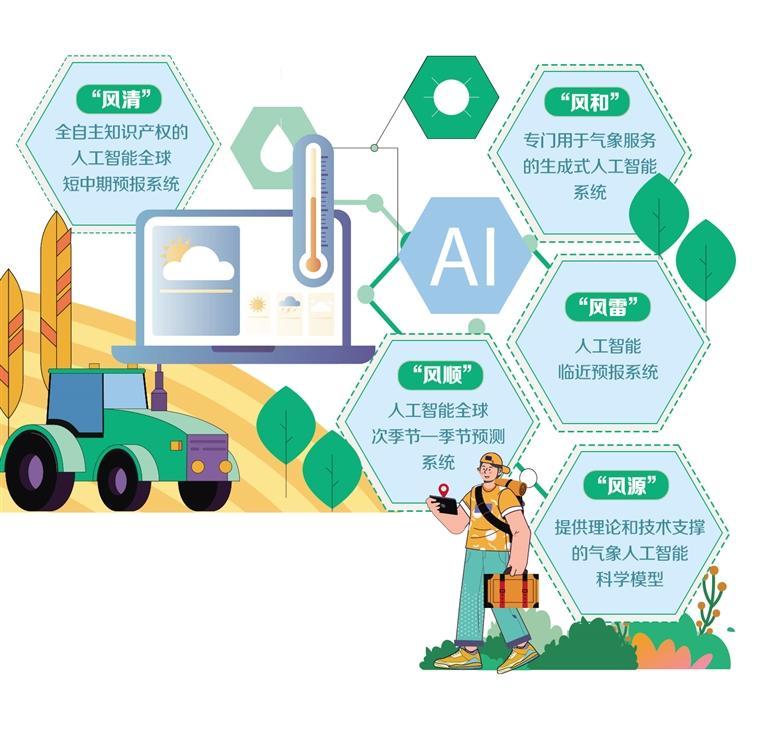
气象人工智能预报模型上新升级——五大模型分工协作赋能千行百业
Jing Ji Ri Bao· 2026-01-03 22:01
Core Viewpoint - The article discusses the advancements in artificial intelligence (AI) models for meteorological services in China, highlighting the launch of new AI models by the China Meteorological Administration (CMA) to enhance weather forecasting and disaster warning capabilities in the context of increasingly complex climate conditions. Group 1: AI Model Developments - The CMA has released the "Fengyuan" AI model and upgraded three other models: "Fengqing," "Fenglei," and "Fengshun," to improve weather forecasting and warning capabilities [1][2] - The "Fenghe" model, with a trillion parameters, is designed for personalized weather services across various sectors, including transportation and health [2] Group 2: Applications and Benefits - The upgraded "Fengshun" model focuses on agricultural, renewable energy, and water resource needs, adding over ten key meteorological factors such as daily maximum and minimum temperatures [3] - The "Fenglei" model has shown a 25% improvement in the quality of severe weather predictions, particularly for thunderstorms and heavy rainfall [4] Group 3: Technological Integration - AI technology is becoming a crucial link between weather forecasting, disaster warning, and emergency response, addressing the challenges posed by extreme weather events [4] - The "Fengyuan" model can directly analyze real-time observational data from satellites and weather stations, enhancing the accuracy of global weather forecasts [5] Group 4: Future Directions - The CMA's strategy for 2025-2035 emphasizes the integration of numerical forecasting with AI to improve simulation and prediction capabilities of Earth's systems [7] - The AI models are expected to significantly enhance forecasting precision and efficiency, with the "Fengqing" model capable of generating 15-day global weather forecasts in just three minutes [7]
“妈祖”出海记
Ren Min Ri Bao· 2026-01-02 01:11
Core Viewpoint - The "Mazu" early warning cloud platform, developed by the China Meteorological Administration, is being implemented globally to enhance disaster prevention and response to climate change, showcasing China's technological capabilities and experience in meteorological AI [1][5][13]. Group 1: Global Implementation and Impact - The "Mazu" platform has been deployed in five countries, including Pakistan and Mongolia, and is undergoing trials in 43 countries across Asia, Africa, and Oceania [5]. - The platform provides customized AI tools for different countries to monitor and respond to various meteorological risks, significantly improving early warning capabilities [3][4]. - In countries like Afghanistan and Uganda, the platform has successfully predicted extreme weather events, allowing for timely warnings and disaster mitigation [2][5]. Group 2: Technological Advancements - The "Mazu" platform integrates advanced AI technologies to enhance the accuracy of weather forecasts, particularly for extreme weather events that are traditionally difficult to predict [7][8]. - The platform employs innovative algorithms to improve the detection and forecasting of severe weather phenomena, addressing the limitations of conventional models [8][9]. - The AI models developed under "Mazu" are open-source, allowing global access and collaboration, which enhances the platform's adaptability and effectiveness [6][10]. Group 3: Training and Capacity Building - The China Meteorological Administration is committed to training over 2,000 professionals from developing countries in meteorological forecasting and disaster risk management from 2025 to 2027 [6]. - Collaborative efforts include sending scholars to China for training and developing localized forecasting models tailored to specific regional needs [6][10]. - The initiative aims to build a global network of early warning systems, fostering international cooperation in climate change adaptation [12][13]. Group 4: Future Prospects and Collaborations - The "Mazu" platform is set to integrate additional AI models, enhancing its service offerings and expanding its global reach [11][15]. - Upcoming collaborations with various countries and organizations aim to further develop meteorological AI capabilities and improve disaster response strategies [13][15]. - The initiative aligns with global climate governance efforts, positioning China as a key player in international meteorological cooperation [13][15].
“妈祖”出海记(深度观察)
Ren Min Ri Bao· 2026-01-01 22:10
Core Viewpoint - The "Mazu" early warning cloud platform, developed by the China Meteorological Administration, is being implemented globally to enhance disaster prevention and climate change response, showcasing China's technological capabilities and experience in meteorological AI [1][5][16]. Group 1: Global Implementation and Impact - The "Mazu" platform has been deployed in five countries, including Pakistan and Mongolia, and is undergoing trials in 43 countries across Asia, Africa, and Oceania [5]. - The platform provides customized AI tools for different countries, addressing specific meteorological challenges such as extreme weather events [3][4]. - In Afghanistan and Uganda, the AI system successfully issued early warnings for severe weather, aiding in disaster response and loss reduction [2]. Group 2: Technological Advancements - The "Mazu" platform integrates various AI models and tools for risk assessment, monitoring, warning dissemination, and emergency response [4]. - The platform's AI models have shown superior performance, with the "Fengqing" model producing results in half the time of traditional numerical forecasting models [16]. - Innovations in AI algorithms have improved the detection and prediction of extreme weather events, addressing historical challenges in meteorological forecasting [8][9]. Group 3: Training and Capacity Building - The China Meteorological Administration is committed to open-source AI models and data sharing, facilitating international collaboration and training for meteorological professionals [6]. - Plans for 2025-2027 include providing over 2,000 short-term training opportunities and scholarships for professionals from developing countries [6]. - The initiative aims to build a global network for early warning systems, enhancing the capacity of countries to respond to climate-related disasters [12][14]. Group 4: Strategic Collaborations and Future Plans - The "Mazu" initiative aligns with international efforts, such as the UN Climate Change Framework, to improve early warning systems and climate adaptation capabilities in developing nations [16]. - Collaborative projects with countries like Ethiopia and Mongolia are underway to develop tailored meteorological AI models [6][16]. - The platform is positioned as a key player in global climate governance, contributing to the establishment of a safer and more resilient global community [16].
大国五年丨观云识天,护航国计民生
Xin Hua She· 2025-12-05 09:20
Core Insights - Meteorological services have become a crucial support for meeting public expectations and promoting economic and social development during the 14th Five-Year Plan period [1] Group 1: Technological Advancements - The global first achievement of meteorological satellite with a regional resolution of 250 meters for continuous imaging every minute [3] - Fengyun-3G satellite is China's first and the world's third low-inclination orbit precipitation measurement satellite [3] - Fengyun-3E satellite is the only civil polar meteorological satellite conducting observations during dawn and dusk [3] - High-level self-reliance and strength achieved through meteorological detection equipment and technologies such as Fengyun satellites, Beidou sounding, and weather radars [7] Group 2: Forecasting Accuracy - The monitoring rate for hazardous weather has increased to 83% [10] - The lead time for severe convective weather warnings has been advanced by 13% [10] - Regional heavy rain, high temperature, and cold wave events can be forecasted 3 to 7 days in advance [10] - National significant weather events can be predicted 15 days ahead, and global climate anomalies can be forecasted 6 months in advance [10] - Climate annual outlook products can be released 1 year in advance [10] Group 3: Service Expansion - The life meteorological service index has increased to over 70 types, covering various aspects of daily life [21] - Refined meteorological services encompass clothing, food, housing, transportation, tourism, shopping, and entertainment, covering over 50,000 scenic spots nationwide [21] - Health meteorological warning products for high temperatures and pollen allergies are popular among the public [21] - Meteorological information is integrated into major media, mainstream information, and life service platforms [21] Group 4: Economic Impact - Economic losses due to meteorological disasters have decreased by an average of 0.12 percentage points of GDP during the 14th Five-Year Plan period [14] - Artificial rainfall and snow operations have cumulatively increased precipitation by approximately 1,677 million tons [14] - Early warnings for winter wheat dry hot wind have contributed to an increase in grain production by 8.3 billion jin [15] - The optimization of the "One Road Three Parties" warning linkage mechanism has led to a 51% reduction in traffic accidents on improved road sections [15] Group 5: Data Sharing and Collaboration - A seamless and comprehensive intelligent digital meteorological forecasting business system has been established, with spatial resolution refined to 5 kilometers globally and 1 kilometer nationally [12] - 17 industries have achieved the integration and rapid release of 82 types of warning information, with alerts delivered to emergency responders within 1 minute [18] - Over 12 categories and 100 types of meteorological data products have been shared with society, serving 153 countries and regions, and nearly 1.3 million users across 21 industries in China [25]
气象服务系统“风和”有多智能?一文了解
Yang Shi Xin Wen· 2025-10-29 10:26
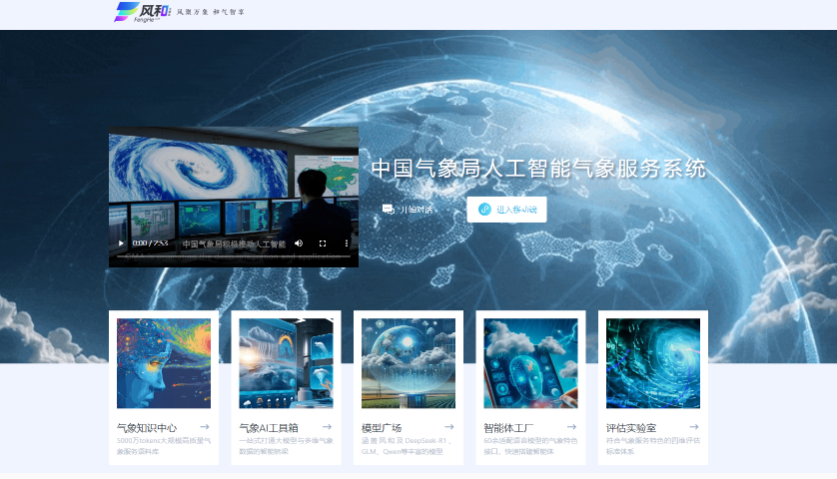
Core Insights - The China Meteorological Administration has launched an AI meteorological service system named "Fenghe," which significantly enhances smart meteorological service capabilities, featuring data fusion, real-time human-machine interaction, and intelligent tool invocation [1][4]. Group 1: Features and Capabilities - "Fenghe" allows users to input weather-related queries and receive automated responses, providing personalized suggestions across various scenarios such as travel, health, and logistics [3][4]. - The system includes five major modules: Meteorological Knowledge Center, Model Plaza, Meteorological AI Toolbox, Intelligent Agent Factory, and Evaluation Laboratory, which collectively enhance its service capabilities [4]. Group 2: Technical Framework - The design of "Fenghe" is based on a unique "1+1+N" technical framework, integrating a foundational model with professional meteorological knowledge and a large-scale meteorological service corpus of 550 billion tokens [5]. - The system employs advanced technologies such as LoRA for fine-tuning, reinforcement learning from human feedback (RLHF) for deep reasoning, and multi-agent collaborative technology to improve understanding of user needs and adaptability to various scenarios [5].
国内首个!千亿级!会让天气预报更准吗?
Huan Qiu Wang Zi Xun· 2025-10-29 04:41
Core Insights - The China Meteorological Administration has launched the "Fenghe" model, a billion-parameter meteorological service model that integrates AI technology with meteorological expertise, aiming to transform traditional weather services into an intelligent new phase [1][2]. Group 1: Technical Features of "Fenghe" - "Fenghe" is a generative AI system specifically designed for meteorological services, built on a large language model architecture, distinguishing it from traditional numerical weather prediction models [2]. - The model boasts a powerful core with a trillion parameters, indicating its strong learning and expressive capabilities, allowing it to capture intricate atmospheric phenomena [2]. - Through multimodal integration and generative AI technology, "Fenghe" aims to provide more accurate forecasts, achieving high resolution, efficiency, and rapid response in intelligent meteorological services [2]. Group 2: Comparison with Previous Models - Previous models like "Fengqing," "Fenglei," and "Fengshun" were primarily designed for internal meteorological forecasting systems, focusing on enhancing the core technology of large model predictions [3]. - "Fenghe" is targeted at the public and industry, addressing the limitations of existing general models in understanding meteorological service needs and generating professional content [3]. - The model aims to deliver reliable, usable, and trustworthy meteorological decision-making information, surpassing the capabilities of general models in terms of professionalism, precision, safety, and cost-effectiveness [3]. Group 3: Impact on Public Services - "Fenghe" is expected to revolutionize public travel services by providing unprecedented precision and detail in travel decision support, moving beyond traditional weather forecasts [5]. - For example, it can simulate microclimate conditions in complex areas, offering specific forecasts for different locations, such as predicting sunny conditions on one slope while rain occurs on another [5]. - The service will transition from regional forecasts to point-to-point forecasts, enabling proactive intelligent interventions for optimal travel decision-making [6].