鱼腥草注射液

Search documents
中药注射剂再评价:行业转型的“生死考题”与破局之道
Di Yi Cai Jing· 2025-12-07 12:09
Core Viewpoint - The traditional Chinese medicine injection industry is undergoing a systematic transformation that is crucial for its future, driven by new regulatory policies aimed at ensuring safety, efficacy, and quality control [1][2][5]. Regulatory Changes - The recent policy document emphasizes that if oral formulations can meet clinical needs, injection formulations will not be approved for market entry, and similar restrictions apply to muscle versus intravenous injections [1]. - A re-evaluation of existing injection products will be conducted over the next 5 to 10 years, marking a significant regulatory upgrade aimed at addressing safety and efficacy concerns [1][2]. Industry Challenges - The injection industry has faced significant challenges, including frequent adverse reactions and insufficient evidence of efficacy, which have highlighted deep-seated issues within the sector [2]. - The shift from an experience-driven to a market-driven evaluation process will lead to the elimination of products lacking sufficient evidence, accelerating the trend of declining sales for many companies [3]. Financial and Operational Impact - The financial burden of compliance with new regulations, including investments in research, clinical trials, and quality control systems, poses a significant challenge for small and medium-sized enterprises [3]. - Companies will need to upgrade their entire value chain from research and development to sales in response to new quality control requirements [3]. Structural Transformations - The re-evaluation policy is expected to drive four major structural changes in the industry: a shift from experience-driven to evidence-driven practices, from rough production to precise manufacturing, from marketing-led to research-driven strategies, and from a single market focus to diversified international markets [3][4]. Strategic Responses - Companies are advised to form specialized working groups to assess their products, focus resources on core products, and consider partnerships to share costs [4]. - Emphasizing evidence-based medicine and enhancing production quality through smart manufacturing and closed-loop management systems are critical for compliance and competitiveness [4]. Legal Framework - The re-evaluation policy is supported by legal frameworks that require ongoing verification of drug safety, efficacy, and quality, ensuring that public health interests are prioritized [5]. - Companies can challenge unreasonable evaluation standards through administrative litigation, fostering a constructive interaction between regulation and industry [5]. Future Outlook - Successfully navigating the re-evaluation process will enable companies to better handle future challenges, including negotiations with health insurance and regulatory oversight, while also enhancing the global perception of traditional Chinese medicine [5][6]. - The transformation is seen as a necessary step for the industry to gain trust and recognition in the global medical community, ensuring the safe and effective use of traditional Chinese medicine [6].
中药注射剂迎来“大淘汰”时代
Xin Lang Cai Jing· 2025-10-14 08:24
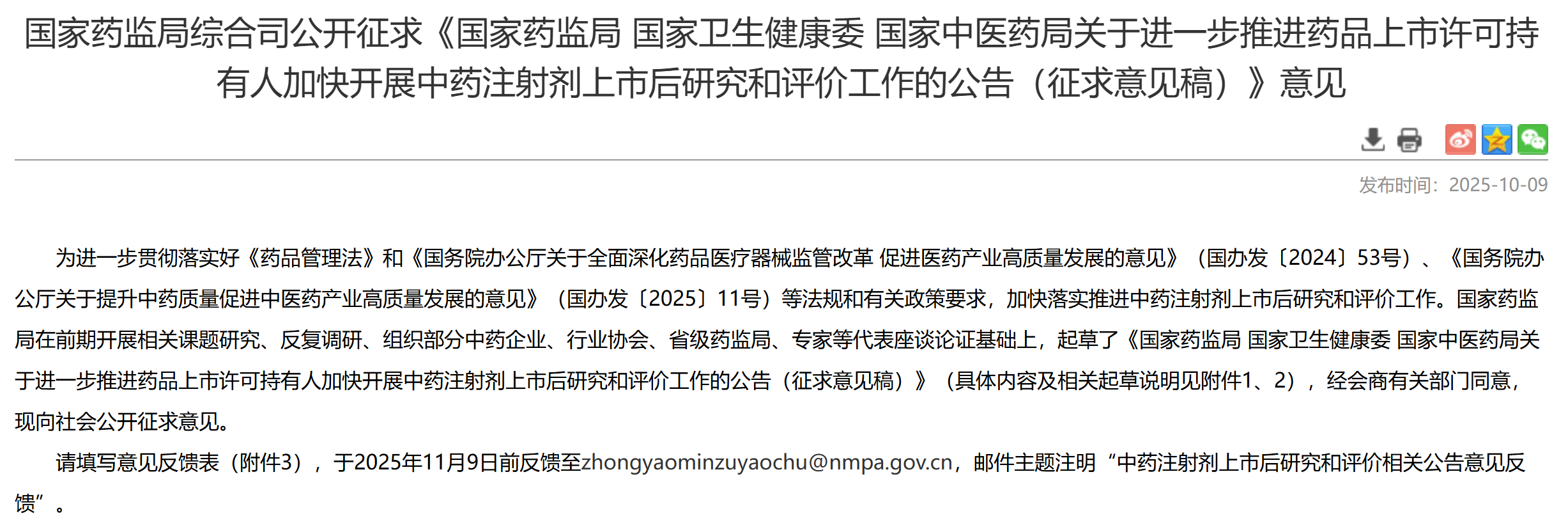
Core Viewpoint - The National Medical Products Administration (NMPA) of China is accelerating the post-marketing research and evaluation of traditional Chinese medicine (TCM) injections, signaling a push for improved safety and efficacy standards in the industry [1][5][9]. Regulatory Developments - The NMPA, along with the National Health Commission and the State Administration of Traditional Chinese Medicine, has drafted a proposal to enhance post-marketing research for TCM injections, which is currently open for public consultation [1][5]. - A "淘汰令" (elimination order) has been introduced, stating that TCM injections that do not comply with research and evaluation requirements may face deregistration or cancellation of their drug registration certificates [5][7]. Industry Context - TCM injections have been controversial in China, with a history of safety concerns, including reported deaths following their use. The NMPA has highlighted the need for ongoing monitoring and evaluation of these products [3][5]. - The market for TCM injections has grown significantly, with annual sales exceeding 100 billion RMB, indicating a substantial commercial scale despite regulatory scrutiny [3][9]. Product Focus - The proposal prioritizes TCM injections listed in the National Essential Medicines List and the National Medical Insurance Catalog, such as Qingkailing Injection and Heduoning Injection, for post-marketing research [6][7]. - The National Essential Medicines List includes 10 TCM injections, while the National Medical Insurance Catalog includes 58, indicating a broad scope for evaluation [7]. Market Impact - The acceleration of post-marketing research may lead to the exit of less viable products from the market, promoting a competitive environment that favors high-quality offerings [8][9]. - Major TCM injections have historically generated significant revenue, with products like Qingkailing Injection projected to exceed 1 billion RMB in sales in 2024 [9][11]. Historical Context - Previous regulatory actions have included the proposal to eliminate certain TCM injection products, reflecting ongoing efforts to ensure safety and efficacy in the market [12][13].