黄惠铁路专用线

Search documents
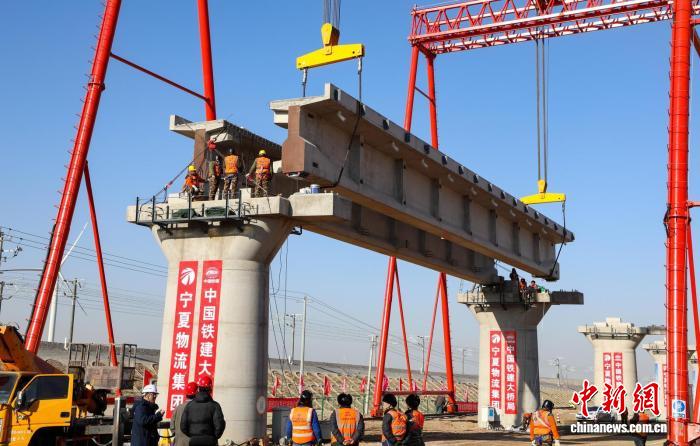
黄惠铁路建设取得关键进展首片T梁成功架设开启上部结构施工
Zhong Guo Xin Wen Wang· 2025-12-08 13:55
Core Viewpoint - The construction of the Huanghui Railway dedicated line has officially entered the bridge superstructure construction phase, marking significant progress in this key railway project between Ningxia and Inner Mongolia [1][3]. Project Overview - The Huanghui Railway dedicated line spans approximately 13.192 kilometers, crossing Ningxia's Shizuishan City and Inner Mongolia's Wuhai City, and includes the construction of 2 bridges, 4.08 kilometers of roadbed, and 2 stations [3]. - A total of 430 simple T-beams need to be installed along the entire line, with the heaviest single piece weighing up to 142.9 tons [3]. Construction Challenges - The project faces multiple challenges, including limited working space due to its proximity to the existing Baoyin Railway and the technical complexity of the Huinong Yellow River Grand Bridge, which has a high pier and a minimum curve radius of only 500 meters [3][4]. - To ensure the safe and precise installation of the first T-beam, the contractor, China Railway Construction Bridge Bureau, developed a specialized construction plan and conducted rigorous technical training and safety briefings for the workers [3]. Current Progress - As of now, approximately 65% of the main construction work, including pile foundations and pier bodies, has been completed [4]. - The construction of the Huinong Yellow River Grand Bridge is progressing steadily, with the main span using a high-precision cantilever pouring method for continuous beam construction [4]. Future Impact - Once completed, the Huanghui Railway dedicated line will create a new land-sea intermodal transport corridor from Shizuishan's Huinong District to Huanghua Port and Tianjin Port, enhancing the railway connectivity between Shizuishan and Wuhai [4]. - This project is expected to play a crucial role in promoting ecological protection and high-quality development in the Yellow River basin, accelerating the transformation of the regional transport structure from road to rail, and effectively reducing social logistics costs [4].