3D子宫胚胎植入模拟芯片

Search documents
【新华社】新技术有望探明胚胎移植失败原因
Xin Hua She· 2025-12-24 02:48
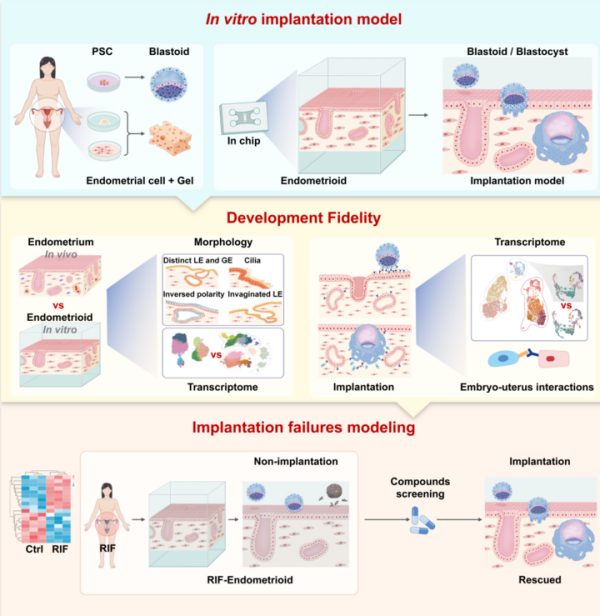
Core Viewpoint - The research team from the Chinese Academy of Sciences has developed a 3D human embryo implantation model that successfully replicates the entire process of human embryo implantation in vitro, which may help identify the causes of repeated implantation failure (RIF) in assisted reproductive technology [6][9]. Group 1: Research Findings - Approximately 10% of patients undergoing assisted reproductive technology experience clinical pregnancy failure after three embryo transfers, with factors such as embryo quality, endometrial condition, and immune response potentially contributing to this issue [7]. - The study found that RIF patients often have increased apoptotic cells and reduced proliferation ability in their endometrial cells, indicating a less favorable environment for embryo implantation [7]. - The implantation rates of blastocysts in RIF patients were lower compared to healthy individuals, correlating with clinical observations of "successful transfers but embryo arrest" [7]. Group 2: Technological Innovations - The new technology allows for the construction of an artificial endometrial model using endometrial cells obtained from menstrual blood, achieving a 94% similarity in gene expression to biopsy samples, thus enhancing patient acceptance due to its non-invasive nature [7]. - The research team has developed a microfluidic chip that simulates the pathological abnormalities of embryo implantation, enabling more precise identification of causes for implantation failure [7][9]. Group 3: Implications for Clinical Practice - The 3D embryo implantation model bridges basic research and clinical application, providing practical diagnostic tools for clinicians in the field of reproductive medicine [9]. - The research team has tested 1,119 FDA-approved drugs, paving the way for personalized drug screening for patients, which could enhance the precision of assisted reproductive technologies [9].

3D子宫胚胎植入模拟芯片破解胚胎反复种植失败难题
Ke Ji Ri Bao· 2025-12-24 02:37
Core Viewpoint - A new 3D embryo implantation simulation chip developed by a research team from the Chinese Academy of Sciences offers new hope for precise treatment of infertility, particularly for patients facing recurrent implantation failure (RIF) [1][3]. Group 1: Research Breakthrough - The chip successfully replicates the entire process of human embryo implantation in the laboratory, overcoming ethical and technical barriers that have long plagued the field [1][3]. - The research findings were published in the journal "Cell" on the 23rd [1]. Group 2: Impact on Patients - Over 40 million people in China suffer from infertility, with about 10% of those undergoing assisted reproductive technology experiencing multiple failed embryo implantations [3]. - The chip technology aims to address three major pain points for patients, including the ability to accurately identify the root causes of infertility [3][4]. - It was found that the implantation rate of embryos from RIF patients is only 60% of that of healthy individuals, explaining the phenomenon of "successful transfer but fetal arrest" [3]. Group 3: Personalized Treatment - The research team has tested over a thousand approved drugs using the chip, successfully identifying targeted medications that significantly enhance endometrial receptivity and promote embryo implantation and development [3][4]. - This advancement suggests a shift from broad-spectrum treatment approaches to personalized medication strategies, reducing ineffective treatments [3]. Group 4: Non-Invasive Testing - The detection process using the chip is expected to be more convenient and non-invasive, as it can utilize endometrial cells derived from the patient's menstrual blood, achieving results comparable to traditional biopsy methods [4]. - This innovation is anticipated to improve patient acceptance and accessibility, marking a transition in reproductive medicine from experience-driven to technology-driven approaches [4].
点亮希望!新技术有望探明胚胎移植失败原因
Xin Lang Cai Jing· 2025-12-23 15:58
Core Viewpoint - The research from the Chinese Academy of Sciences introduces a 3D human embryo implantation model that replicates the entire process of embryo implantation, aiming to identify the causes of repeated implantation failure (RIF) in assisted reproductive technology [1][3]. Group 1: Research Findings - Approximately 10% of patients undergoing assisted reproductive technology experience clinical pregnancy failure after three embryo transfers, with factors such as embryo quality, endometrial condition, and immune response potentially contributing to this issue [1]. - The study reveals that RIF patients exhibit increased apoptotic cells and decreased proliferation ability in their endometrial cells, indicating a less favorable environment for embryo implantation [1]. - The implantation rates and subsequent development of embryos in RIF patients are significantly lower compared to healthy individuals, correlating with clinical observations of "successful transfers but embryo arrest" [1]. Group 2: Technological Advancements - The research team has validated that endometrial cells obtained from menstrual blood have a 94% similarity in gene expression to those from biopsy samples, allowing for the creation of an "artificial endometrium" with a variance of less than 5% in implantation rates [2]. - This non-invasive method of obtaining endometrial samples through menstrual blood significantly enhances patient acceptance compared to traditional biopsy methods that carry risks of bleeding and infection [2]. Group 3: Embryo-Maternal Interaction - The research elucidates the signaling interactions between the embryo and the endometrium during the attachment and invasion phases, identifying pathways that promote attachment site formation and inhibit epithelial cell apoptosis [3]. - Blocking these pathways can lead to a 68% decrease in blastocyst attachment rates, highlighting the critical nature of these interactions for successful implantation [3]. - The study also extends the simulation of embryo development to the post-implantation phase, allowing for the observation of whether the embryo is truly developing [3]. Group 4: Implications for Reproductive Medicine - The 3D embryo implantation simulation chip technology bridges basic research and clinical application, providing practical diagnostic tools for clinicians in reproductive medicine [3]. - The research team has tested 1,119 FDA-approved drugs, paving the way for personalized drug screening for patients, which could enhance the precision of assisted reproductive technologies [4]. - This advancement not only addresses implantation failure but also contributes to understanding early developmental abnormalities and pregnancy complications [4].
科学与健康|点亮希望!新技术有望探明胚胎移植失败原因
Xin Hua She· 2025-12-23 15:08
Core Viewpoint - The research from the Chinese Academy of Sciences has developed a 3D human embryo implantation model using microfluidic chips, which successfully replicates the entire process of human embryo implantation in the lab, potentially uncovering the causes of repeated implantation failure (RIF) in assisted reproductive technology [2][10]. Group 1: Simplified Detection Process - Approximately 10% of individuals undergoing assisted reproductive treatment experience clinical pregnancy failure after three embryo transfers, with factors such as embryo quality, endometrial condition, and immune system responses contributing to this issue [3]. - The new technology creates a simulated endometrial system to accurately identify the causes of implantation failure, revealing that RIF patients often have increased apoptotic cells and decreased proliferation ability in their endometrial cells, indicating a less favorable environment for embryo implantation [3][5]. Group 2: Observing Embryo Development - The research team has analyzed the signaling interactions between the embryo and the endometrium during the attachment and invasion stages, identifying pathways that promote attachment site formation and inhibit epithelial cell apoptosis [6][9]. - Blocking these pathways can lead to a 68% decrease in blastocyst attachment rates, highlighting the critical nature of these interactions for successful implantation [6]. Group 3: Efficient Drug Screening - The 3D embryo implantation simulation technology bridges basic research and clinical application, providing practical diagnostic tools for clinicians in the field of reproductive medicine [10]. - The research team has tested 1,119 FDA-approved drugs, paving the way for personalized drug screening for patients, which could enhance the precision of assisted reproductive technologies [12].