
40G光模块

Search documents
2025年中国光模块细分产品分析 800G光模块在2025年成为主流【组图】
Qian Zhan Wang· 2026-01-19 09:10
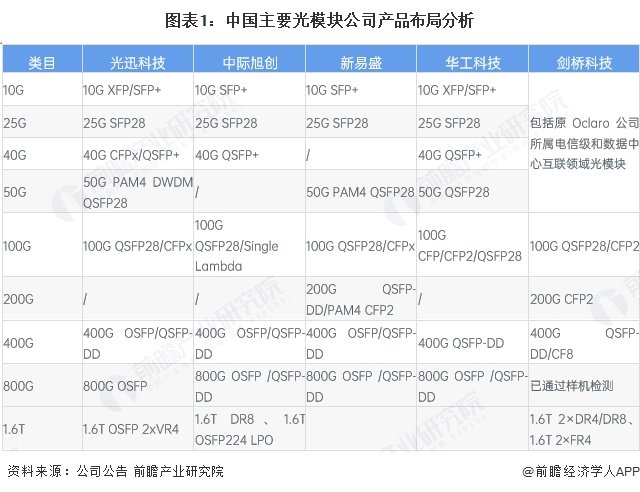
Core Insights - The report provides an analysis of the global and Chinese optical module industry, highlighting the product layout of representative companies and a comparative analysis of segmented products. Group 1: Product Layout of Representative Companies - Major Chinese optical module companies have product lines covering transmission rates up to 800G and below, including 10G, 25G, 40G, 50G, 100G, 200G, 400G, and 800G modules [1]. - The table outlines the specific products offered by companies such as Guangxun Technology, Zhongji Xuchuang, and others across various transmission rates, indicating a comprehensive coverage in the optical module market [1]. Group 2: 10G Optical Module Market - The 10G optical module market is mature, primarily featuring XFP and SFP+ modules, with SFP+ being favored for its lower cost, smaller size, and strong compatibility [3]. - 10G data center solutions typically involve 10G switches paired with SFP+ modules and LC fiber jumpers, emphasizing the importance of matching switch rates with corresponding optical modules [3]. Group 3: 40G Optical Module Demand - The 40G optical module, particularly the QSFP+ type, is widely used due to its compact design and ability to meet high-density, high-speed market demands [6]. - Transitioning from 10G to 40G is driven by the need for increased bandwidth and throughput in data centers, with 40G solutions often involving 40G switches and QSFP+ modules [6]. Group 4: 100G Optical Module Applications - The 100G optical module is primarily utilized in cloud data centers and high-speed networks, with QSFP28 emerging as the mainstream packaging method [7]. - Significant technological advancements in 100G modules include digital coherent receiver technology and advanced error correction coding, catering to evolving user demands [7]. Group 5: 400G Optical Module Commercialization - The 400G optical module is set to become commercially viable in 2023, driven by the increasing demand from AI model training and 5G network construction [10]. - Major Chinese telecom operators are expected to deploy 400G modules extensively, with significant market share anticipated by 2024-2025 [10]. Group 6: 800G Optical Module Projections - The 800G optical module is projected to become mainstream by 2025, primarily driven by the needs of AI data centers for large-scale GPU cluster interconnections [13]. - Different types of 800G modules are categorized based on transmission distance, catering to various applications from data center interconnections to long-distance transmission [15]. Group 7: 1.6T Optical Module Development - The 1.6T optical module is expected to see commercial rollout in 2025, with gradual scaling from initial small batch shipments to larger production volumes by year-end [16]. - Key players like Nvidia and Zhongji Xuchuang are leading the early adoption and certification processes for 1.6T modules [18].




中际旭创20250824
2025-08-25 09:13
Summary of Zhongji Xuchuang Conference Call Company Overview - Zhongji Xuchuang has rapidly captured market share by deeply binding with major clients such as Google, Amazon, and Meta, establishing a leading position in the optical module industry with significant market share in 40G optical modules [2][3][10] - The company has a strong technological foundation, having launched 40G and 100G optical module products ahead of competitors, and has made breakthroughs in parallel packaging technology and COB (chip on board) processes, effectively reducing packaging costs [2][4][5] Key Industry Insights - The optical module industry is characterized by a stable competitive landscape, with Zhongji Xuchuang holding nearly 40% market share, benefiting from strong downstream demand and slow capacity expansion from upstream chip manufacturers [2][10] - The shift towards silicon photonics technology is crucial for future data center development, as EML (electro-absorption modulated laser) solutions face yield and capacity issues at 1.6T and iteration bottlenecks at 3.2T [6][7] Technological Innovations - Zhongji Xuchuang has maintained its industry-leading position through continuous investment in technology and innovation, being one of the first to mature and promote parallel packaging technology [4][5] - The company has developed its own silicon photonic chips and possesses system design capabilities and high-precision optical coupling technology, maintaining a gross margin above 40% [2][8][9] Market Dynamics - The demand from major internet companies in the U.S. is robust, with annual capital expenditures around $340-350 billion, while upstream suppliers are expanding capacity slowly, allowing Zhongji Xuchuang to better manage material supply [10][11] - Chinese companies have significant advantages in capacity and profit margins compared to U.S. firms, which struggle with delivery and capacity expansion [11] Future Growth Potential - The company is expected to accelerate the delivery of silicon photonic solutions, enhancing gross and net profits, and driving revenue growth [2][8][13] - Current market valuations are considered undervalued, with potential for significant growth as the company adapts to future technological changes [2][20] Strategic Positioning - Zhongji Xuchuang is well-prepared for technological shifts, having anticipated the importance of silicon photonics even when the market was skeptical [14] - The company plans to leverage the upcoming period to generate cash flow for investments in semiconductor transformation and emerging technologies [19] Conclusion - The outlook for Zhongji Xuchuang is optimistic, with expectations of maintaining high market share and improving profitability through strategic technological advancements and market positioning [13][20]