4F² DRAM

Search documents
这类DRAM,成为新研究方向
半导体芯闻· 2026-02-14 08:56
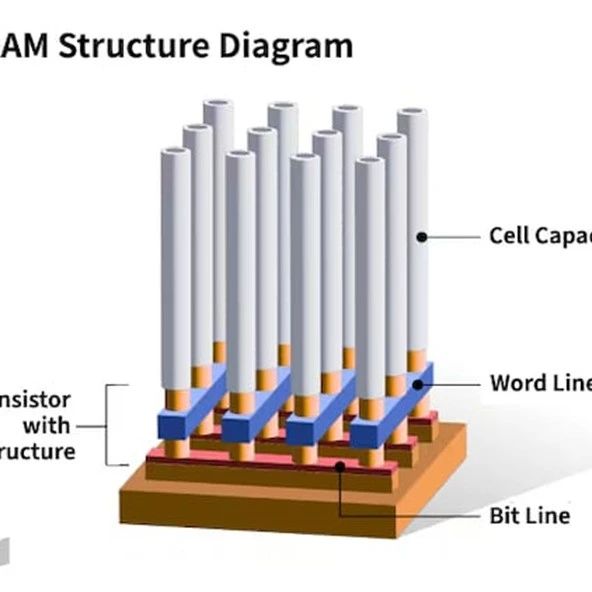
Core Viewpoint - Samsung Electronics and SK Hynix are accelerating the development of the next-generation 3D Dynamic Random Access Memory (DRAM), specifically the vertical structure "4F² DRAM," aiming to complete and test early prototypes by the end of this year [2][3]. Group 1: 4F² DRAM Development - The 4F² DRAM architecture overcomes the limitations of traditional planar DRAM by utilizing a vertical stacking method, which is expected to enhance performance, data transfer rates, and energy efficiency [2]. - Samsung and SK Hynix plan to validate the commercial viability of the 4F² DRAM prototype before advancing to 3D DRAM development [3]. - Micron Technology has opted to skip the 4F² DRAM stage and move directly into 3D DRAM development [3]. Group 2: Industry Challenges and Innovations - The transition to vertical structure designs is seen as essential to overcome the challenges posed by the shrinking of planar DRAM, which has led to increased complexity and manufacturing costs [4]. - Samsung anticipates launching the 4F² DRAM following its seventh-generation 10nm products, while SK Hynix may introduce its 4F² series in the next generation [4]. - The performance of the 4F² DRAM is projected to improve by nearly 50% compared to existing models, with a potential for mass production within three years if development progresses smoothly [4].


存储双雄,豪赌4F² DRAM
半导体芯闻· 2025-06-18 10:09
Core Viewpoint - Samsung Electronics and SK Hynix are accelerating the development of the next generation of 3D DRAM, specifically the vertical structure "4F² DRAM," aiming to complete and test early prototypes by the end of this year [1][2]. Group 1: Development and Technology - The 4F² DRAM architecture differs significantly from traditional planar DRAM, utilizing a vertical stacking method to overcome miniaturization limitations, which is expected to enhance performance, data transfer rates, and energy efficiency [1]. - Both companies plan to validate the commercial viability of the 4F² DRAM prototype before fully launching into 3D DRAM development, while Micron Technology is reportedly skipping the 4F² DRAM stage to directly enter 3D DRAM development [2]. - The transition to vertical design is seen as essential due to the increasing challenges of miniaturizing planar DRAM, with the latest products being based on the 10nm process node [5]. Group 2: Market Impact and Future Projections - The anticipated performance improvement of 4F² DRAM is nearly 50% compared to existing models, with mass production expected within the next three years if development proceeds as planned [5]. - The architectural shift is expected to reshape manufacturing processes, materials, and equipment requirements, with both companies collaborating with global semiconductor equipment manufacturers to develop advanced processes for 4F² DRAM production [6]. - The transition to vertical DRAM architecture is viewed as the only viable path forward, despite the significant challenges posed by the scale of structural changes in development and manufacturing processes [6].