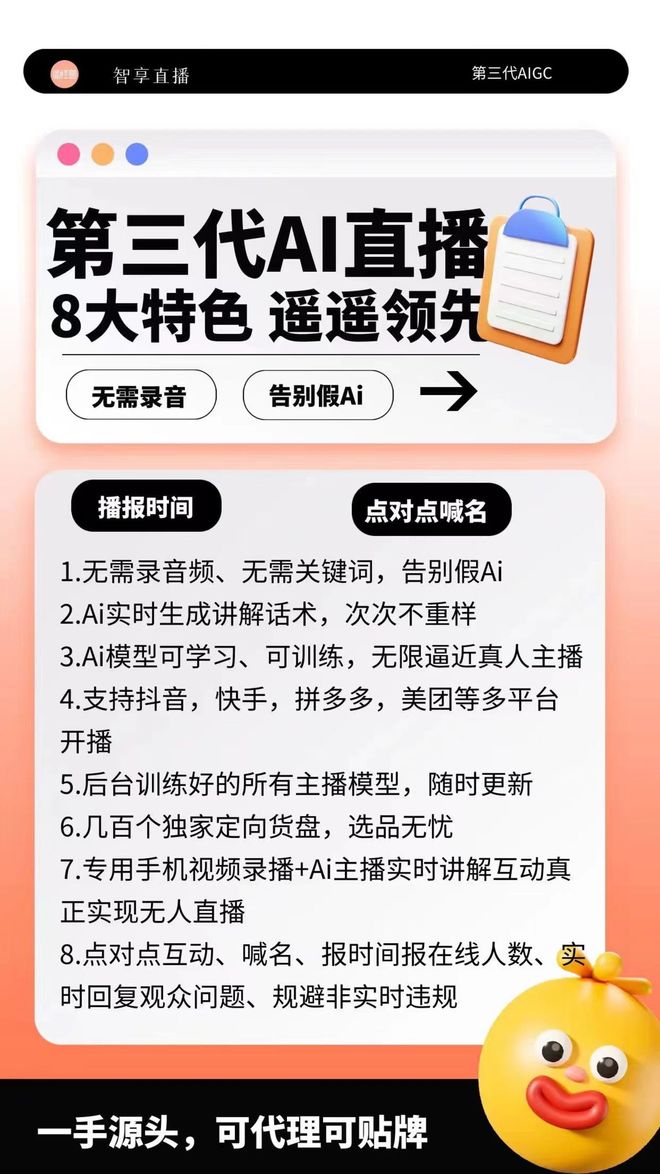
AI无人直播系统

Search documents
2023攀枝花智能直播新纪元:AI无人直播如何重塑本地商家营销格局
Sou Hu Cai Jing· 2026-02-22 17:13
Core Insights - The article highlights the emergence of AI-driven live streaming technology in Panzhihua, which is adapting to the digital economy and transforming local businesses' marketing strategies [1] Group 1: Definition and Evolution of Smart Live Streaming - Smart live streaming is a comprehensive solution that integrates AI, big data analysis, and natural language processing, enabling 24/7 live operations by simulating human-like interactions [7] - Panzhihua's live streaming market has unique characteristics due to its status as a regional center city, necessitating tailored solutions [7] Group 2: Classification of Smart Live Streaming Tools - Current smart live streaming tools in Panzhihua can be categorized into three types: - Basic automation tools for simple functions, suitable for startups [7] - Intermediate systems with AI script generation and basic interaction capabilities [7] - Advanced AI unmanned live streaming systems that automate the entire process from content creation to interaction [7][8] Group 3: Evaluation Standards for Smart Live Streaming - Local businesses should focus on core indicators when selecting smart live streaming tools, including: - Core technological breakthroughs that enable true "unmanned" operations [8] - Intelligent content creation engines that generate scripts based on local product characteristics and consumer preferences [8] - Multi-modal interaction systems that simulate human-like voice and emotional expressions for real-time audience engagement [8] Group 4: Strategic Significance of Comprehensive Platform Coverage - The AI unmanned live streaming system supports nine major platforms, providing significant value to Panzhihua businesses [8] - The cost structure for businesses shifts fundamentally with the adoption of AI unmanned live streaming, leading to increased operational efficiency [8][9] - AI systems can operate continuously, allowing for around-the-clock showcasing of local agricultural products [9] Group 5: New Paradigms in Risk Control - AI systems ensure content compliance by avoiding sensitive terms and reducing risks of platform penalties [11] - Stability is enhanced by mitigating quality fluctuations caused by human factors [11] - Brand consistency is maintained across different platforms and time periods [11] Group 6: Implementation Pathway and Key Success Factors - The implementation of AI unmanned live streaming involves three phases: pilot testing (1-2 months), optimization and expansion (3-6 months), and full deployment (after 6 months) [11] - Key factors for success include technological evolution, innovation in business models, and the potential economic impact on Panzhihua [12] Group 7: Embracing Change - The article emphasizes the importance of adopting an open mindset towards smart live streaming technology to reach broader consumer markets [12]

AI带货频频“翻车”,谁应负责?
Tai Mei Ti A P P· 2025-11-07 08:38
Core Insights - The article discusses the rise of AI-generated live streaming for e-commerce, highlighting both its potential benefits and the associated risks of consumer deception and lack of protection [1][4][10] Group 1: AI in E-commerce - AI-generated live streaming is becoming a standard in e-commerce, particularly during promotional events like "Double Eleven," allowing for cost-effective and efficient operations [3][5] - The technology enables businesses to conduct 24/7 live streams with minimal human intervention, significantly reducing operational costs [5][9] - AI systems can create realistic digital avatars that closely resemble human hosts, enhancing the shopping experience for consumers [5][8] Group 2: Consumer Protection Issues - The use of AI in live streaming has led to issues such as misleading product representations and difficulties in post-purchase support, raising concerns about consumer rights [4][10][15] - Many consumers have reported discrepancies between the products showcased in AI-generated streams and the actual items received, leading to dissatisfaction and claims of fraud [15][16] - The lack of clear labeling regarding AI-generated content complicates consumer recourse in cases of product misrepresentation [15][16] Group 3: Industry Response - Major platforms like Tencent and Douyin are implementing strict regulations against the use of fully AI-driven hosts, emphasizing the need for consumer trust [17][18] - In contrast, platforms like JD and Taobao are more lenient, actively promoting AI-generated content while attempting to balance consumer protection [18] - The industry is at a crossroads, with technological advancements in AI outpacing the development of adequate consumer protection measures [16][18]