AI检测模型

Search documents
硅谷“大裁员”引发热议 “AI向善”这道思考题该如何做?
Sou Hu Cai Jing· 2025-11-05 13:15
Core Insights - The recent wave of layoffs by tech giants like Microsoft and Amazon is largely driven by the rapid development of generative AI technology, which has shifted from being a tool to assist humans to one that replaces human labor [1] - The discussion around AI's impact on employment and society emphasizes the need for a balance between efficiency and fairness, as well as the importance of using AI to address social issues [1][2] Group 1: AI Development and Employment - The emergence of AI is rooted in humanity's pursuit of improved productivity and quality of life, necessitating that its development serves to enhance human welfare [1] - Concerns about job displacement due to AI applications in business highlight the challenges of societal acceptance, similar to historical reactions during the Industrial Revolution [2] - Companies are urged to take social responsibility by providing guidance and support for workers who may face job loss due to AI advancements [2][3] Group 2: AI for Social Good - Alibaba's "AI for Good Action Report 2025" suggests that the integration of technological, commercial, and social values is essential for AI's development [2] - The concept of "AI for Good" is not merely an afterthought but should be a guiding principle throughout the technology's evolution [2] - AI has already shown promise in various fields such as remote education, healthcare, and disaster prediction, demonstrating its potential to address societal challenges [3]

朱自清《荷塘月色》也是AI代写?网友质疑AI检测科学性 记者实测
Yang Zi Wan Bao Wang· 2025-05-10 07:41
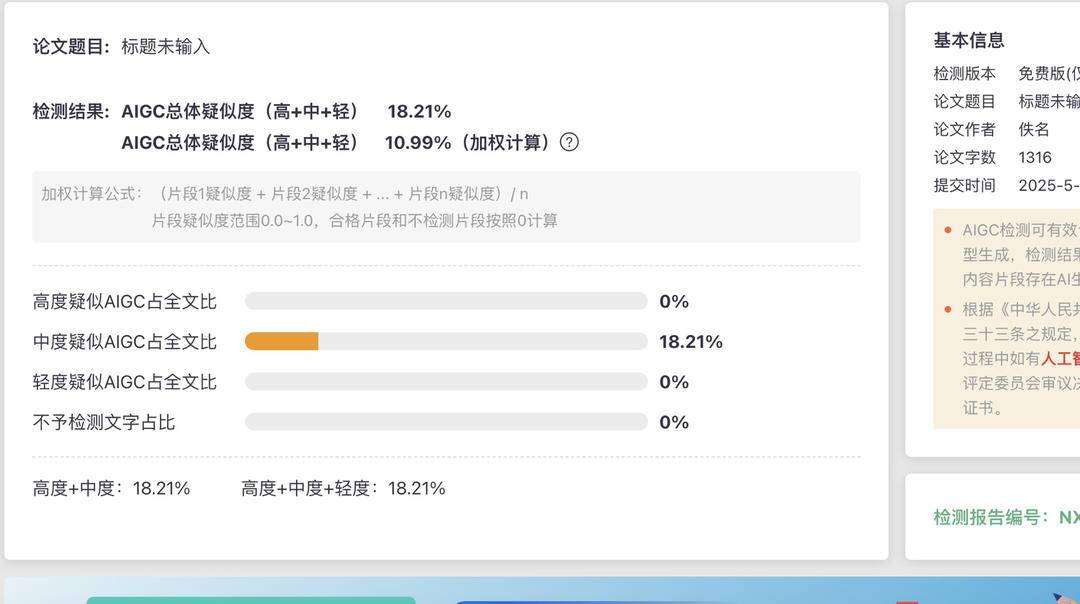
Group 1 - The core issue revolves around the reliability of AI detection systems, as classic literary works like Zhu Ziqing's "Lotus Pond Moonlight" and Liu Cixin's "The Three-Body Problem" are flagged with high AI generation probabilities, raising doubts among netizens about the accuracy of these tools [1][2] - A practical test conducted by reporters showed that the AI generation probability for "Back Shadow" was 18.21%, while "Ball Lightning" had a probability of 32.05%. Other AI detection websites reported even lower rates for "Back Shadow," with some showing less than 1% [2][4] - AI detection models are based on training with large datasets of both human and AI-generated texts, but they can misjudge due to the evolving nature of AI-generated content. Continuous updates to detection models are necessary to reduce misjudgment rates [4][6] Group 2 - The discussion on social media regarding the high AI detection rates in academic papers suggests that educators should not rely solely on these results as a measure of student performance, but rather consider them as part of a broader evaluation system [6]