AI芯片/加速卡

Search documents
英伟达“归零”,揭示芯片市场的变局
Zhong Guo Xin Wen Wang· 2025-10-25 02:39
Core Viewpoint - The article highlights the significant shift in the semiconductor market, particularly in China, where NVIDIA's market share has plummeted from 95% to 0% due to U.S. policies, indicating a move towards domestic innovation and self-reliance in AI chip development [1][12]. Group 1: Market Dynamics - NVIDIA's CEO Jensen Huang stated that U.S. policies have led to the loss of a major market, with the company's share in China's high-end chip market dropping dramatically [1]. - The article emphasizes that this shift does not signify China's rejection of international markets but rather a transition away from dependency on foreign technology [2]. - The emergence of domestic chip manufacturers is reshaping the supply landscape, with local companies rapidly gaining ground [4]. Group 2: Technological Evolution - A structural transformation in China's computing power landscape is underway, moving from reliance on NVIDIA to a more diverse ecosystem centered around domestic firms [4]. - Chinese internet giants and cloud service providers are reconstructing AI infrastructure to adapt to non-NVIDIA architectures, creating a self-sufficient technology stack [4]. - Despite performance gaps, Chinese companies are adopting a "good enough" computing power strategy through large-scale deployment and software optimization to meet commercial and industry needs [4]. Group 3: Talent and Innovation - China possesses about half of the world's AI researchers, supported by strong educational institutions and significant interest in AI development [7]. - The integration of production, academia, research, and application is fostering continuous innovation that is resilient to external pressures [8]. - The article notes that the U.S. chip blockade has inadvertently cost American companies their largest growth market and weakened their innovation momentum for next-generation products [13]. Group 4: Strategic Adjustments - China is leveraging its systemic advantages to advance computing power network construction through a comprehensive approach [9]. - The article discusses the importance of AI integration across various sectors, including manufacturing, energy, and urban governance, to build a robust and resilient industrial path [11]. - The narrative suggests that technological progress should not be viewed as a zero-sum game, but rather as an opportunity for collaboration between the U.S. and China [14].


美企为封锁政策买单
Zhong Guo Xin Wen Wang· 2025-10-24 14:24
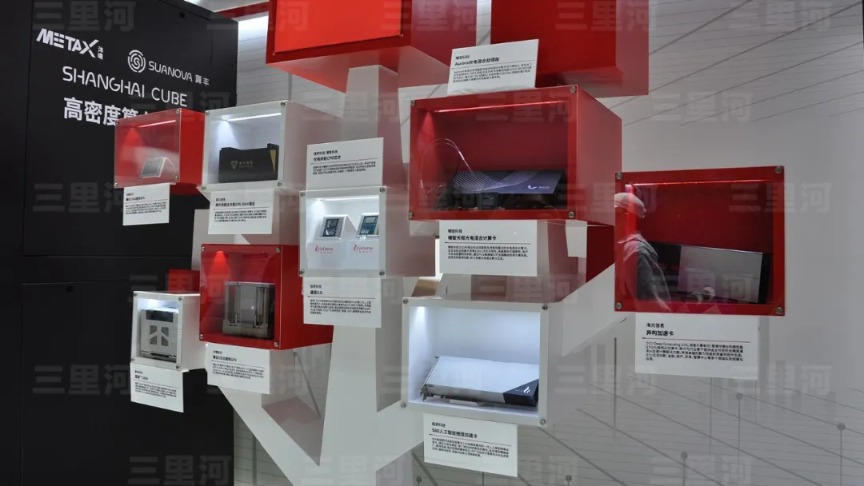
第二,架构体系重构。国内互联网大厂和云服务商正在重构AI基础设施,将训练框架、编译器等深度 适配非英伟达架构,形成具有自主性的技术堆栈。 "我们(美国)实施的政策,导致美国失去了世界上最大的市场之一。" 近期一次公开采访中,英伟达CEO黄仁勋称,公司在中国高端芯片市场份额已从95%降至0%。 英伟达"归零",揭示了芯片市场的变局。 这不代表中国拒绝国际市场,更不是放弃人工智能(AI)发展,而是告别依赖。 当美国试图用AI芯片"卡脖子"时,中国以自主创新回应封锁。 2025世界人工智能大会中国人工智能产业创新成果展上,展出的AI芯片/加速卡。 "中国的算力格局正在经历结构性转变。可以说,'英伟达依赖时代'已经结束,取而代之的是一个以国 内厂商为核心、多元并进的生态体系。"复旦大学中国研究院副研究员刘典接受三里河专访时表示。 他进一步解释道,首先,是供应格局重塑。国产的主力替代者已经出现,更多本土芯片公司正在快速崛 起。 第三,战略路径调整。虽然国产芯片在顶级性能上仍有差距,但中国企业正通过大规模部署、软件优 化、任务分流等方式实现"够用就好"的算力策略,满足多数商用和行业应用需求。 "中国的算力体系正逐步实现芯 ...