AI辅助学习工具

Search documents
2025 职教上市公司一季报:回暖信号初现,分化趋势加剧
3 6 Ke· 2025-05-14 01:00
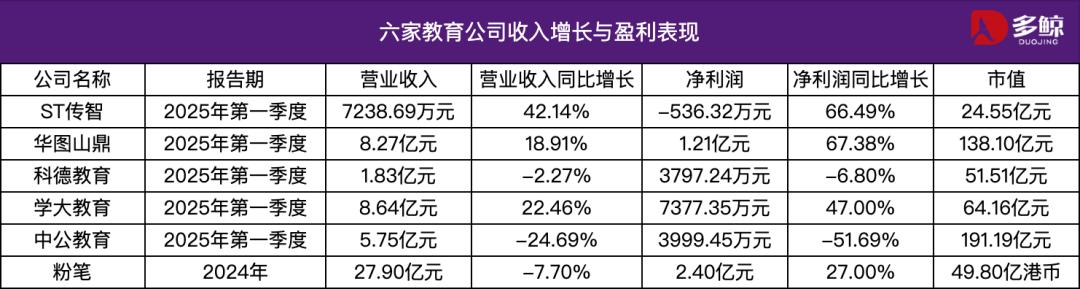
随着全球经济逐渐复苏和对职业技能需求的增长,职业教育行业正迎来新的发展机遇。截至目前,我国已经建成世界上最大规模的职业教育体系,每年为 社会培养约 1000 万高素质劳动者。 在这样的大背景下,职业教育行业内各公司的发展状况备受瞩目。 2025 年一季度,职业教育行业在政策支持与市场竞争中呈现出差异化发展态势。从已披露的财报来看,职教公司在收入增长、盈利表现、业务布局及风 险挑战上各有侧重。下面通过对ST传智、华图山鼎、科德教育、学大教育、中公教育、粉笔六家职业教育公司的深入分析,探讨它们在市场中的表现及 其未来发展前景。 收入增长与盈利表现——六家公司财报概览 | | | | 六家教育公司收入增长与盈利表现 | | | 三明 | | --- | --- | --- | --- | --- | --- | --- | | 公司名称 | 报告期 | 营业收入 | 营业收入同比增长 | 净利润 | 净利润同比增长 | 市值 | | ST传智 | 2025年第一季度 | 7238.69万元 | 42.14% | -536.32万元 | 66.49% | 24.55亿元 | | 类图川醋 | 2025年第一季度 | ...

2025年AI预测未来10年的创业产业排名
Sou Hu Cai Jing· 2025-05-07 12:10
Core Insights - The report analyzes the entrepreneurial activity and development potential of various industries in China from 2015 to 2025, highlighting key trends and factors influencing growth. Group 1: Wholesale and Retail Industry - The wholesale and retail industry ranks first in entrepreneurial activity, with new registered enterprises consistently leading other sectors. In 2022, the number of new registrations was approximately double that of the manufacturing sector, particularly strong in regional hub cities like Shanghai, Chongqing, and Shenzhen [3]. - Key drivers include consumption upgrades, increased e-commerce penetration (such as cross-border e-commerce), and the rise of online-offline integration models (like community group buying) [3]. - A notable example is Yiwu, which has seen a significantly higher number of new registered enterprises in its wholesale and retail sector compared to other regions [3]. Group 2: Manufacturing Industry - The manufacturing sector has experienced sustained growth in entrepreneurial activity since 2015, driven by the "Made in China 2025" policy, particularly in smart manufacturing and new energy equipment [4]. - Key cities for manufacturing innovation include Shenzhen, Suzhou, and Dongguan [4]. - Emerging subfields such as new energy vehicles, new materials, and industrial internet platforms are gaining traction due to policy support and market demand [5]. Group 3: Information Technology and Artificial Intelligence - The information technology and AI sectors are rapidly growing, with applications in healthcare, finance, and logistics creating numerous entrepreneurial opportunities. By 2025, the AI-related market is expected to exceed $62 billion [6]. - Financial technology (like blockchain) and virtual reality (VR/AR) are becoming significant branches within this sector [6]. - Government reports emphasize the development of "smart industries," promoting the integration of technology with traditional sectors [6]. Group 4: Resident and Life Services - Driven by essential needs, the resident services sector includes areas like housekeeping, repair services, and community elder care. Post-2020, online appointment services and community-based service models have surged [7]. - Cities like Beijing and Chengdu lead in the registration of resident service enterprises, correlating with economic levels and population density [8]. Group 5: New Energy and Environmental Protection - The new energy and environmental protection sectors are hotbeds for entrepreneurship, driven by policies and market demand. The solar, wind, and energy storage technologies, along with waste management, are key focus areas [9]. - The electric vehicle supply chain, including charging stations and battery recycling, is expected to see significant growth due to the "dual carbon" goals [9]. - Companies like CATL in the power battery sector are creating entrepreneurial opportunities across the supply chain [10]. Group 6: Health Care and Life Sciences - The aging population and consumption upgrades are propelling growth in areas like gene editing, telemedicine, and health management devices. The pandemic has led to increased profitability in pharmaceuticals and health products, with some subfields (like medical devices) growing faster than traditional industries [11]. - National policies encourage social capital investment in healthcare and elder care, promoting the "medical-elderly care integration" model [12]. Group 7: Educational Technology (EdTech) - The trend towards online and personalized education is driving rapid growth in K12 online education and vocational training platforms. By 2025, the EdTech market is projected to exceed $10 billion, with significant penetration in third- and fourth-tier cities [13]. Group 8: Logistics and Supply Chain Management - The logistics sector is being propelled by e-commerce and globalization, with companies like Cainiao Network leading the digitalization of logistics. Low-barrier entrepreneurial opportunities are emerging in county-level economies through express delivery and same-city distribution [14]. - Technological advancements such as drone delivery and smart warehousing systems are being piloted in certain regions, indicating substantial future growth potential [15]. Group 9: Summary and Future Trends - There are regional disparities in entrepreneurial activity, with coastal areas (like the Yangtze River Delta and Pearl River Delta) remaining the core hubs, while central and western cities (like Chengdu and Chongqing) are accelerating growth due to policy support [16]. - Industry regulations (such as those in financial technology) and technical standards (like AI ethics) will influence future entrepreneurial directions. Potential future hot areas include IoT security devices, the "single economy" (like virtual companionship services), and the pet economy [17].