
AMOLED显示面板

Search documents
和辉光电:公司产品拓展至多个AMOLED新兴领域
Zheng Quan Ri Bao Zhi Sheng· 2026-01-19 13:48
Core Viewpoint - The company is actively expanding its AMOLED product applications across various sectors, including consumer electronics, automotive, aviation, and smart home devices, while focusing on technological innovation to enhance product competitiveness [1] Group 1: Product Applications - The company's products are widely used in consumer electronics such as smart wearables, smartphones, tablets, and laptops [1] - The company has established a stable supply of automotive display products for well-known car manufacturers including SAIC, Geely, and NIO [1] - The company has developed the first domestic 27-inch 4K AMOLED panel for desktop monitors [1] Group 2: Industry Collaborations - The company is collaborating with leading European high-end automotive manufacturers on new projects [1] - The company's high-end AMOLED display panels have been adopted by a world-leading aircraft manufacturer in Europe [1] - The company has partnered with a well-known smart camera brand to develop AMOLED products for action cameras [1] Group 3: Future Outlook - The company aims to cover more application areas for AMOLED display products as technology continues to evolve [1] - The company will maintain its focus on the AMOLED sector, driven by technological innovation for product upgrades [1] - The company seeks to provide superior products and services, leading AMOLED display technology to new heights and invigorating the global display industry [1]

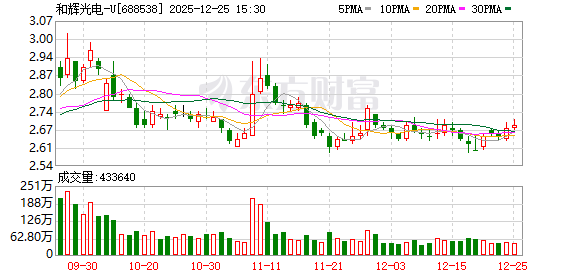
和辉光电:公司拥有第4.5代和第6代两座现代化AMOLED生产工厂
Zheng Quan Ri Bao· 2025-12-25 13:20
Core Viewpoint - Hehui Optoelectronics is a leading domestic company focused on the research, production, and sales of high-resolution AMOLED panels, established in October 2012 [2] Company Overview - The company is recognized as a high-tech enterprise and has received honors such as the "Shanghai Intellectual Property Innovation Award" [2] - Hehui Optoelectronics operates two modern AMOLED production plants, the 4.5-generation and 6-generation plants, which began mass production of smartphone and wearable AMOLED semiconductor display panels in 2014 and 2015, respectively [2] - The company started mass production of its first tablet AMOLED semiconductor display panels in the second quarter of 2020 [2] Product Development - Hehui Optoelectronics continuously invests in new technology research and product innovation to produce a wider range of AMOLED display panels with higher specifications [2] - The company has developed over a hundred high-end rigid and flexible AMOLED display products for various applications, including smart wearables, smartphones, tablets, laptops, automotive, and aerospace [2] - The company has established stable supply relationships with numerous leading domestic and international brands [2]

研判2025!中国像素电路行业产业链、市场规模及重点企业分析:需求攀升驱动技术升级,高分辨率显示产业链强劲动能[图]
Chan Ye Xin Xi Wang· 2025-10-18 02:18
Core Viewpoint - The demand for pixel circuits is growing in tandem with the increasing need for high-resolution and high-contrast displays in various sectors such as smartphones, tablets, automotive electronics, and medical devices. The market size of China's pixel circuit industry is projected to reach approximately 141.736 billion yuan in 2024, reflecting a year-on-year growth of 9.90% [1][7]. Industry Overview - Pixel circuits are the core units of modern display technology, controlling the light emission of individual pixels through independent circuit systems. They are primarily categorized into active matrix and passive matrix types based on their driving methods [2]. Industry Supply Chain - The upstream of the pixel circuit industry includes raw materials such as silicon wafers, photoresists, electronic specialty gases, and target materials, as well as production equipment like cleaning machines and exposure machines. The midstream involves the manufacturing of pixel circuits, while the downstream applications span consumer electronics, automotive electronics, industrial control, medical, and media sectors [4]. Market Size - The pixel circuit industry in China is expected to grow significantly, with a market size of approximately 141.736 billion yuan in 2024, marking a 9.90% increase from the previous year [7][8]. Key Companies' Performance - BOE Technology Group, a leading player in the display panel industry, holds over 5,000 patents in the pixel circuit field. The company reported a revenue of 101.278 billion yuan in the first half of 2025, a year-on-year increase of 8.45%, with a net profit of 3.247 billion yuan, up 42.15% [8][9]. - Visionox Technology focuses on AMOLED pixel circuit innovations and reported a revenue of 4.121 billion yuan in the first half of 2025, reflecting a 4.79% year-on-year growth, although it faced a net loss of 1.062 billion yuan [9][10]. Industry Development Trends 1. **Technological Innovation**: The pixel circuit industry is expected to experience rapid growth driven by technological advancements, with companies like BOE and Visionox leading the way in developing new technologies that enhance display performance and reduce power consumption [10][11]. 2. **Self-sufficiency in Supply Chain**: The industry is accelerating domestic substitution in response to foreign technology barriers, with significant advancements in silicon wafer production and other upstream materials [11]. 3. **Integration with Emerging Technologies**: Pixel circuits are increasingly integrating with AI, IoT, and 5G technologies, creating new application scenarios that enhance functionality beyond traditional display capabilities [12].



头部企业加速抢占高端显示市场
Zheng Quan Ri Bao Zhi Sheng· 2025-09-14 16:08
Core Viewpoint - OLED technology is becoming a critical area of competition among display companies, with TCL Technology Group announcing a significant investment in a new production line to enhance its market position and product offerings [1][2]. Group 1: TCL Technology's Investment - TCL Technology, along with its subsidiary TCL Huaxing, has signed a project cooperation agreement with the Guangzhou government to build an 8.6-generation printed OLED display panel production line, with a total investment of approximately 29.5 billion yuan [1]. - The project, referred to as the "t8 project," will involve a joint capital contribution of 14.75 billion yuan, with TCL Huaxing contributing 8.85 billion yuan and local government entities contributing 5.9 billion yuan [1]. - The t8 project is expected to commence construction in November 2023, with a planned construction period of 24 months, aiming for a monthly processing capacity of about 22,500 glass substrates [2]. Group 2: Advantages of Printed OLED Technology - Printed OLED technology allows for high-precision application of liquid light-emitting materials, resulting in superior color performance, high resolution, and lower energy consumption and manufacturing costs [2]. - TCL Huaxing has been investing in printed OLED research since 2013, and the technology used in the t8 project is proprietary to the company [2]. Group 3: Market Trends and Competitors - The global competition in the display panel industry is increasingly focused on high-end OLED technology, with major players like BOE Technology Group and Visionox also announcing significant investments in similar production lines [2][3]. - BOE announced a 63 billion yuan investment in an 8.6-generation AMOLED production line, targeting the mid-size market, with plans to start product output by late 2024 [2]. - Samsung Display plans to invest 4.1 trillion won in an 8th generation IT OLED production line by 2026, indicating a competitive landscape dominated by Chinese and Korean companies [3].
