APPT

Search documents
奥特曼恩师力挺19岁少年,比AlphaFold快4倍,只杀害虫不伤人
3 6 Ke· 2025-12-04 07:44
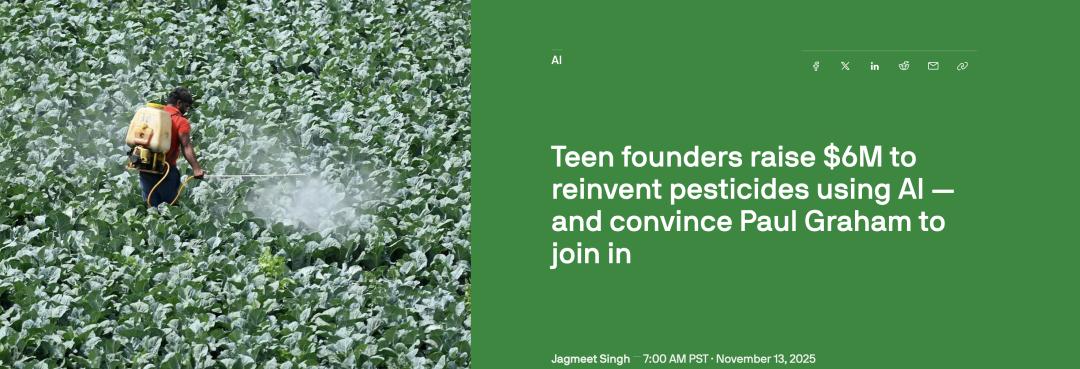
Core Viewpoint - The article discusses the innovative approach of two young founders, Tyler Rose and Navvye Anand, who are leveraging AI technology to revolutionize pesticide development, aiming for targeted pest control without harming beneficial organisms or humans [1][11]. Group 1: Industry Challenges - Global pesticide usage has doubled over the past 30 years, yet 40% of crops still succumb to pests and diseases each year [1]. - The rapid evolution of pests has led to increased resistance, outpacing the development of new pesticides, which has resulted in diminishing effectiveness of existing solutions [3][5]. - Regulatory pressures on pesticide manufacturers are increasing, yet many companies continue to rely on traditional chemical adjustments rather than innovative solutions [3]. Group 2: Company Overview - Bindwell was founded in 2024 by Tyler Rose and Navvye Anand, who are applying AI-driven drug discovery techniques to agriculture, aiming to accelerate the identification and testing of new pesticide molecules [6][13]. - The company is currently part of the Y Combinator Winter 2025 batch and has raised $6 million in seed funding, with notable investors including General Catalyst and Paul Graham [20][15]. Group 3: Technological Innovations - Bindwell has developed a foundational model capable of processing protein and small molecule interactions, significantly enhancing the speed and safety of pesticide development [6][24]. - Their AI tools, including a protein folding model faster than AlphaFold, can analyze billions of molecules in a matter of hours, outperforming existing tools by 1.7 times [24]. - The company aims to license its AI-designed pesticide molecules to major agricultural companies, with initial discussions already underway [25]. Group 4: Future Prospects - Bindwell is exploring partnerships with global agricultural companies and is in talks with institutions in China and India for field testing [25]. - The potential for AI to create highly targeted pesticides that only affect pests while being safe for humans and beneficial insects represents a significant advancement in agricultural technology [26].