
AutoMLGen

Search documents
上海AI Lab&华师大:AI智能编程新框架,节省一半时间就能“聪明”地写代码
3 6 Ke· 2025-10-17 12:13
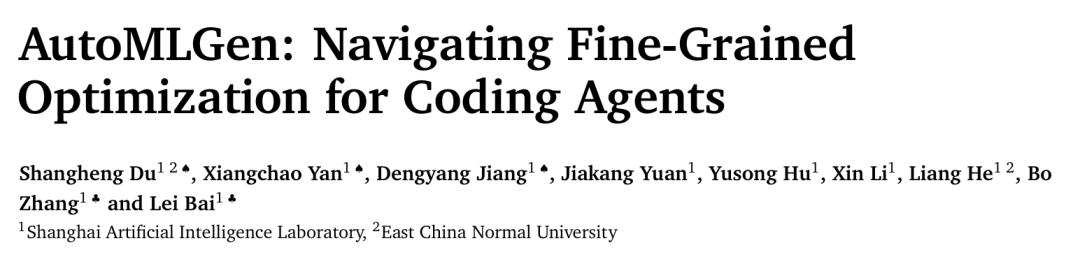
Core Insights - The article discusses the limitations of existing large language models in machine learning engineering, particularly in tasks like AutoML and Kaggle competitions, where continuous iteration and high-performance tuning are essential [1][2] - AutoMLGen, developed by Shanghai Artificial Intelligence Laboratory and East China Normal University, is introduced as a new intelligent programming framework that integrates general large model reasoning with domain knowledge [1][2] Group 1: AutoMLGen Framework - AutoMLGen is designed to enhance the capabilities of large language models beyond code generation, enabling continuous optimization and experience reuse [4][6] - The framework consists of three main modules: a knowledge base, Monte Carlo Graph Search (MCGS), and a fine-grained operator library, which together create a self-evolving loop from experience guidance to intelligent exploration and solution refinement [6][8] Group 2: Knowledge Base - The knowledge base in AutoMLGen systematizes the experience of skilled machine learning engineers, covering model selection, feature processing, and strategy design [7] - During the task initiation phase, AutoMLGen autonomously decides whether to utilize domain knowledge, effectively alleviating the cold start problem while maintaining the independence of the intelligent agent's decisions [7] Group 3: Monte Carlo Graph Search (MCGS) - MCGS innovatively introduces a graph structure to the search process, allowing for dynamic fusion and sharing of nodes and trajectories across different branches, thus enhancing efficiency in complex tasks [8] - Four core mechanisms drive the continuous evolution of the intelligent agent: main expansion, intra-branch evolution, cross-branch reference, and multi-branch aggregation [8] Group 4: Fine-Grained Operator Library - The fine-grained operator library in AutoMLGen defines the evolution methods between different solutions, facilitating a coherent and efficient optimization process [9] - This mechanism allows the intelligent agent to transition from a code generator to an AI engineer capable of proactive reflection and improvement [9] Group 5: Performance Results - AutoMLGen achieved a 36.4% average medal rate and an 18.7% gold medal rate on the MLE-Bench leaderboard, outperforming existing systems while using only half the standard computation time (12 hours) [12][19] - In the MLE-Bench-Lite tests, AutoMLGen maintained a significant lead, demonstrating consistent performance and excellent generalization capabilities [12] Group 6: Future Prospects - The emergence of AutoMLGen signifies a shift in the capabilities of intelligent agents in complex engineering and algorithm design tasks, showcasing AI's potential for autonomous exploration and continuous improvement [19][20] - The framework's principles are expected to extend to broader intelligent system paradigms, paving the way for future developments in AI that can actively understand, improve, and innovate solutions [20]

AI智能编程新框架,节省一半时间就能“聪明”地写代码丨上海AI Lab&华师大
量子位· 2025-10-17 09:45
Core Insights - The article discusses the limitations of existing large language models in machine learning engineering, particularly in optimizing code and algorithms, despite their ability to generate correct code [1][2] - It introduces AutoMLGen, a new intelligent programming framework that combines general large model inference with domain knowledge to enhance machine learning tasks [3][6] Group 1: AutoMLGen Framework - AutoMLGen features a self-developed Monte Carlo Graph Search (MCGS) that allows for dynamic fusion of branches and nodes, breaking the isolation of traditional Monte Carlo Tree Search (MCTS) [4][13] - The framework consists of three main modules: a domain knowledge base, Monte Carlo Graph Search, and a fine-grained operator library, creating a self-evolving loop from experience guidance to intelligent exploration and solution refinement [10][12] Group 2: Performance Metrics - AutoMLGen achieved a 36.4% average medal rate and an 18.7% gold medal rate on the MLE-Bench leaderboard, using only half the standard computation time (12 hours), showcasing its efficiency and effectiveness [21][22] - In the MLE-Bench-Lite test, AutoMLGen maintained a significant performance advantage over existing methods, demonstrating consistent performance and excellent generalization capabilities [21][23] Group 3: Mechanisms of Improvement - The framework's domain knowledge base allows the intelligent agent to quickly transition from "zero experience" to a more knowledgeable state, enhancing decision-making in model selection and feature processing [11][12] - MCGS promotes continuous evolution of the intelligent agent through mechanisms such as intra-branch evolution, cross-branch reference, and multi-branch aggregation, leading to more efficient and robust search processes [14][16][24] Group 4: Future Prospects - The emergence of AutoMLGen signifies a shift in AI capabilities, enabling autonomous exploration and continuous improvement in complex engineering and algorithm design tasks [31] - The integration of memory and collaboration mechanisms is expected to evolve AutoMLGen into an "AI engineering partner," laying the groundwork for higher levels of intelligence and self-improvement in AI systems [31]
