BCM6718

Search documents
抢攻Wi-Fi 8
3 6 Ke· 2026-01-10 09:03
Group 1 - The CES 2026 showcased products labeled "Wi-Fi 8" from major industry players like MediaTek, Broadcom, and ASUS, indicating a strong interest in this emerging technology despite the standard not being finalized yet [1] - The Wi-Fi technology has evolved significantly since its inception in 1991, with various standards being introduced over the years, each improving speed and reliability [2][3][4] - The introduction of Wi-Fi 7 (802.11be) is expected to revolutionize wireless communication with features like 320MHz channels and a theoretical peak speed of 46Gbps, catering to high-bandwidth applications [5][10] Group 2 - Wi-Fi 8 is being developed to focus on "Ultra High Reliability" (UHR), addressing the need for stable connections in complex environments, which is crucial for applications like remote surgery and industrial automation [13][15] - Major companies are already preparing for Wi-Fi 8, with MediaTek launching its Filogic 8000 series solutions, which enhance signal coverage and reduce latency for various devices [23][25][26] - Broadcom is adopting a dual-track strategy by offering complete Wi-Fi 8 chip solutions and licensing its IP to accelerate the adoption of edge AI technologies [27][30] Group 3 - Qualcomm is leading the standardization efforts for Wi-Fi 8, focusing on enhancing reliability and low latency in complex environments, with plans to release a full suite of Wi-Fi 8 products by 2026 [32][33] - Intel is in the prototype validation stage for its Wi-Fi 8 chips, emphasizing AI integration to improve network performance in high-density scenarios [34] - The successful adoption of Wi-Fi 8 will depend on a robust ecosystem involving chip manufacturers, device makers, and standard organizations, with various companies already showcasing Wi-Fi 8 compatible products [35][36]


抢攻 Wi-Fi 8
半导体行业观察· 2026-01-10 03:37
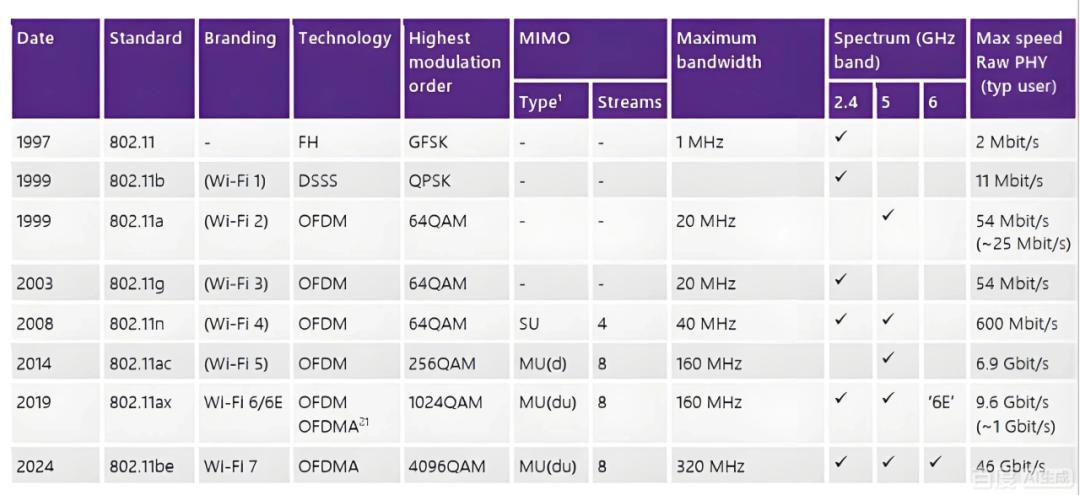
Core Viewpoint - The article highlights the evolution of Wi-Fi technology, focusing on the upcoming Wi-Fi 8 standard, which aims to enhance reliability and performance in wireless communication, addressing the growing demand for stable connections in various applications such as IoT, AR/VR, and industrial automation [11][14][40]. Group 1: Wi-Fi Technology Evolution - Wi-Fi technology originated in 1991 with the creation of "WaveLAN" by NCR, leading to the establishment of the 802.11 standard by IEEE in 1997, which initially offered a maximum speed of 2 Mbps [2]. - The introduction of 802.11b and 802.11g standards in the early 2000s increased speeds to 11 Mbps and 54 Mbps respectively, facilitating the initial adoption of Wi-Fi in home environments [2]. - The 802.11n standard (Wi-Fi 4) released in 2009 significantly improved speeds to 600 Mbps and introduced MIMO technology, paving the way for multi-device connectivity [3]. - The 802.11ac standard (Wi-Fi 5) launched in 2013 further enhanced speeds to 6.9 Gbps, catering to high-definition content needs [4]. - Wi-Fi 6 (802.11ax) introduced in 2019 improved network efficiency by supporting multiple devices simultaneously, achieving speeds of 9.6 Gbps [5]. Group 2: Wi-Fi 7 and Market Adoption - Wi-Fi 7 (802.11be) was officially commercialized in December 2023, supporting theoretical peak speeds of 46 Gbps and low latency for applications like cloud gaming and XR [5][8]. - The adoption of Wi-Fi 7 is expected to accelerate, with shipments projected to rise from 26.3 million units in 2024 to 66.5 million in 2025, and reaching 117.9 million by 2026 [8][9]. - By 2026, total shipments of Wi-Fi 7 devices are anticipated to reach 1.1 billion units, including significant contributions from IoT and healthcare devices [9]. Group 3: Wi-Fi 8 Development and Features - Wi-Fi 8, defined by the IEEE 802.11bn task group, aims to provide ultra-high reliability (UHR) and is expected to address the limitations of previous standards in complex environments [11][14]. - Key features of Wi-Fi 8 include enhanced coordination between access points, congestion avoidance mechanisms, and improved modulation schemes, which collectively aim to ensure stable connections even under high-density conditions [17][18]. - The standard is projected to be finalized by March 2028, with industry players already beginning to develop products based on its draft specifications [19][20]. Group 4: Industry Players and Strategies - MediaTek has launched its Filogic 8000 series for Wi-Fi 8, focusing on applications in gateways and various devices, with plans for mass production by the end of 2027 [21][25]. - Broadcom is employing a dual-track strategy by offering complete Wi-Fi 8 chip solutions while also licensing its IP to accelerate adoption across various sectors [26][31]. - Qualcomm is leading the standardization efforts and plans to unveil a comprehensive Wi-Fi 8 product lineup at the 2026 Mobile World Congress, emphasizing reliability and low latency [33][34]. - Intel is focusing on AI integration within Wi-Fi 8, enhancing network performance in high-density environments through intelligent resource management [35].