BoltzGen

Search documents
UBS Likes Pfizer’s MTSR Obesity Deal but Stays Neutral on PFE
Yahoo Finance· 2026-01-12 22:00
Pfizer Inc. (NYSE:PFE) is included among the 13 Best Dividend Stocks Paying Over 6%. UBS Likes Pfizer’s MTSR Obesity Deal but Stays Neutral on PFE On January 7, UBS initiated coverage of Pfizer Inc. (NYSE:PFE) with a Neutral rating and a $25 price target. The firm pointed to lingering uncertainty around Pfizer’s revenue outlook, with roughly $15 billion to $20 billion tied to major drugs expected to lose patient exclusivity over the next three years. UBS said it likes the recent MTSR obesity deal, but ad ...

AI辅助抗体设计进入快车道 药物安全问题仍需进一步验证
Ke Ji Ri Bao· 2025-12-17 00:47
Core Insights - AI technology has shown unprecedented potential in therapeutic antibody design since the advent of "AlphaFold 2" for protein structure prediction [1] - Multiple research teams have successfully developed various therapeutic antibodies using proprietary AI tools, although safety and efficacy still require further validation [1] Antibody Drug Market - Antibodies are key proteins in the immune system that recognize specific targets and trigger protective responses, with over 160 engineered antibodies approved for treating cancer, infectious diseases, and autoimmune diseases globally [2] - The global antibody drug market is projected to exceed $455 billion in annual revenue by 2028, driven by the emergence of thousands of new antibodies [2] - Traditional antibody development faces challenges such as long cycles and high costs, but recent AI advancements are transforming the paradigm of antibody research and development [2] Innovative Developments - Several research teams have successfully developed a range of functional antibody drugs using AI platforms [3] - Absci announced the design of a specific antibody targeting a conserved region of the HIV virus, which could lead to a broad-spectrum anti-HIV drug [3] - The BoltzGen AI model, developed by a team led by Gabriel Corson, focuses on de novo design of proteins and peptides, achieving atomic-level precision in structural modulation [3] Significant Progress by Other Teams - A team led by David Baker discovered a broad-spectrum antibody that can bind to proteins common to all influenza viruses, paving the way for universal flu drugs [4] - Nabla and Chai Discovery successfully designed full-length antibodies that can specifically recognize GPCRs, which are traditionally difficult to target [4] - Nabla generated thousands of GPCR-binding antibodies, with some showing comparable or superior affinity to existing drugs [4] Impact on Clinical Development - The current wave of AI-driven antibody design is expected to significantly impact the number of clinical candidates and the efficiency of drug development [5] - AI-designed antibodies may soon enter human trials, as demonstrated by Genative's large-scale clinical trial for an antibody drug targeting severe asthma [6] Safety Validation Challenges - Despite advancements, AI-generated antibodies still face challenges in performance across different targets and predicting binding strength [6] - There is a need for rigorous preclinical safety evaluations to determine if AI-designed antibodies will be recognized as foreign by the human immune system [6] - Future AI designs may create antibodies with special functions, such as penetrating the blood-brain barrier or targeting multiple sites simultaneously [6]
MIT团队开源BoltzGen,可跨分子类型设计蛋白结合物,66%靶标获纳摩尔级亲和力
3 6 Ke· 2025-10-27 07:31
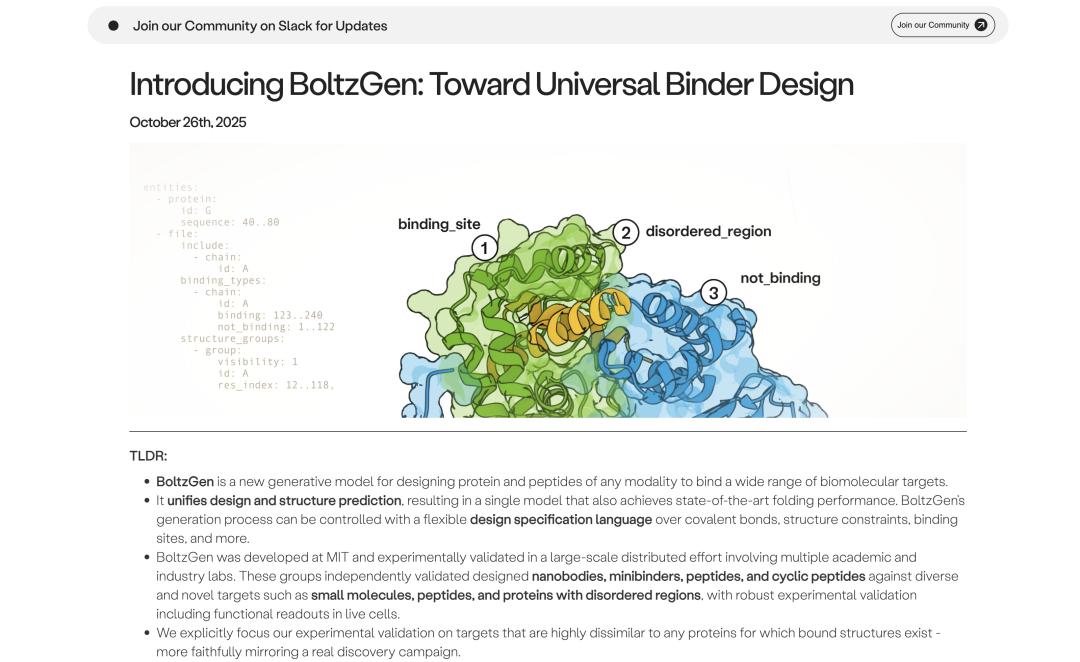
Core Insights - The article discusses the introduction of BoltzGen, a new model developed by MIT and several institutions to address the limitations of traditional protein design methods, which rely heavily on physical calculations and have high computational costs [1][2][3] Group 1: Model Overview - BoltzGen utilizes a unified all-atom generative model that replaces traditional discrete residue labels with geometric continuous representations, allowing for joint training of protein folding and complex design [2][3] - The model incorporates a flexible design specification language that enables controllable generation across different molecular types, enhancing design efficiency and interpretability [1][3] Group 2: Research Highlights - The model has demonstrated a 66% success rate in achieving nanomolar affinity for designed nanobodies and protein complexes, showcasing its ability to optimize folding and binding performance simultaneously [2][12] - BoltzGen's architecture integrates a trunk network for token representation and a diffusion module for generating three-dimensional structures, allowing for effective modeling of atomic relationships [10][11] Group 3: Experimental Validation - In experiments involving 26 targets, BoltzGen maintained a high success rate, achieving nanomolar affinity in 66% of cases for previously unseen complex targets [12][25] - The model has shown versatility in designing peptides that bind to various structures, including those related to acute myeloid leukemia and specific enzymes, with binding affinities ranging from nanomolar to micromolar levels [15][17][19] Group 4: Data Utilization - The training of BoltzGen involved a multi-modal dataset sourced from high-quality experimental structures, AlphaFold predictions, and generated complex structures, enhancing the model's generalization capabilities [7][9] - The research team ensured diversity in the training data by excluding over-sampled datasets, maintaining a broad generation space [9]